

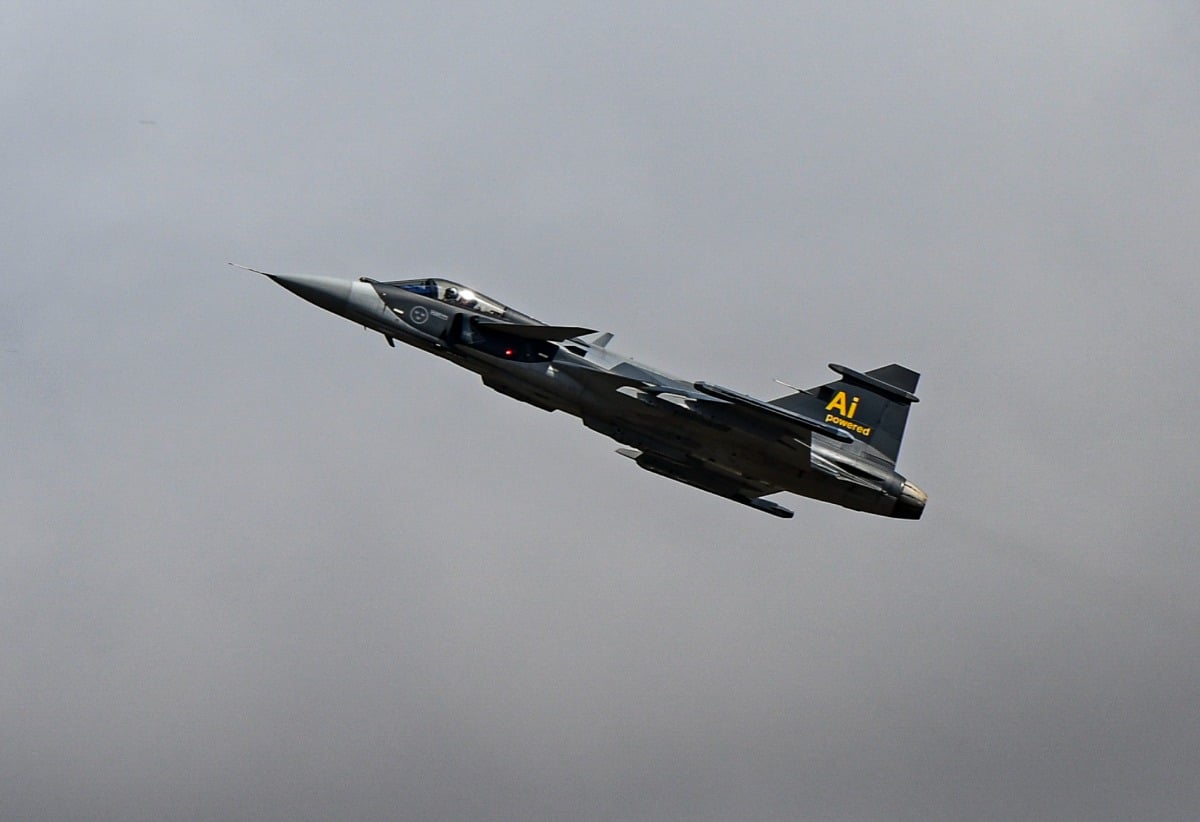
- Ukraine and Sweden signed an agreement for the procurement of Gripen E fighters, with deliveries reportedly beginning in early 2029, according to Militarnyi.
- A separate, previously confirmed transfer of 16 Gripen C/D fighters from Sweden's active fleet is scheduled to begin deliveries in early 2027.
Sweden and Ukraine signed an agreement covering the procurement of fighter jets for Ukraine’s Air Force, with deliveries set to begin in early 2029, Militarnyi reported.
The signing ceremony took place in the presence of Ukrainian President Volodymyr Zelensky and Swedish Prime Minister Ulf Kristersson, with Ukraine set to receive not only the aircraft but the associated equipment, logistics, and technical support package that comes with operating a modern fighter fleet. Ukrainian pilots and technical personnel are already training in Sweden ahead of the aircraft’s arrival.
The deal Militarnyi described sits alongside a separate, earlier arrangement already underway: Sweden’s transfer of 16 Gripen C/D fighters to Ukraine’s Air Force as a donation, with deliveries beginning in early 2027. That transfer, confirmed during a May 28, 2026 joint press conference between Kristersson and Zelensky at Uppsala Air Base, comes directly from active Swedish Air Force inventory rather than reserve storage, representing close to one-sixth of Sweden’s roughly 94 operational Gripen C/D fighters and corresponding to one tactical squadron. The donated aircraft arrive already integrated with NATO-standard weapons, Link 16 tactical datalink architecture, and Western Identification Friend or Foe systems, configured for immediate frontline use rather than as downgraded export models. According to the Swedish government, the C/D donation forms part of Stockholm’s 22nd military support package to Ukraine, valued at SEK 25.2 billion ($2.7 billion).
The newer Gripen E aircraft, the version Ukraine intends to purchase rather than receive as a gift, represents a different generation of the platform entirely. Where the donated C/D models are aircraft Sweden has flown for years, the Gripen E is Saab’s latest production variant, built around an improved AESA radar, significantly upgraded electronic warfare systems, an extended weapons range, and a General Electric F414 engine that gives it greater thrust than the older Gripen C/D’s Volvo-built RM12 powerplant. Zelensky, speaking at the May 28 press conference confirming the broader Gripen framework, described the electronics aboard the newer aircraft as comparable in sophistication to those on the American F-35.
“We’re talking specifically about a squadron of Gripens for Ukraine, and this is tremendously important support for us,” Zelensky said at the time.
The financing mechanism behind Ukraine’s Gripen E acquisition runs through the European Union’s Ukraine Support Loan, a €90 billion ($103 billion) facility the EU finalized on April 23, 2026. According to the Swedish government’s own confirmed figures, Ukraine plans to allocate €2.5 billion ($2.8 billion) from that loan toward acquiring up to 20 Gripen E/F fighters, the same figure both Swedish and Ukrainian officials cited at the May 28 announcement. Militarnyi’s reporting on the agreement signed with Zelensky and Kristersson describes 16 aircraft rather than 20, and a 2029 delivery timeline rather than the 2030 date Kristersson cited publicly in May. The discrepancy between those figures has not been independently resolved, and Saab itself stated at the time of the May announcement that no formal contract had yet been signed, with negotiations remaining at the government-to-government stage.
The Gripen’s specific suitability for Ukraine’s operating environment is not a marketing claim invented for this deal. Sweden engineered the JAS 39 Gripen from its earliest design phases during the Cold War specifically to survive a scenario where Soviet strikes destroyed Swedish air bases, building an aircraft that could disperse onto short runways, rural roads, and improvised highway strips while being serviced by small teams, often conscript airmen rather than specialized ground crews. That doctrine maps almost perfectly onto the threat Ukraine’s Air Force currently faces, where Russian long-range missiles and drones routinely target fixed airfields, and the ability to scatter combat aircraft across dispersed, less predictable locations directly reduces the vulnerability that concentrated, fixed-base operations create. Ukrainian fighter pilot Vadym Voroshylov, callsign Karaya, who has flown the Gripen, described the aircraft’s side-mounted air intakes as a specific operational advantage, reducing the risk of debris ingestion into the engine on airfields that have frequently been damaged by Russian strikes.
Peter Layton, a military expert at the Royal United Services Institute, explained the historical roots of that resilience to the Kyiv Independent. “The Swedish Air Force has put a lot of effort into, since World War II, being able to maintain aircraft in the field, simply using conscript airmen, which makes it much easier,” Layton said. According to Saab and Voroshylov, a Gripen can be refueled and rearmed for a second sortie in roughly ten minutes under ideal conditions, a turnaround time that allows a smaller fleet to generate significantly more sorties per day than aircraft requiring longer ground servicing cycles.
The broader Gripen relationship between Ukraine and Sweden traces back to an October 22, 2025 letter of intent, signed in Stockholm following talks between Kristersson and Zelensky, that outlined Ukraine’s interest in acquiring between 100 and 150 Gripen E aircraft over the coming years, a figure that, if it ever fully materializes, would represent by far the largest export contract in Saab’s history. Two Ukrainian fighter pilots had already test flown the Gripen between August and September 2023, completing familiarization training and giving what observers described as glowing reviews of the aircraft’s handling and operational concept, though no funding existed at the time to translate that interest into a purchase.
Ukraine’s current Western fighter fleet remains a patchwork built from whatever allies have been willing to donate rather than a coherent, purpose-built force. The country currently operates a few dozen F-16AM+ aircraft donated by Denmark, Norway, the Netherlands, and Sweden, alongside fewer than ten French-donated Mirage 2000-5F fighters, both aircraft types dating to the 1990s and, according to Ukrainian Air Force spokespersons, somewhat less suited to Ukraine’s current operational demands than the Gripen would be. The Gripen agreement, regardless of whether the final figures land at 16 or 20 aircraft and whether deliveries begin in 2029 or 2030, represents Ukraine’s first genuine attempt to build toward a single, standardized, NATO-compatible fighter platform rather than continuing to absorb whatever mixed inventory partner nations happen to have available to donate.