

- Ukrainian Ministry of Defense adviser Serhii "Flash" Beskrestnov publicly listed nine critical technology gaps, including no mass-production counter to Russian glide bombs and no indigenous ballistic missiles.
- Beskrestnov identified lagging electronic warfare against Russian MESH-networked drones and insufficient tactical radar density as compounding problems that undermine Ukraine's overall air defense architecture.
Serhii Beskrestnov, known by his call sign “Flash” and serving as an adviser to Ukraine’s Ministry of Defense, published a public assessment that catalogs nine specific technological deficiencies he says are creating serious problems across the front, ranging from the absence of any mass-production solution against Russian glide bombs to a near-total lag in electronic warfare systems capable of countering Russian mesh-network drones.
Beskrestnov is one of the most closely followed open-source intelligence voices in the Ukrainian defense community, widely cited by Western analysts for his ground-level tracking of electronic warfare trends along the contact line, and his willingness to speak publicly about Ukrainian shortfalls carries significant weight precisely because he operates inside the ministry rather than outside it.
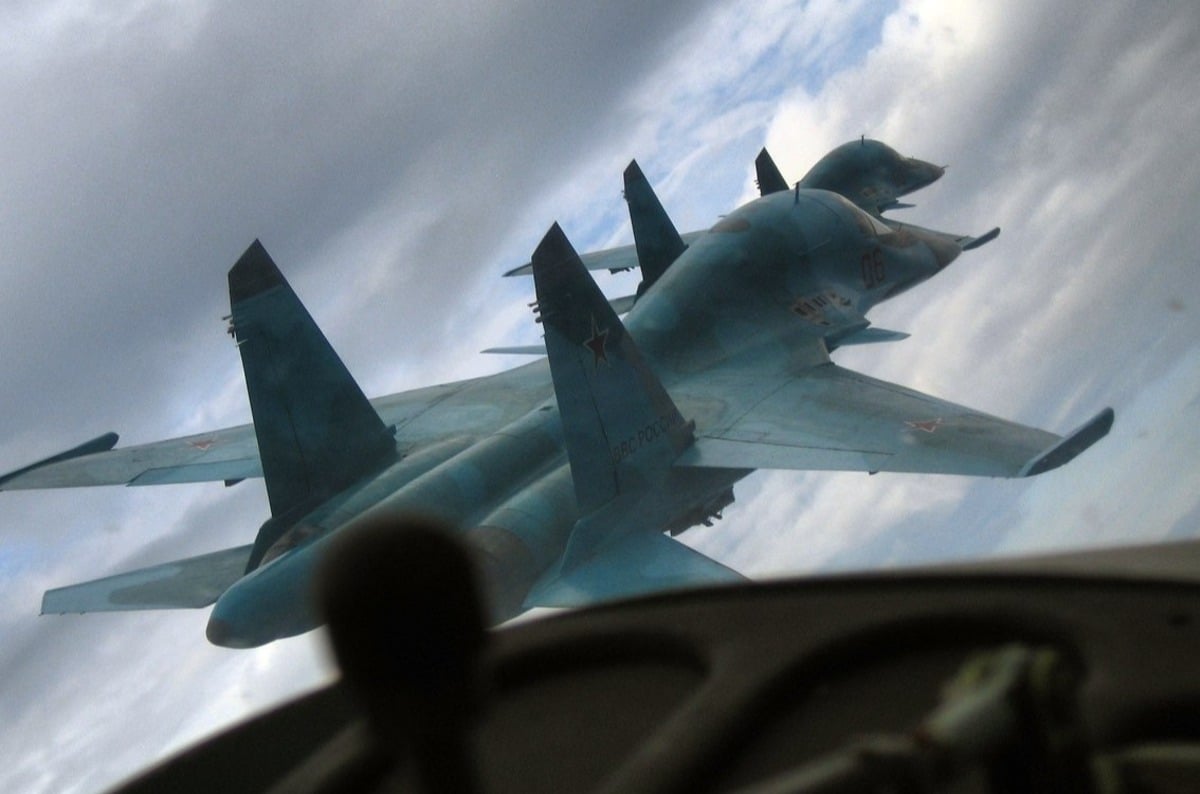
The first problem Beskrestnov names — the absence of a serial, mass-production solution against Russian glide bombs — sits at the top of his list for good reason, as these weapons have become one of the defining challenges of the current phase of the war. Russian KAB-series guided aerial bombs, primarily the KAB-500 and KAB-1500 variants carrying 500 kg (1,102 lb) and 1,500 kg (3,307 lb) warheads respectively, are released from Su-34 and Su-35 aircraft at standoff distances of up to 70 km (43 miles) using the UMPK glide kit, which adds pop-out wings and a satellite navigation guidance package to legacy unguided bombs. Ukraine has no reliable way to consistently intercept them at scale, partly because intercepting a glide bomb requires either shooting down the launching aircraft before weapon release, which demands air superiority Ukraine does not have, or building a dense enough radar and interceptor network to track and engage the fast-moving bomb itself after release, which requires precisely the tactical radar density Beskrestnov separately identifies as inadequate.
His second point concerns what he describes as the inadmissibly slow pace of Ukrainian electronic warfare development against Russian MESH modems, a category of radio networking hardware that Russia has been integrating into its Shahed-136 drone fleet and the newer Gerber variants at an accelerating rate. MESH networking allows drones to form autonomous relay chains in which each aircraft passes targeting data and control signals to the others, reducing the range requirement for any single ground-based control station and dramatically complicating the jamming problem. A conventional drone jammer works by overwhelming the frequency band the controller uses to communicate with the drone; against a MESH network, the drone may receive its instructions through relays from other aircraft rather than directly from a ground station, making the jammer’s point of attack unclear and its effectiveness uncertain. Beskrestnov describes Ukraine as falling behind on both developing countermeasures to this architecture and gaining the operational experience needed to apply them effectively.
The third gap he identifies is the cascading drone problem affecting not just front-line villages but Ukrainian cities including Kherson, Kharkiv, Zaporizhzhia, and Sumy, which sit within effective range of Russian first-person view and loitering munition drones. Beskrestnov calls for both improved early warning systems and what he terms “systemic actions” on counter-drone measures, language that implies the current approach is ad hoc and fragmented rather than coordinated and scalable. The populations of these cities have been living under near-daily drone harassment, and the absence of a reliable city-level drone defense architecture has made civilian life in the near-front zone increasingly untenable.
The tactical radar density problem he raises as his fourth point underpins several of the others. Interceptor drones, both dedicated counter-UAS platforms and modified FPV drones launched against incoming targets, cannot engage what they cannot detect, and Beskrestnov’s framing suggests Ukraine’s radar coverage, while improved, remains too sparse and too discontinuous to support the dense interception rates the drone threat demands. More tactical radar nodes mean earlier detection, more time to cue interceptors, and higher kill rates against incoming threats of all types, from glide bombs to Shahed variants to FPV kamikaze drones.
The fifth gap is the one that has generated the most public attention in Ukrainian defense circles: the absence of indigenous ballistic missiles. Beskrestnov characterizes this not as a minor shortfall but as a capability whose presence would “radically change the course of the war,” a framing consistent with how Ukrainian defense officials and analysts have discussed the issue across multiple public forums. Ballistic missiles traveling at Mach 5 or higher compress decision time for Russian air defense systems to seconds, penetrate at trajectories that radar systems optimized for slower threats struggle to track, and can reach targets across all of Russia’s depth including command centers, logistics hubs, and production facilities that slower cruise missiles and drones currently take hours to reach under intercept pressure. Ukraine’s Fire Point company is pursuing the FP-9 program with precisely this rationale, though as of mid-2026 the system remains in pre-flight ground testing of its solid-fuel engine.
On electronic warfare against drone video channels, his sixth point, Beskrestnov states plainly that the enemy leads Ukraine in both the technology and the operational experience of applying it, and that this specific category of electronic warfare capability is what could most directly protect near-front zones from drone attack. Russian forces have developed increasingly sophisticated optical jamming and video disruption systems designed to break the FPV drone operator’s live video feed at the critical moment of terminal engagement, exploiting the fundamental vulnerability of any optically guided weapon: the pilot needs to see. Ukraine’s countermeasures in this category, Beskrestnov suggests, remain underdeveloped relative to the threat.
The seventh gap addresses a rapidly emerging problem for Ukraine’s own air operations: the absence of verified solutions to protect Ukrainian mid-range strike drones and bombers from Russian anti-aircraft drones. Russia has been deploying drone interceptors, essentially FPV drones repurposed to hunt Ukrainian aircraft, with enough frequency that Beskrestnov assesses Ukrainian long-range strike platforms will face serious operational constraints if the problem is not solved. The eighth gap extends this into the radar domain: Ukraine currently lacks, in Beskrestnov’s assessment, a systematic technological approach to finding and destroying Russian tactical ground radar systems, which he describes as “the enemy’s eyes in the sky at the front,” referring to the radars that cue Russian air defense systems and artillery against Ukrainian forces.
His ninth point concerns navigation for deep strikes, specifically the need for alternatives to satellite positioning systems in environments where GPS and GLONASS signals face jamming or spoofing. Ukraine’s long-range strike campaign against Russian territory has become central to its strategic approach, and any degradation in strike accuracy from navigation interference directly affects the campaign’s effectiveness.
“I am looking at things with absolute sobriety,” Beskrestnov wrote, prefacing his list. “And I see that, in addition to positive news about the war with Russia, there are also a huge number of technological problems.”
That combination of qualified optimism and unsparingly specific criticism is what makes the assessment worth treating seriously. Beskrestnov is not a pessimist looking to undermine Ukrainian morale, and he is not a propagandist looking to mask real problems with rhetoric. He is a practitioner identifying the gaps that his visibility into the front gives him no choice but to see, and making the case publicly that addressing them is urgent.