

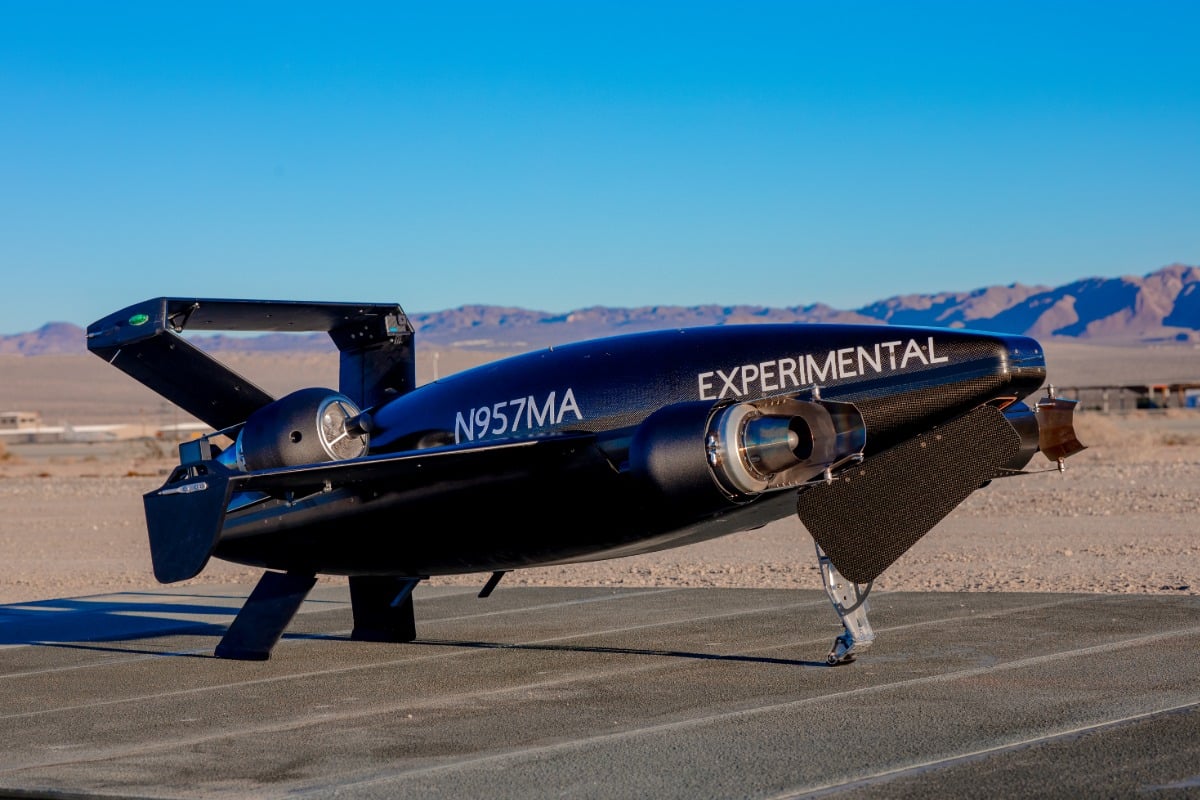
- Mayman Aerospace's P100 turbine VTOL drone carries a 100-pound payload at 300 knots over 130 kilometres without a pilot or runway.
- USSOCOM recently expanded its Other Transaction Authority agreement with Mayman Aerospace after the P100 achieved a 200-knot flight in March.
At 3 a.m. in a contested forward operating base, a patrol thirty kilometres out is taking casualties. They need blood, plasma, and ammunition, not in hours, but in minutes. The aircraft that answers that call launches from a patch of dirt, climbs vertically on four jet turbine engines, pitches forward, and is gone. It returns to base in under twelve minutes, having crossed sixty kilometres of denied airspace at 300 knots without exposing a single crew member to fire.
That aircraft is the P100, a turbine-powered vertical take-off and landing drone developed by Mayman Aerospace, and the scenario above is not a promotional hypothetical. It is, according to company founder and Chief Executive Officer David Mayman Aerospace, the operational reality the aircraft was designed for. The P100 is built to carry a 45-kilogram (100-pound) payload at high speed over contested terrain, without a runway and without a pilot. After a series of flight milestones and an expanded agreement with United States Special Operations Command (USSOCOM), the platform is moving steadily toward fielding.
The Defence Blog spoke with Mayman about the P100’s mission profile, the lessons absorbed from Ukraine, the limits of electric vertical take-off and landing (eVTOL) technology, and what comes next before the aircraft can move from evaluation into regular military use. The answers below reflect the current state of a programme that is accelerating.
The following responses were submitted in writing and have been lightly edited for clarity. Answers touching on operational security have been reviewed by the company prior to publication.
Q: Mayman Aerospace says the P100 is designed to carry a 100-pound payload at high speed without needing a runway. What specific military logistics problem is the aircraft intended to solve first?
A: The US and our allies are used to the luxury of air superiority and moving where and how we want at the time and place of our choosing. Over the last forty years, we have overmatched ground defenses and easily dominated the skies. That is over. In modern warfare, everything, everywhere, is likely to be within a weapon engagement zone, or WEZ. Anything that moves on the modern battlefield is at risk. This means the domains and environments, however austere, we have manoeuvred in freely in the past will assuredly be contested.
While it is worth pointing out we are developing the P100 to support multi-mission capabilities, our initial research and development has focused on solving gaps in contested logistics that have not been addressed by current aircraft, whether we are talking about eVTOLs, which lack the speed and range, or helicopters, which are expensive, inefficient for these use cases, and expose human pilots to risk. Contested logistics is our first programme of record, but it certainly will not be the last.
Specific to logistics, the P100 is equipped to address a range of needs, courtesy of payload size, runway independence, and performance that cannot be matched by eVTOLs. Our primary use cases include resupplying food, ammunition, and medical supplies to forward operating forces. And with cruise speeds fast enough to outrun ground threats, we ensure these supplies arrive reliably.
Our military and the militaries of our allies need a logistics capability which is sufficiently fast and capable of delivering cargo when and where they need it, with some degree of certainty. They also need a platform which sits on a spectrum of attritability that narrows the cost asymmetry to a more sustainable level. We can no longer afford to lose tens or hundreds of millions of dollars of aircraft to move supplies to sustain our forces. We need capable and cost-effective systems that can outrun and outlast the threats we face long enough to keep the mission moving forward, and that is precisely what we are aiming to build with our family of tVTOL [Editor’s note: turbine-powered vertical take-off and landing] aircraft.
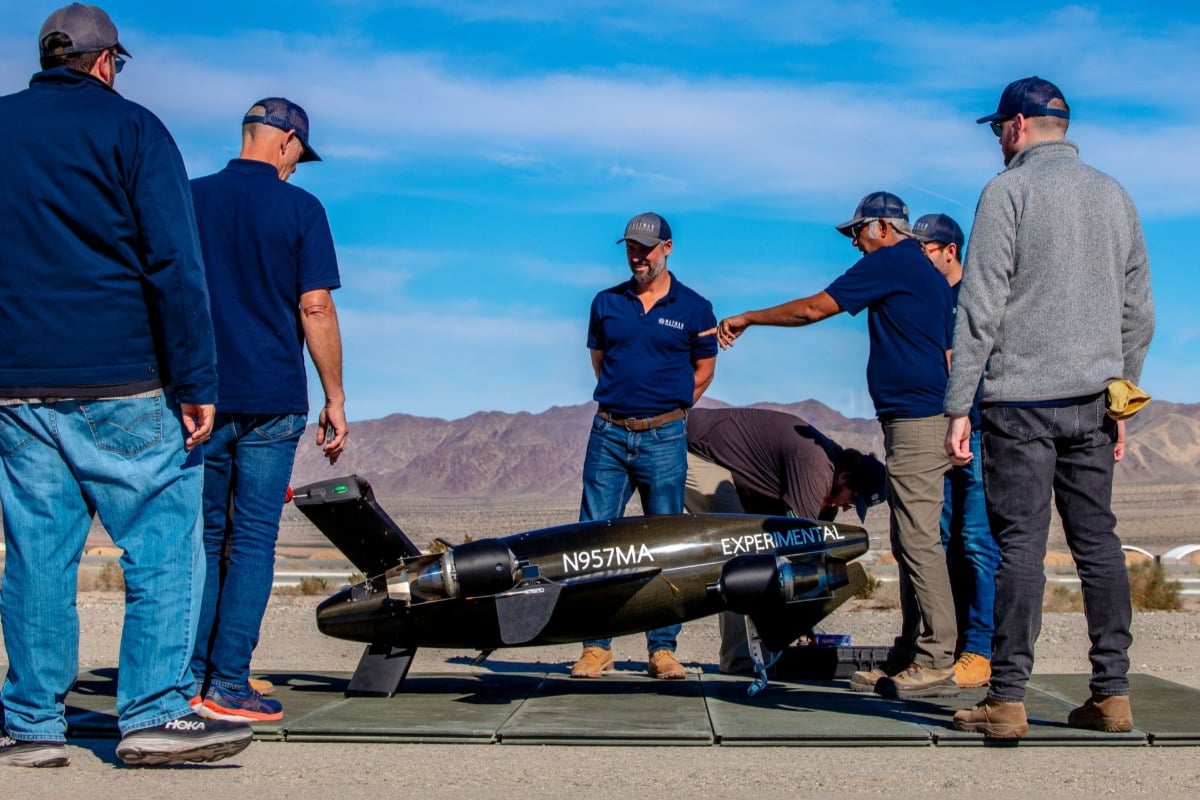
Q: Walk us through a realistic mission profile for the P100 in a contested environment, from launch and transit to delivery and recovery. What can you say publicly about range, payload, and operating assumptions?
A: Imagine it is 3 a.m. at a forward operating base in a contested region. A patrol thirty kilometres away is under fire and taking casualties. They need ammunition and, more critically, they need blood and plasma in minutes, not hours. The same fuel truck that topped off the Humvees the night before topped off the P100. It launches from a patch of dirt behind the tactical operations centre, taking off like a helicopter as it climbs to altitude.
At launch, four jet turbine engines lift the aircraft straight up. Once airborne, our proprietary flight control system monitors the aircraft’s speed, position, and orientation hundreds of times per second. When conditions are right, it commands the aircraft to pitch forward and accelerate. The wings take over, lift replaces thrust, and the P100 transitions into fixed-wing cruise flight: at its maximum payload, it cruises at 300 knots (approximately 556 kilometres per hour or 345 miles per hour) and can do so for 130 kilometres (81 miles).
That means the P100 arrives at the patrol’s position in under six minutes. The supplies are released without the need to land, and the aircraft returns to base. Or, in the case of a landing, the flight control reverses the process: decelerating the aircraft, dropping back into hover, checking the landing site for obstructions, and touching down autonomously.
Q: USSOCOM has been described as continuing its work with Mayman Aerospace. What can you confirm publicly about the current status of that relationship: testing, evaluation, funding, or operational feedback?
A: We have a strong relationship with USSOCOM. Our product is extremely unique in the market, and we believe USSOCOM understands the importance of novel technologies in their work.
Our initial Other Transaction Authority (OTA) [Editor’s note: an OTA is a legal instrument that allows the US Department of Defense to engage with non-traditional contractors outside of standard federal acquisition rules] was recently expanded significantly. This was done based on demonstrated flight performance, and it reflects the P100’s progress against real mission requirements. While we cannot disclose additional details about our relationship with USSOCOM, what we can say is that the P100 has been successfully demonstrated on military bases under Department of Defense research and development contracts.
Q: You argue that turbine VTOL aircraft have advantages over eVTOL systems because of fuel energy density, range, and speed. Where do you believe eVTOLs still have a role, and where do they fall short for military missions?
A: eVTOLs absolutely still serve essential roles for warfighters. That is undeniable, but the reality is they support a much narrower set of use cases. I often think of eVTOLs’ demonstrated success in Ukraine, where they have proven useful for short-range, tactical missions. Yet they are operating in a specific context: short distances, and often optimised for attritable use.
They can win engagements. They cannot solve the logistics and multi-mission problem at range. The contested logistics gap, moving critical supplies anywhere from 60 to 130 kilometres into denied airspace at speeds that outrun ground threats, is precisely where battery energy density hits a hard ceiling that better software will not fix. While Ukraine has demonstrated that small electric drones have a time and a place, there are use cases they simply cannot support. We are building the P100 to address those gaps.
Q: What lessons from Ukraine and other contested environments are shaping the design of the P100, especially regarding survivability, autonomy, logistics, and electronic warfare?
A: Among the most critical lessons from Ukraine is the requirement for GPS- and communications-denied operations. We have to assume that we lose GPS on take-off or do not acquire it before launch. That operational reality has informed the development of our autonomy stack and command, control, and communications [Editor’s note: C2/C3] survivability architecture.
Throughout the conflict, eVTOLs have shown real limitations alongside their successes. Limited range means limited scale of operations, and relatively slower speeds create the risk of being engaged by ground forces.
On the other end of the spectrum are helicopters, which carry risks that have long remained unsolved. While they remain essential for heavy-lift missions and personnel transport, they come with inherent constraints in high-threat environments, primarily cost and human risk. A single eight-figure aircraft is a significant loss, especially as smaller, cheaper systems are increasingly introduced in contested environments. Autonomous aircraft shift the operational calculus from mitigating risk to eliminating the need to expose personnel to hazards entirely.
The bottom line is that the P100 was designed to operate where others cannot: to fly with more certainty in a battlespace that is increasingly uncertain and will always remain contested. We are building the means to get the job done faster, cheaper, and without putting real lives at risk.
Q: What are the next steps for the P100 before it can move from demonstration and evaluation into regular military use?
A: We work closely with our counterparts at the Department of Defense as we continue to enhance the P100 and set our sights on other milestones outlined in our OTA. In the near term, we are intensely focused on expanding our flight envelope and capabilities integration.
In March, we achieved our 200-knot (approximately 370 kilometres per hour) flight, successfully crossing what we regard as the highest threshold of risk in our flight test programme. This validated our testing methodology and simulation, and we are now at a point where every successive flight further derisks the platform.
Our ambition is to build a fully autonomous drone that reaches full sprint speeds of Mach 0.75 (approximately 926 kilometres per hour or 575 miles per hour at sea level). Getting there will require work to both hardware and software, and our team is full steam ahead.
The Defence Blog will continue to follow the P100 programme.