


- Ukraine used four U.S.-supplied ATACMS missiles in a daytime strike on targets in Russia’s Voronezh region.
- Russia claimed all missiles were intercepted by S-400 and Pantsir air defense units, but local footage showed mid-air detonations consistent with cluster warhead deployment.
Ukraine conducted a rare strike inside Russian territory on Nov. 18, using four U.S.-made long‑range ATACMS missiles against targets in the Voronezh region.
Both Ukraine and Russia confirmed the attack, marking one of the deepest ATACMS engagements since the United States transferred the weapon to Kyiv.
According to Russia’s Ministry of Defense, the strike occurred mid‑afternoon. In a statement, the ministry claimed: “On November 18 at 14:31 Moscow time, the Kyiv regime attempted to carry out a missile strike on civilian facilities deep inside the territory of the Russian Federation. Four ATACMS operational‑tactical missiles manufactured in the United States were used by the enemy against the city of Voronezh.”
The ministry went on to state that Russia’s air defense forces activated multiple systems to counter the incoming missiles. As noted by the Russian side, “air defense units operating S‑400 and Pantsir systems intercepted all ATACMS missiles, with no civilian casualties.”
However, visual evidence from the impact area raised questions about those claims.
Within an hour of the strike, local residents and Russian media began publishing photos and videos from sites across Voronezh. Multiple clips recorded four mid‑air detonations, each producing a characteristic pattern linked to the MGM‑140E ATACMS cluster warhead. These bursts occur when the warhead opens at altitude and disperses its payload over a designated area.
Residents also captured four discrete smoke trails hanging in the sky above the impact zone. According to Ukrainian and Western analysts, this visual signature is consistent with a successful activation of the missile’s cluster payload rather than destruction by air defense fire.
Later in the evening, Russian outlets published photographs of missile debris recovered near the city. The images showed empty ATACMS rocket motor casings without any warhead sections attached, and none exhibited visible damage normally caused by interception fragments. This condition is typical when the cluster warhead opens normally in flight, leaving the spent motor to fall to the ground intact.
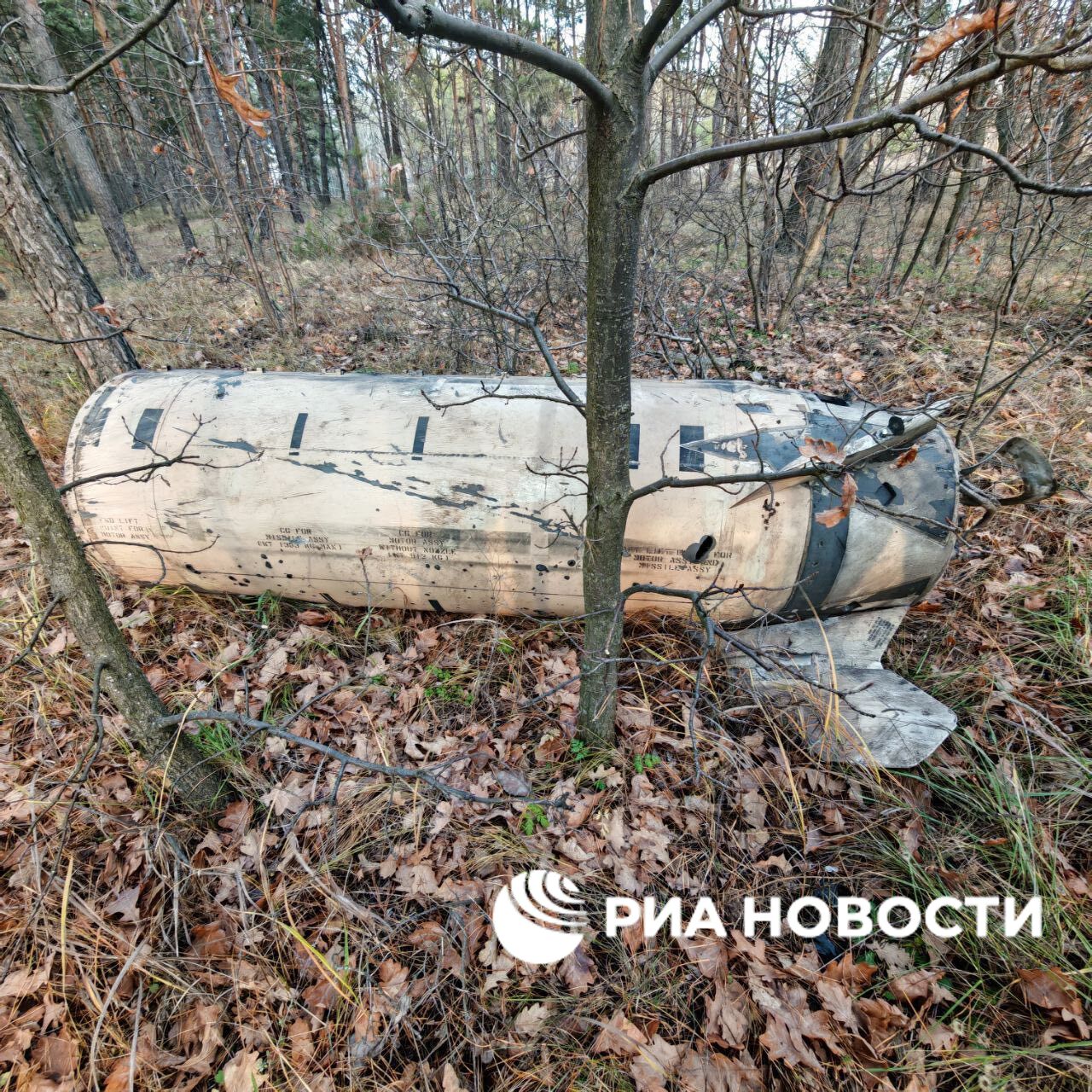
Ukraine’s General Staff acknowledged the operation, stating that the ATACMS strike was conducted against military assets.
In an official announcement, the General Staff said: “The Armed Forces of Ukraine successfully used ATACMS tactical missile systems to carry out a precise strike on military facilities on the territory of Russia. This is a landmark event that underscores Ukraine’s unwavering commitment to its sovereignty.”
The statement did not specify the exact targets, though earlier ATACMS strikes have focused on Russian airfields, command nodes, and troop concentrations.
The Nov. 18 engagement stands out not just for its depth—Voronezh lies roughly 250 kilometers from the Ukrainian border—but also for the daylight timing, which made the event highly visible to civilians and produced clear photographic records.
Russian officials maintained that the missiles were aimed at “civilian facilities,” a claim often issued after previous Ukrainian long‑range strikes. No independent confirmation has surfaced to support the allegation, and Russia did not release imagery of the supposed civilian impact points.
Ukraine’s position has remained unchanged: all long‑range strikes target military infrastructure used to support Russia’s invasion.