

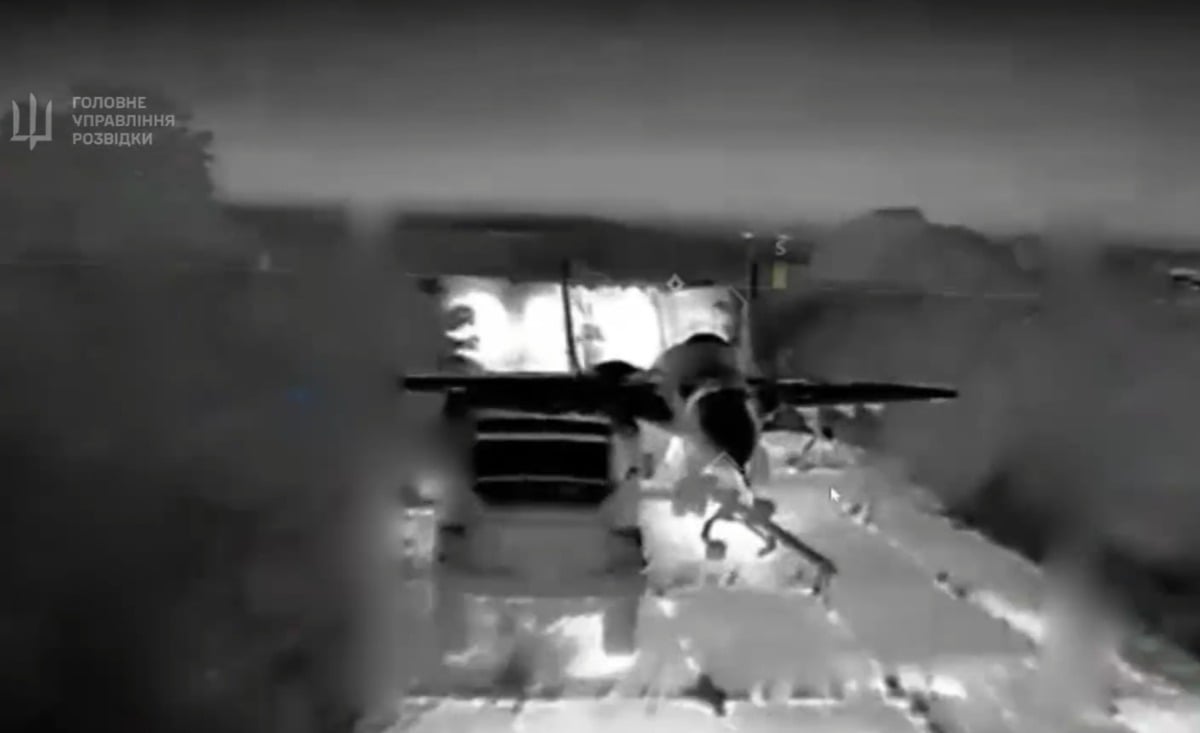
- Ukraine's GUR said its drone unit destroyed a Russian MiG-29 and a ground support vehicle at Belbek airfield overnight June 25 into 26, 2026.
- GUR estimated the damage at tens of millions of dollars, a figure based on the agency's own assessment.
A Russian fighter jet parked on a runway in occupied Crimea burst into flames overnight, and Ukraine’s military intelligence agency says its drone operators are responsible.
Ukraine’s Main Directorate of Intelligence, known by its Ukrainian abbreviation GUR and distinct from the country’s domestic security service, announced Saturday morning that its Department of Unmanned Systems struck the Belbek military airfield near Sevastopol on the night of June 25 into June 26, 2026, destroying a Russian MiG-29 fighter jet and setting fire to an airfield ground support vehicle that was actively servicing the combat aircraft at the moment of the strike. GUR estimated the combined damage from the attack at tens of millions of dollars and released what it described as exclusive footage of the strike, though the agency’s damage figures reflect its own assessment rather than independent verification.
The MiG-29, known by the NATO reporting name Fulcrum, is a twin-engine fighter jet first introduced during the Soviet era that Russian forces still fly for air defense and patrol missions, including coverage of occupied Crimea, even as the aircraft has grown increasingly outdated compared to more modern fighters in Russia’s inventory. Belbek itself ranks among the most significant military airfields on the peninsula, serving as home base for Russia’s 38th Fighter Aviation Regiment, a unit that has flown Su-27SM and Su-27SM3 fighters from the site and that Russian forces quietly began basing MiG-31 interceptors at starting in the fall of 2023, a deployment Moscow initially kept hidden from public view. The airfield sits roughly 300 kilometers (186 miles) in a straight line from mainland Ukraine’s coast, a distance that Ukrainian drone forces have repeatedly proven capable of reaching despite Russia’s efforts to reinforce the base with hardened aircraft shelters and camouflage measures introduced since 2024 specifically to blunt this kind of attack.
This strike extends what has become a sustained campaign against Belbek rather than an isolated success. Ukraine’s domestic security service, the SBU, struck the same airfield overnight on December 17 and 18, 2025, using long-range drones from its Alpha Special Operations Center to destroy a MiG-31 fighter loaded with weapons along with two Nebo-SVU early-warning radars, a 92N6 radar tied to Russia’s S-400 air defense system, and a Pantsir-S2 air defense system, damage the SBU valued at up to $300 million at the time. Two days later, the SBU hit Belbek again, striking two additional Su-27 fighters, with one destroyed while sitting fully armed on a taxiway ready for a combat sortie. Those repeated strikes illustrate a broader Ukrainian strategy that GUR’s own past statements have described explicitly, with the agency previously saying its special units are working to systematically weaken Russian air defense coverage over Crimea by destroying radars, anti-aircraft systems, and fighter aircraft in sequence rather than through any single decisive blow.
GUR has conducted similar operations against other Crimean airfields well beyond Belbek. In December 2025, the agency’s Prymary special-purpose unit struck a MiG-29 stationed at Kacha airfield near Sevastopol during the same operation that hit an Irtysh radar complex close to Simferopol, though independent aviation analysts later raised questions about that specific strike, since Kacha has historically hosted helicopters and flying boats rather than fighter jets, leading at least one expert interviewed by The War Zone to suggest the aircraft may have been a deliberately placed decoy meant to draw Ukrainian strikes away from more valuable, hardened targets nearby. No such ambiguity surrounds Belbek, a base with a well-documented history of hosting frontline fighter squadrons, making this latest MiG-29 loss harder to dismiss as a staged target even without independent confirmation of the exact damage GUR has claimed.
Crimea has absorbed a punishing pace of Ukrainian strikes throughout 2026, with satellite imagery reviewed by analysts in early July showing damage to six of seven hardened aircraft shelters at the Saky airfield elsewhere on the peninsula, part of a broader pattern that has also included sustained attacks on the bridges connecting Crimea to mainland Russia and on the fuel infrastructure supporting the peninsula, contributing to gasoline shortages severe enough that regional officials have discussed rationing during the height of Crimea’s summer tourist season. Russian military planners have responded by running exercises simulating a hypothetical Ukrainian amphibious landing on the peninsula, according to open-source defense analysts tracking the drills, even though most military observers consider an actual large-scale Ukrainian landing operation unlikely given the forces and logistics such an assault would require.
Ukraine keeps finding ways to reach hardened airfields that Russia has spent years and considerable resources trying to protect, and each burning fighter jet on a Crimean runway is one more data point suggesting that no amount of shelters, camouflage, or air defense batteries has yet made the peninsula the secure rear base Moscow once assumed it would remain.