

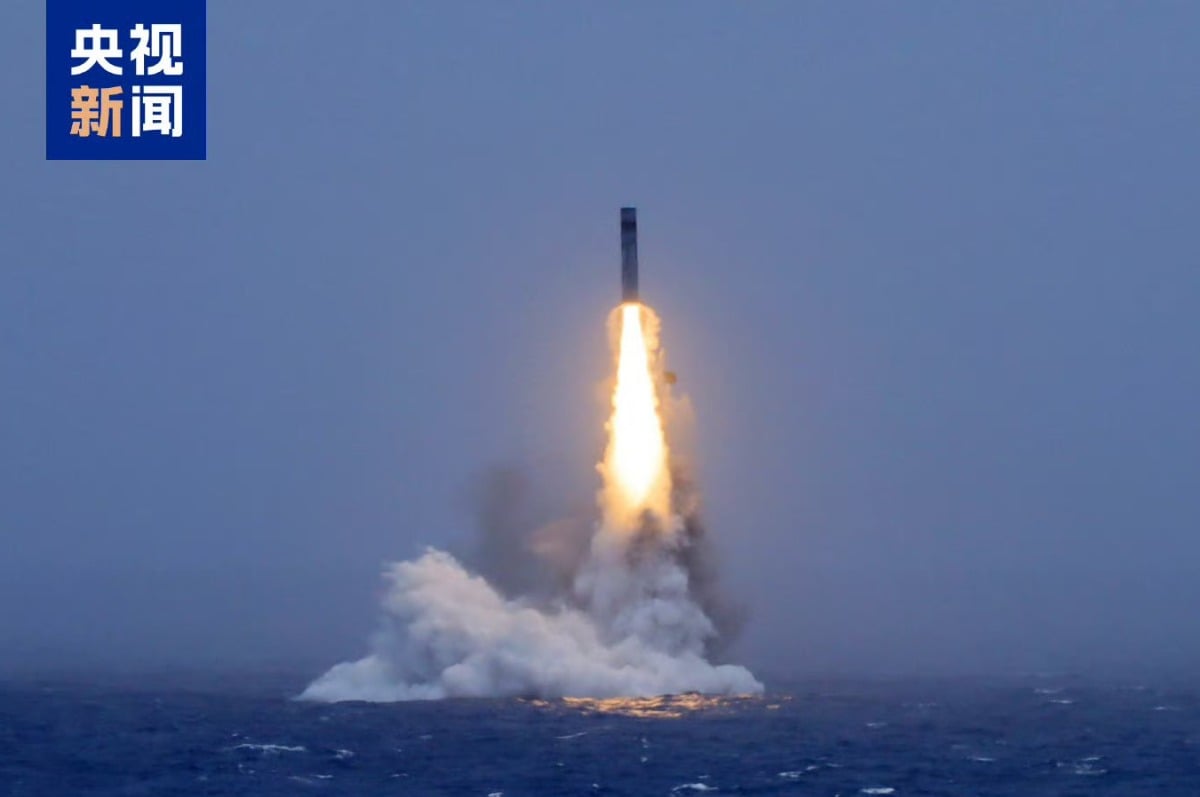
- China's Navy test-fired a submarine-launched ballistic missile with a mock warhead into the Pacific Ocean on Monday, July 6.
- Japan received 90 minutes of formal notice before the noon launch and says it found no evidence the missile crossed its airspace or economic zone.
A Chinese Navy submarine fired a nuclear-capable ballistic missile into the Pacific Ocean on Monday, and Tokyo says it “strongly urged” Beijing to call off the test beforehand, the Japan Times reported.
The launch, carried out with a mock warhead rather than a live one, hit its intended impact zone according to China’s state-run Xinhua News Agency, which described the shot as a routine part of the country’s annual military training calendar and said other governments had been notified in advance.
China’s Defense Ministry gave Japan only 90 minutes of formal warning before the launch, a narrow window that left Tokyo scrambling to register its objections through diplomatic channels before the missile ever left the water. The Japanese Embassy in Beijing was told just before the noon launch that a ballistic missile test was imminent, and Tokyo used that limited window to lodge its concerns directly with Chinese officials.
Independent tracking data lines up closely with the sequence Beijing and Tokyo have each described, adding an outside layer of confirmation to the official timeline neither government has disputed. Jonathan McDowell, a Harvard-Smithsonian astrophysicist who has built a reputation for cataloguing rocket and missile launches from public tracking data, wrote on X that the suborbital launch occurred at 4:01 a.m. UTC on July 6, which converts to noon in Beijing. McDowell identified the weapon as either a JL-2 or JL-3 submarine-launched ballistic missile fired from the Bohai Sea, the body of water off China’s northeastern coast that hosts several Chinese naval facilities. Based on tracking inputs, he estimated a roughly 3,900 by 1,050 km (2,400 by 650 mile) trajectory at a 44-degree inclination, with impact occurring around 4:28 a.m. UTC near 174 degrees east, 6 degrees south, a stretch of open Pacific water southeast of the Solomon Islands.
Japan’s government said it has no evidence the missile crossed into its territorial airspace or exclusive economic zone. Chief Cabinet Secretary Minoru Kihara told reporters the passage had “not been confirmed,” and added that Tokyo had received no reports of damage to any Japanese aircraft or vessels. The Japan Coast Guard had been given advance notice a day earlier, though the initial Chinese message described only a “restricted area” opening up south of Cape Shionomisaki in Wakayama Prefecture in connection with reentering space debris, not a missile test. The coast guard issued a navigation warning for the zone before China’s Defense Ministry clarified, hours later, what the exercise actually involved.
The missile in question is almost certainly one of two systems that make up the sea-based leg of China’s nuclear arsenal. The JL-2 has been in service for over a decade with an estimated range of roughly 7,200 to 9,000 km (4,500 to 5,600 miles), while the newer JL-3 pushes past 10,000 km (6,200 miles) and is believed capable of carrying multiple independently targetable warheads. Both missiles are built to launch from China’s Type 094 and upgraded Type 094A Jin-class nuclear-powered ballistic missile submarines, a fleet that now numbers roughly nine boats and forms the backbone of Beijing’s ability to strike from the sea rather than relying solely on land-based silos or mobile launchers. China’s expanding undersea nuclear deterrent has drawn sustained attention from military planners in Washington and allied capitals precisely because submarines are difficult to track and nearly impossible to preemptively destroy, which makes them the most survivable piece of any nuclear arsenal.
Monday’s test was not China’s first Pacific launch to draw international pushback. In September 2024, the People’s Liberation Army Rocket Force fired an intercontinental ballistic missile with a dummy warhead into waters near French Polynesia, marking Beijing’s first public test of that kind in more than four decades. That earlier launch drew comparisons to routine test-firing programs long run by the United States and Russia, and some analysts at the time framed it as China signaling that its nuclear force had matured to the point where it no longer needed to hide its testing activity.
Analysts see a similar signal in this week’s test, though with an added layer given where and how it happened. Yang Zi, a research fellow at Singapore’s S. Rajaratnam School of International Studies, said the launch appears to be the first time China has tested a submarine-launched ballistic missile in the Pacific Ocean specifically, as opposed to firing a land-based ICBM from its own territory.
“A general probing maneuver as China perceives weakness in US-centric alliance systems,” Yang said.
Australia was also notified ahead of time and used the moment to register its own concerns publicly. Defense Minister Richard Marles, quoted by the Australian Broadcasting Corporation, framed the test as part of a broader pattern Canberra is watching closely.
“This is a long-range missile test, and we are very concerned about any actions that undermine the stability, peace and security of the Pacific,” Marles said.
China has pushed back against the criticism, arguing that its advance notifications satisfy international norms and that the test targeted no country or entity. Beijing has simultaneously expanded its submarine fleet at a pace that, by some counts, has now made it the world’s second largest operator of nuclear-powered submarines behind the United States, ahead of Russia. That buildup, combined with a modernized land-based missile force and a developing air-launched nuclear capability unveiled at a military parade in Beijing last year, points to a deliberate strategy of fielding a fully modernized nuclear triad rather than leaning on any single leg of deterrence.
What remains unclear is exactly how far the missile traveled beyond McDowell’s estimated trajectory, whether the test was tied to any broader exercise involving Chinese naval assets already operating in the region, and whether Beijing plans to make Pacific submarine launches a recurring feature of its annual training cycle rather than a rare event. Japan, Australia and other regional governments will likely be watching for the answer to that last question most closely, because a one-off test and an established pattern call for very different responses.