

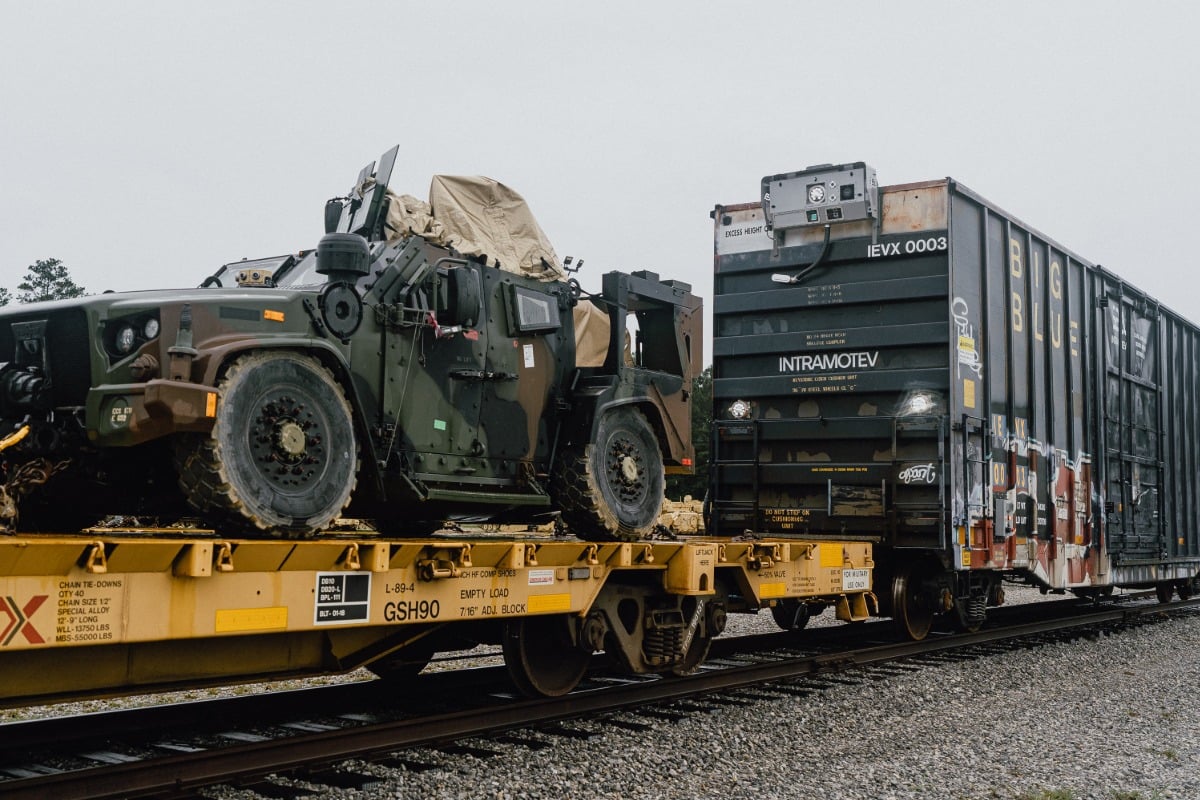
- Intramotev's TugVolt autonomous railcar was used by soldiers to switch DODX railcars during Operation Sentinel Justice at Camp Shelby Joint Forces Training Center, June 9 to 17, 2026.
- Real military cargo arrived unplanned during the exercise's final hours, and soldiers used TugVolt to reorder and spot the cars for unloading.
A self-driving railcar built by a St. Louis startup ended up doing real Army work at America’s largest Army Reserve training exercise this month, moving actual military cargo that arrived unannounced rather than the simulated loads the demonstration was originally designed around.
Intramotev announced June 24, 2026, that soldiers operated its TugVolt autonomous battery-electric railcar throughout Operation Sentinel Justice at Camp Shelby Joint Forces Training Center in Mississippi, the largest training exercise in the history of the U.S. Army Reserve, and that when real military cargo arrived by rail in the event’s final hours, the crew put the system to work meeting that actual logistics need instead of just running the planned assessment.
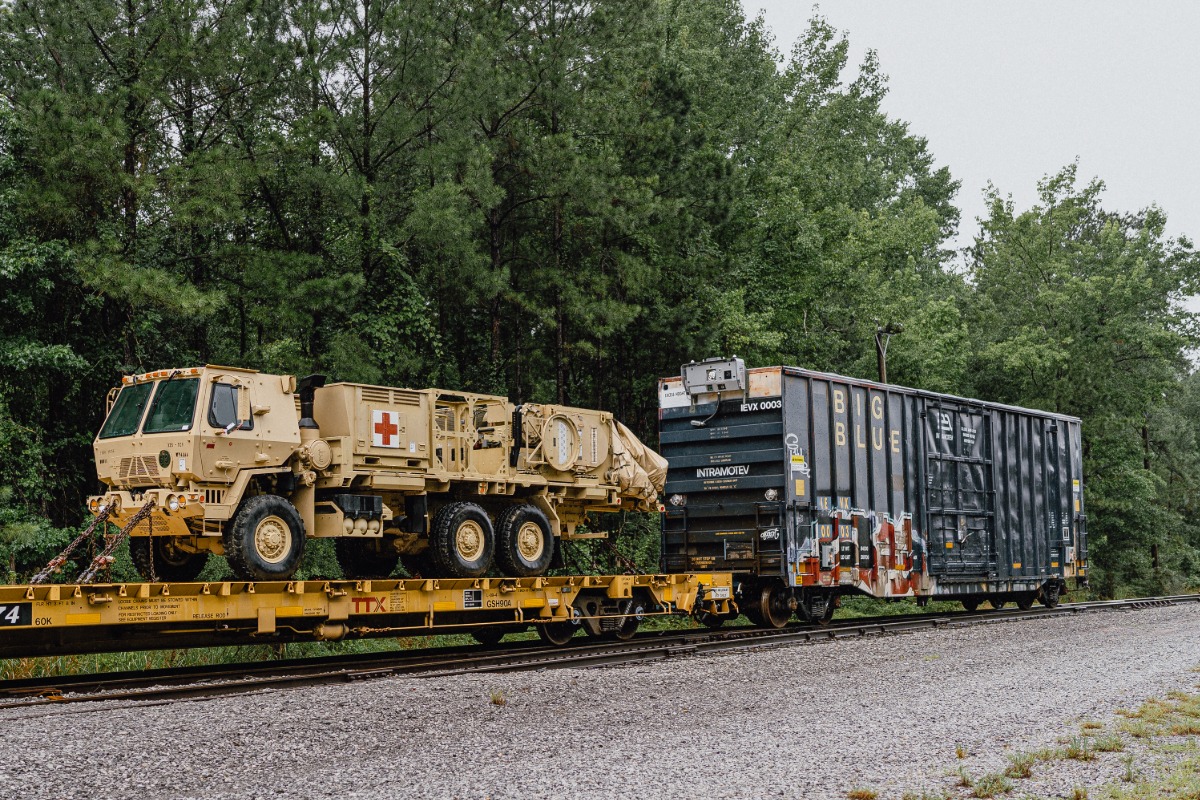
TugVolt is not a new locomotive design; it is a retrofit system that Intramotev installs onto existing freight railcars, adding battery storage, electric motors, regenerative braking, and a sensor and communications suite that enables either remote-controlled or fully autonomous operation. The core idea is straightforward: instead of needing a diesel locomotive to move a string of railcars, a single TugVolt-equipped car can move independently, point to point, decoupling from a train and operating on its own for short-haul movements, or it can function as what the company describes as a “switcher,” acting like a mini locomotive to position traditional railcars for loading and unloading without any separate engine attached. That switching function is precisely what happened at Camp Shelby. Intramotev deployed TugVolt to serve as the switcher for multiple DODX railcars, the standard Department of Defense rail equipment used to transport military vehicles and cargo, moving them between rail spurs for loading and unloading entirely without a locomotive.
The exercise involved a genuinely broad coalition of Army organizations responsible for the unglamorous but essential work of moving military equipment from where it is stored to where it needs to deploy. Intramotev partnered with the U.S. Army Reserve Command’s 75th Innovation Command, the unit specifically tasked with evaluating emerging technology for Army Reserve applications, alongside the 377th Theater Sustainment Command, the Deployment Support Command and its 757th Expeditionary Rail Center, and the Mississippi Army National Guard. The 757th Expeditionary Rail Center’s involvement is particularly significant because that unit specializes in exactly the kind of rail-based power projection logistics TugVolt is designed to support, namely the movement of military equipment onto and off rail cars at installations and ports during deployment operations.
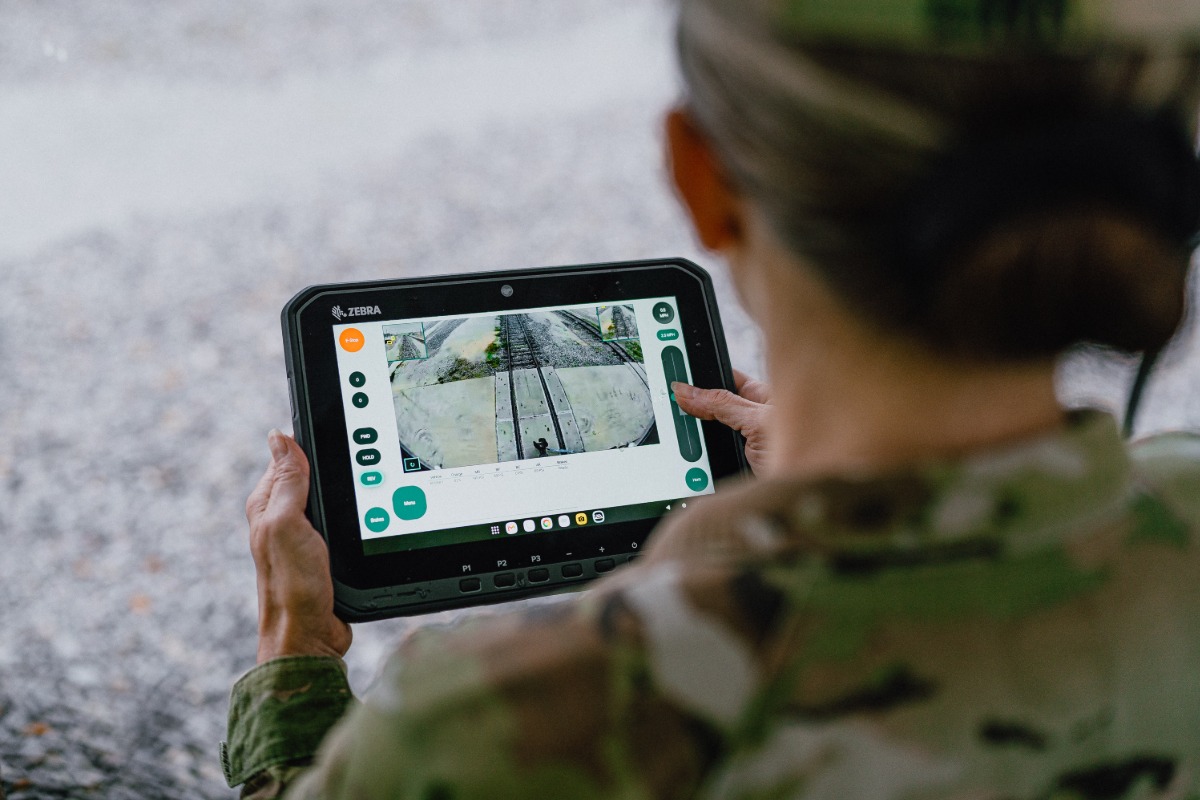
Soldiers, according to Intramotev, trained on and operated the TugVolt system under company supervision throughout the exercise and quickly became proficient with the technology, a detail that matters because military rail operations have traditionally required specialized rail crews, a category of personnel the Army has struggled to maintain at sufficient strength given how infrequently large-scale rail movements occur outside major deployment exercises. A system that ordinary soldiers can learn to operate competently within the span of a single training event addresses a specific manpower bottleneck rather than simply offering a more efficient version of existing capability.
The opportunistic real-world use case that emerged in the exercise’s final hours is the part of the story that elevates this from a successful demonstration into something closer to operational proof. When actual military cargo arrived via rail at Camp Shelby, outside the planned assessment script, soldiers used the TugVolt to reorder and spot railcars for unloading, meeting a genuine logistics need rather than a simulated one. That distinction carries weight in defense technology evaluation, where the gap between a controlled demonstration and an unscripted operational moment often determines whether a new system gets a second look from program managers or quietly disappears after one successful trade show pitch.
Alex Peiffer, Intramotev’s Chief Operating Officer and a U.S. Air Force veteran, framed the exercise as confirmation that the company’s military ambitions extend beyond marketing.
“Sentinel Justice was a powerful display of the TugVolt’s capabilities,” Peiffer said. “On top of the successful training of dozens of Soldiers, we showed that Intramotev is ready to meet real-world military needs, just as we are for commercial customers. We’re grateful for the U.S. Army’s partnership, and energized by how our technology can strengthen defense logistics, protect Soldiers, and keep our forces ready.”
Maj. Gen. (ret.) Stephen Farmen, who serves as Senior Advisor at Intramotev, connected the exercise to a broader strategic logic about Army readiness and power projection that goes beyond the immediate logistics task performed at Camp Shelby.
“Equipping our men and women in uniform with better tools is what readiness is all about,” Farmen said. “It was powerful to see Soldiers, from junior enlisted to general officers, put this technology to work. Placing this capability directly in the hands of Soldiers at power projection platforms enhances the Army’s ability to deploy at speed and scale, and to fill the gaps and seams at the installations that support projecting the force.”
Farmen’s framing points toward the specific operational gap TugVolt addresses for the Army: the recurring shortage of qualified rail crews and the fuel, maintenance, and logistical overhead that conventional diesel locomotives require to perform what is fundamentally simple switching work at installations and ports. Farmen, speaking at the National Defense Industrial Association’s Future Force Capabilities Conference prior to the Camp Shelby exercise, described how relying on rail crews or locomotives creates persistent friction at power projection platforms, the installations the Army uses to load and ship equipment for deployment, and how a battery-electric autonomous railcar could open up capacity in exactly that bottleneck.
Intramotev, founded in St. Louis in 2020 by Tim Luchini, Alex Peiffer, and Corey Vasel, has built its commercial business steadily over the past two years, with TugVolt systems now in revenue service moving more than 350,000 tons of material in 2025 for industrial customer Carmeuse Americas at a limestone mine in Michigan’s Upper Peninsula, alongside deployments with short line operator Watco at an Illinois transload terminal and a commercial agreement signed with R.J. Corman Railroad covering Kentucky’s 113-mile Memphis Line. The company expanded internationally in April 2026 with an agreement covering Austria’s Rail Cargo Group, the freight subsidiary of the country’s national railway. That commercial track record, built largely on industrial and short line rail applications where TugVolt has proven it can reduce operating costs by 30 to 80 percent compared to conventional locomotive switching, gave the company an established technology base to bring into the Army Reserve evaluation rather than an unproven concept.
Military mobilization at scale depends on moving enormous quantities of vehicles, equipment, and supplies efficiently between storage facilities, rail yards, ports, and ships, a process that becomes the binding constraint on how quickly American forces can actually deploy when called upon, regardless of how capable the equipment being moved might be. A technology that lets soldiers, rather than scarce specialized rail crews, operate switching equipment without a diesel locomotive addresses a genuine bottleneck in that mobilization chain, and Camp Shelby gave the Army its first direct look at whether that technology works when soldiers, rather than company engineers, are the ones running it.