

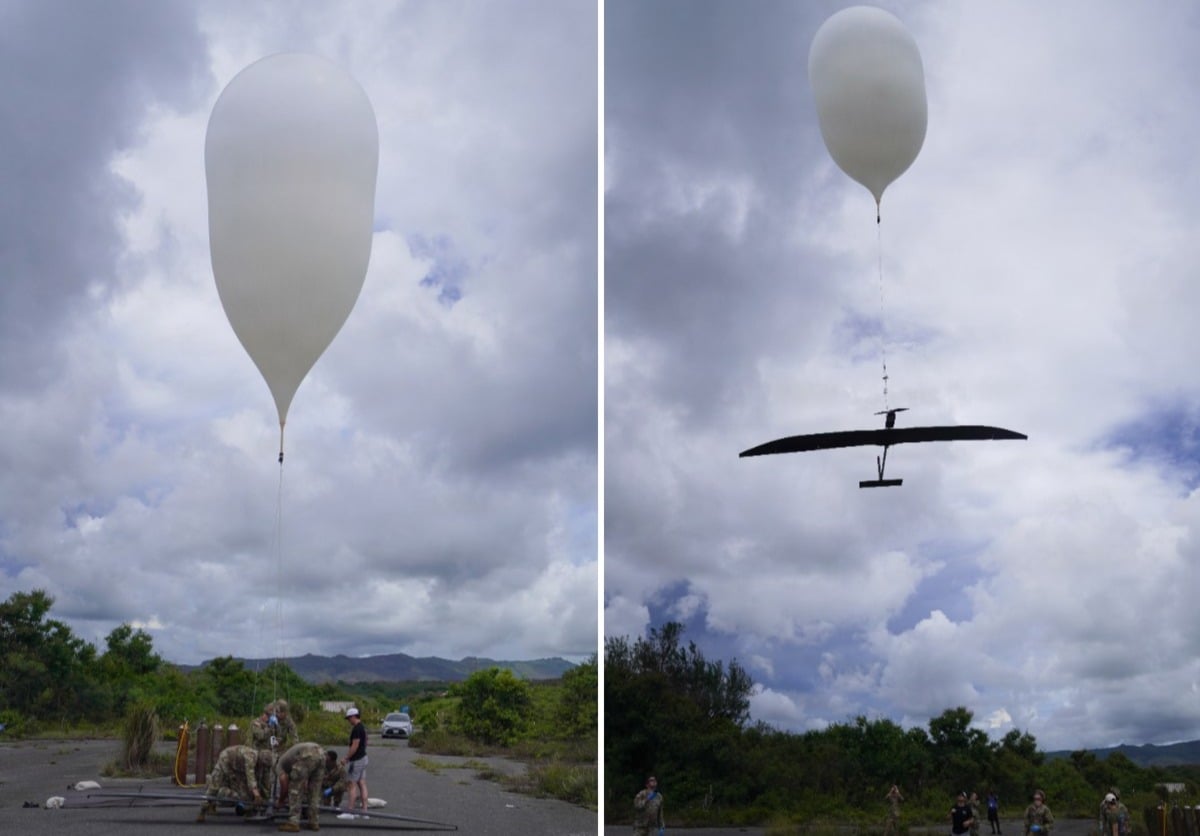
- Army soldiers from the 3d Multi-Domain Task Force launched the Icarus Apollo R stratospheric aircraft on an Urban Sky balloon at Orote Airfield, Naval Station Guam, on June 24, 2026.
- The demonstration tested stratospheric sensor capabilities and extended joint communications networks in support of Valiant Shield 2026 and CJADC2 validation.
U.S. Army soldiers attached a solar-powered fixed-wing aircraft to a high-altitude balloon at Orote Airfield on Naval Station Guam on June 24, 2026, and prepared to launch the combination into the stratosphere as part of Valiant Shield 2026, the largest U.S.-led joint exercise in the Indo-Pacific.
The aircraft is the Apollo R, built by Icarus, a Los Angeles-based aerospace company that manufactures autonomous solar-powered planes designed to fly indefinitely at altitudes exceeding 18,300 m (60,000 ft). The balloon lifting it off the ground was built by Urban Sky, a Denver-based company specializing in rapidly deployable stratospheric microballoons that can be launched by a single operator in under five minutes. Together, the two systems represent an approach to persistent surveillance and communications in the Pacific that the Army’s 3d Multi-Domain Task Force is actively evaluating as an alternative to satellites and conventional aircraft.
The soldiers conducting the demonstration belong to the Extended Range Sensing and Effects Company, 3d Multi-Domain Effects Battalion, part of the 3d Multi-Domain Task Force, one of the Army’s five dedicated multi-domain task forces designed to integrate space, cyber, electronic warfare, long-range fires, and information operations into land combat at the theater level. Their specific mission on Guam was to test stratospheric sensor capabilities and extended joint communications networks as part of the validation effort for Combined Joint All-Domain Command and Control, known as CJADC2, the Pentagon’s overarching framework for connecting sensors and shooters across all military branches and allied forces in real time, regardless of the domain they operate in.
Understanding why a solar-powered airplane attached to a balloon matters for Pacific Command operations requires a brief explanation of the problem it is trying to solve. The Indo-Pacific theater is immense, spanning more than 100 million km² (38 million sq miles) of ocean, island chains, and contested maritime space, and the distances involved create fundamental challenges for any communications and surveillance architecture. Satellites in low Earth orbit, orbiting at approximately 550 km (342 miles) altitude, provide broad coverage but pass over any given point for only about 10 minutes per orbit, creating gaps in persistent coverage, and they require specialized terminals on the ground to communicate with. Traditional aircraft and drones provide persistent coverage but need fuel, airfields, maintenance cycles, and crews, all of which become increasingly difficult to sustain as an adversary targets the logistics infrastructure those aircraft depend on.
Stratospheric platforms like the Apollo R occupy a different niche entirely, operating at altitudes between 18 and 20 km (59,000 to 65,000 ft), above the weather and above the effective operational ceiling of most threats while remaining far closer to the Earth’s surface than any satellite. According to performance data provided in the source material, a stratospheric platform at 20 km altitude can maintain persistent 24-hour coverage of an area of approximately 7,500 km² (2,895 sq miles) with fiber-like signal latency of 5 to 10 milliseconds, direct-to-device communication without requiring a satellite terminal on the receiving end, and the ability to stay on station indefinitely if solar-powered. A single low Earth orbit satellite pass covers a larger 50,000 km² (19,305 sq miles) footprint but only for 10 minutes per orbit, with 25 to 60 millisecond latency and the requirement for a dedicated satellite receiver terminal at every node. For a small Marine unit or Special Forces team operating from a remote island without heavy communications equipment, direct-to-device connectivity from a platform orbiting in the stratosphere above them represents a qualitatively different communications option than coordinating access to a satellite terminal.
Icarus’s Apollo R, the fixed-wing aircraft used in the Guam demonstration, is a solar-powered autonomous plane designed to remain airborne for weeks without landing, drawing continuous power from solar panels on its wings during daylight hours and storing enough energy to maintain flight through the night. The company, founded in Los Angeles and testing its aircraft in the Mojave Desert, describes the Apollo as capable of deploying in hours, stationing for weeks, and providing continuous intelligence and communications coverage with ultra-low latency over a persistent footprint. The company completed its first fully solar-powered autonomous flights in 2024 and has been advancing toward military demonstration events since. The use of an Urban Sky high-altitude balloon to lift the Apollo R to stratospheric altitude represents a launch methodology that avoids the need for a conventional runway or ground-based launch system, since Urban Sky’s microballoon systems can deploy from virtually any location in under five minutes by a single operator, including from a ship’s deck or an unimproved field position.
Urban Sky, founded in 2019 and headquartered in Denver, Colorado, has conducted more than 350 successful stratospheric balloon flights and holds over 20 patents on altitude-control and navigation systems for its microballoon platforms. The company’s systems operate at altitudes between roughly 12,000 and 23,000 m (40,000 to 75,000 ft), providing altitude stability and limited navigational control that allows the balloon to hold position over a target area rather than simply drifting with the prevailing winds. One third of all non-weather, non-latex high-altitude balloons flown in the United States in 2023 were built or operated by Urban Sky, according to industry figures the company has cited publicly.
The combination of Urban Sky’s rapid-launch balloon capability and Icarus’s persistent solar aircraft addresses a specific operational problem that the 3d Multi-Domain Task Force exists to solve in the Pacific: how to maintain persistent intelligence, surveillance, and reconnaissance coverage and extend communications networks across vast ocean distances when adversary strikes may have degraded or destroyed the fixed infrastructure those networks depend on. China’s People’s Liberation Army has devoted substantial investment to anti-satellite capabilities, electronic warfare systems designed to jam satellite communications, and long-range precision missiles capable of striking the airfields and radar installations that conventional ISR aircraft require. A solar-powered stratospheric platform launched by balloon from a ship or an unimproved airfield, capable of persisting for weeks above the weather and above most threats while providing direct-to-device communications, is precisely the kind of resilient, distributed architecture that Pacific Command planners have been seeking as a hedge against that threat.