

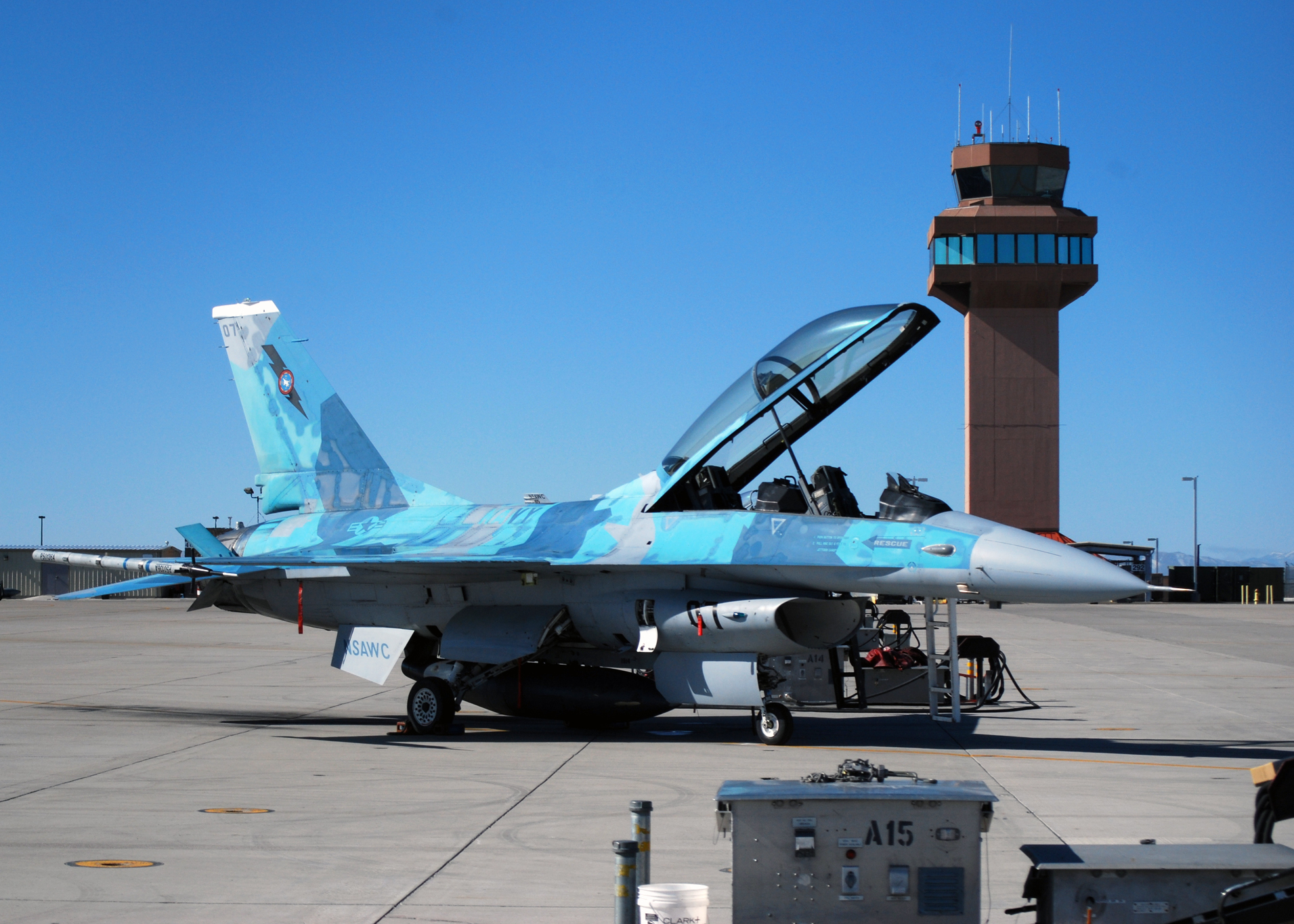
The Naval Air Systems Command has reported on Monday that the Specialized and Proven Aircraft program office (PMA-226) recently completed a modification on several U.S. Navy F-16A Fighting Falcon aircraft to increase readiness and service life.
The FalconUp modification improves F-16A readiness by extending their fatigue lives by over 500 hours and provides the configuration baseline to incorporate the funded Falcon Star program, which adds an additional 3750 hours to the service life of the aircraft.
“The FalconUp upgrade incorporates structural improvements that extend the service life of the aircraft from 3665 hours to 4250 hours,” said Capt. Ramiro Flores, PMA-226 program manager. “The program procured and installed proven structural modification kits on 10 U.S. Navy aircraft that enhanced and strengthened their internal structure.”
PMA-226 used a rapid acquisition approach, in this case a build-to-print strategy to minimize risk and eliminate the need for test plans, systems engineering plans and design reviews. Build-to-print is a process in which a manufacturer produces products, equipment, or components according to the customer’s exact specifications.
The program office leveraged existing designs that the U.S. Air Force and international partners have used to install the modification and have been including it in production of the F-16 for over two decades. The Navy competitively awarded the contract to ES3 Prime Logistics Group, Inc., which has previously manufactured the same components for the Air Force and PMA-226.
“Since the proven design has flown thousands of hours in this configuration, and it doesn’t require expansion of the current flight envelope, we were able to deliver this training capability to the warfighter much faster than a traditional program,” said Lt. Cmdr. Heather Bliss, PMA-226 adversary program team co-lead.
“The upgrade allows the Navy to provide mission ready adversary aircraft for Naval aviation advanced tactical and aerial combat training, extending the operational life of the F-16A through 2025,” said Boyd Forsythe, PMA-226 adversary program team lead.
PMA-226 is responsible for life cycle cradle to grave management of several legacy and out-of-inventory aircraft and engines, assigned by NAVAIR and contracted air services. Assigned platforms and services include: adversary aircraft (F-5, F-16); contracted aircraft services; U.S. Naval Test Pilot School / Naval Postgraduate School (T-38, H-72, X-26, U-6, NU-1B, O-2, OH-58C); and foreign military sales out-of-active Navy inventory aircraft (T-2, H-2, H-3, and A-4).