

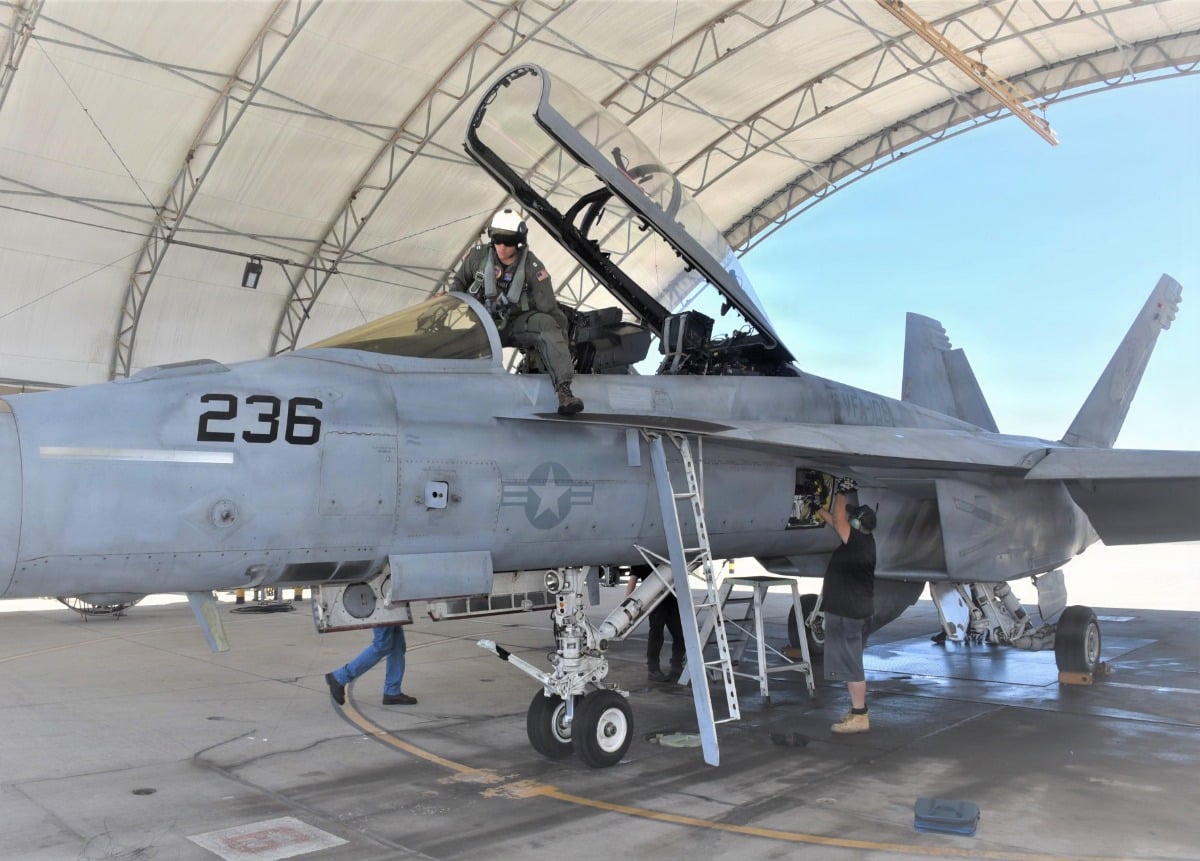
- NAWCAD and Fleet Readiness Center Southwest developed a 3D-printed composite repair method for F/A-18 Super Hornet jets at forward bases.
- The teams plan to flight-test the repair on an operational aircraft this summer after completing lab and ground testing.
Engineers at the Naval Air Warfare Center Aircraft Division and Fleet Readiness Center Southwest built a 3D-printing method that lets sailors repair cracked composite panels on the F/A-18 Super Hornet right at the base where the jet is stationed, and they expect it to cut repair time by roughly 50 percent once it reaches the fleet. The two commands plan to flight-test the printed repair on an operational aircraft this summer, a milestone that would move the technology from lab bench to a real jet carrying real pilots.
Composite materials are the carbon fiber and resin panels that make up much of a modern fighter’s skin, prized because they are lighter than aluminum while still strong enough to handle the stress of high-speed flight, and the Super Hornet relies on them for parts like its engine bay doors. When one of those panels cracks or gets damaged, whether from a bird strike, debris on a runway, or the routine wear of carrier operations, the jet is grounded until someone fixes it, and that has traditionally meant a slow and specialized process. Composite repair has historically required highly trained maintenance artisans working with materials that cannot simply be patched the way a metal panel can be welded or riveted, and getting the right part or the right expert to a squadron often meant shipping components back to a repair depot in the United States, a process that can take weeks and strand aircraft at exactly the moment commanders need them flying.
“Our goal is to put capability directly into the hands of the Fleet. By simplifying a complex repair so it can be done forward, our engineers would get aircraft back in the fight faster, it’s a smart solution that makes our squadrons more self-sufficient and directly improves operational readiness,” said NAWCAD Commander Rear Adm. Todd Evans.
The fix Evans described involves high-performance composite patches that engineers print directly using additive manufacturing equipment, essentially building the replacement material layer by layer from digital blueprints rather than machining it from a preformed sheet, and then applying that printed patch straight onto the damaged section of the aircraft. Getting from a working patch in a lab to a part cleared for flight required NAWCAD and FRCSW engineers to develop specific application procedures and quality checks, since a composite structure that looks solid can still fail catastrophically in flight if it has not been bonded, cured, and inspected to exacting standards, and the successful ground and lab testing described in the announcement represents that verification work clearing its first hurdles before the technology reaches an actual flight test this summer.
FRCSW is well positioned to push this kind of repair into daily use because it already runs one of naval aviation’s busiest maintenance operations, a San Diego-based command that has repaired military aircraft for more than a century and has spent the past several years expanding its use of 3D printing for everything from backordered aircraft components to structural fixes. Earlier work at the command used a Stratasys F-900 industrial printer to fabricate an F/A-18 button plug that had been stuck on backorder for months, with engineers reporting that a first print took about two weeks but that future parts made the same way could take as little as one to four days, a preview of the kind of turnaround the Navy is now betting on for structural composite repairs as well. Separately, NAVAIR’s additive manufacturing teams have also used cold spray 3D printing, a different process that sprays metal powder to build up material, to repair Super Hornet landing gear wheel rims that previously had to be discarded and replaced at a cost of roughly $100,000 per wheel assembly, underscoring how aggressively the Navy has been chasing 3D printing solutions across multiple aircraft systems rather than treating this composite patch method as an isolated experiment.
What makes the composite repair program more than a one-base curiosity is the infrastructure already sitting in place to support it. The Navy has 3D printers deployed at 22 maintenance sites around the world, a network built up gradually for other additive manufacturing projects that can now serve as the backbone for pushing composite repair capability out to wherever Super Hornets actually operate, rather than requiring every damaged jet to wait for a part to arrive from a depot thousands of miles away. That distinction carries real weight for a Navy increasingly focused on operating in the Pacific, where distances between bases stretch for thousands of miles and a grounded jet at a forward airfield cannot simply hop a supply flight home for a quick fix.
Boeing has said it plans to end Super Hornet production by 2027, and FRCSW completed its first fully in-house Block III modification of a Super Hornet earlier this year, a separate upgrade program intended to keep the jet’s radar, cockpit displays, and airframe viable into the 2040s even as the Navy’s newer F-35C stealth fighter takes on a growing share of carrier air wing missions. A fleet expected to keep flying for another two decades needs maintenance solutions that scale, and a repair method that can be executed by sailors at a forward base rather than routed through a handful of specialized depots is exactly the kind of capability that determines whether jets sit grounded or get back into the fight.
NAWCAD has not disclosed how quickly the method would roll out fleet-wide if the summer flight test succeeds, and a single successful flight will not by itself prove the patches hold up across years of carrier deployments and combat sorties. What the program does confirm is that the Navy is treating additive manufacturing as core infrastructure for keeping its aircraft flying rather than a novelty limited to backordered plastic parts, and a sailor at a forward base printing a structural patch for a fighter jet’s skin is a very different picture of naval readiness than the one the fleet operated under a decade ago.