

- X-Bow Systems said Monday it has delivered more than 1,100 solid rocket motors for defense applications.
- X-Bow previously delivered 600 RATO motors to AEVEX under a $12 million Disruptor drone contract announced in April 2026.
X-Bow Systems said Monday it has delivered more than 1,100 solid rocket motors, a sharp production milestone for a U.S. defense market trying to rebuild a rocket motor supply base that has struggled to keep pace with missile and drone demand.
The company did not identify every customer or program tied to the 1,100 motors in its public statement, but the announcement builds directly on its rocket-assisted takeoff work for AEVEX Aerospace’s Disruptor strike drone. X-Bow said in May that it had delivered its 600th RATO motor to AEVEX under a $12 million contract to supply thousands of rocket-assisted takeoff kits, solid rocket motors, and components for the unmanned aircraft.
The milestone matters because small solid rocket motors have become a bottleneck in modern weapons production. They power missiles, interceptors, rockets, and launch-assist systems, and they are harder to scale than their size suggests. A motor must burn predictably, survive storage and transport, and deliver thrust within tight tolerances, because a failure in the first seconds of launch can destroy the aircraft or weapon before the mission begins.
X-Bow framed the new delivery total as evidence that the United States can add capacity beyond the traditional solid rocket motor suppliers that have long dominated the market. The company said it moved from signed contract to combat-ready production in six months, while arguing that delivered motors, rather than future production promises, are changing the industrial picture.
That message lands in a defense sector still absorbing the lessons of Ukraine, the Red Sea, and the Iran crisis. Modern conflict has turned guided munitions, air defense interceptors, and long-range drones into high-consumption items rather than boutique weapons used sparingly. The Department of War and allied militaries now face a simple arithmetic problem: sophisticated weapons are useful only if industry can build them faster than combat burns through them.
For AEVEX, X-Bow’s motors solve a launch problem rather than a cruise-flight problem. The Disruptor is a Group 3 unmanned aircraft, a category that generally covers drones weighing less than 599 kg (1,320 lb), operating below 5,486 m (18,000 ft), and flying below 463 km/h (250 knots). These aircraft are much larger than quadcopters or backpack-launched reconnaissance drones, but still small enough to move with tactical units and operate outside the infrastructure demands of crewed aviation.
Rocket-assisted takeoff gives such an aircraft a different kind of mobility. Instead of needing a runway, a large pneumatic launcher, or a fixed catapult, a drone can leave the ground with a short burst of rocket thrust from a cradle or compact launch rail. The idea has existed for decades in military aviation, including heavy aircraft operating from short fields, but its use on expendable or attritable unmanned aircraft changes the battlefield geometry.
A drone that can launch from a road, clearing, or concealed position is harder to find before launch and easier to disperse across a theater. That matters for strike systems because launch sites quickly become targets once an enemy understands their pattern. A mobile rocket-assisted launch kit lets operators avoid predictable infrastructure, shift firing points, and complicate an opponent’s surveillance and targeting cycle.
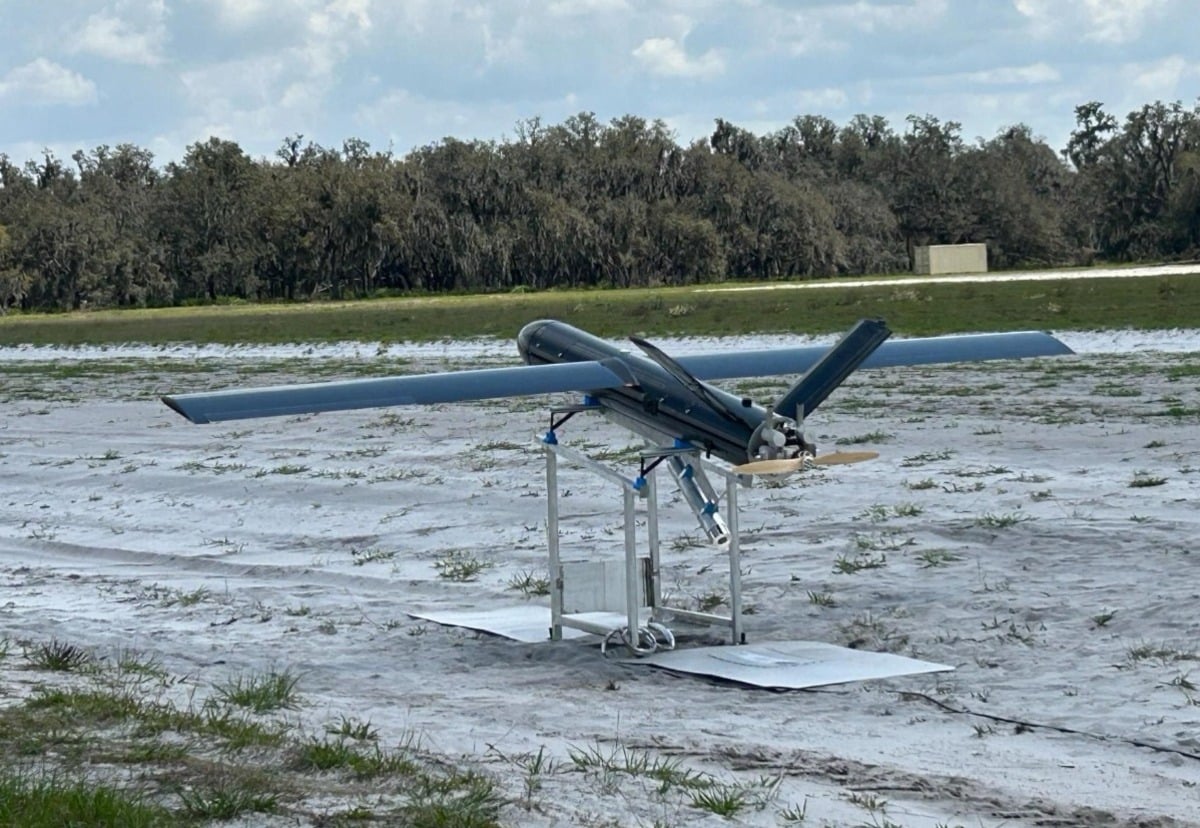
X-Bow’s RATO system, branded RATO² for Rapidly Assembled Tactical Option for Rocket-Assisted Takeoff, combines solid rocket motors with launch cradles for unmanned aircraft. The company has said the system uses proprietary additive-manufactured solid propellant, a method that builds propellant geometry layer by layer through a process comparable to industrial 3D printing rather than relying only on traditional casting or pressing.
The manufacturing approach is central to X-Bow’s pitch. In a solid rocket motor, the internal shape of the propellant affects how the motor burns, how thrust rises, and how long the burn lasts. Additive manufacturing can allow more control over those internal shapes, at least in principle, while reducing tooling and setup burdens that slow conventional production lines when orders surge.
X-Bow has described the AEVEX work as the first high-volume use of additive-manufactured solid propellant for a Group 3 unmanned aircraft system. That is a company claim, but the production pace now gives it more weight than a laboratory demonstration or trade-show concept. Moving from hundreds of motors to more than 1,100 delivered units suggests the company has crossed from prototype manufacturing into repeat production, even if many details remain commercially or militarily sensitive.
The AEVEX contract announced in April called for hundreds of RATO production kits and thousands of solid rocket motors and components, with deliveries scheduled between March and August 2026. That timeline was unusually compressed for defense hardware, especially hardware involving energetic materials, which must pass safety, quality, and performance checks before it can be handled by military users.
X-Bow’s announcement does not disclose how many of the 1,100 motors went to AEVEX, how many were assigned to other customers, or how many have been used in operational launches.