

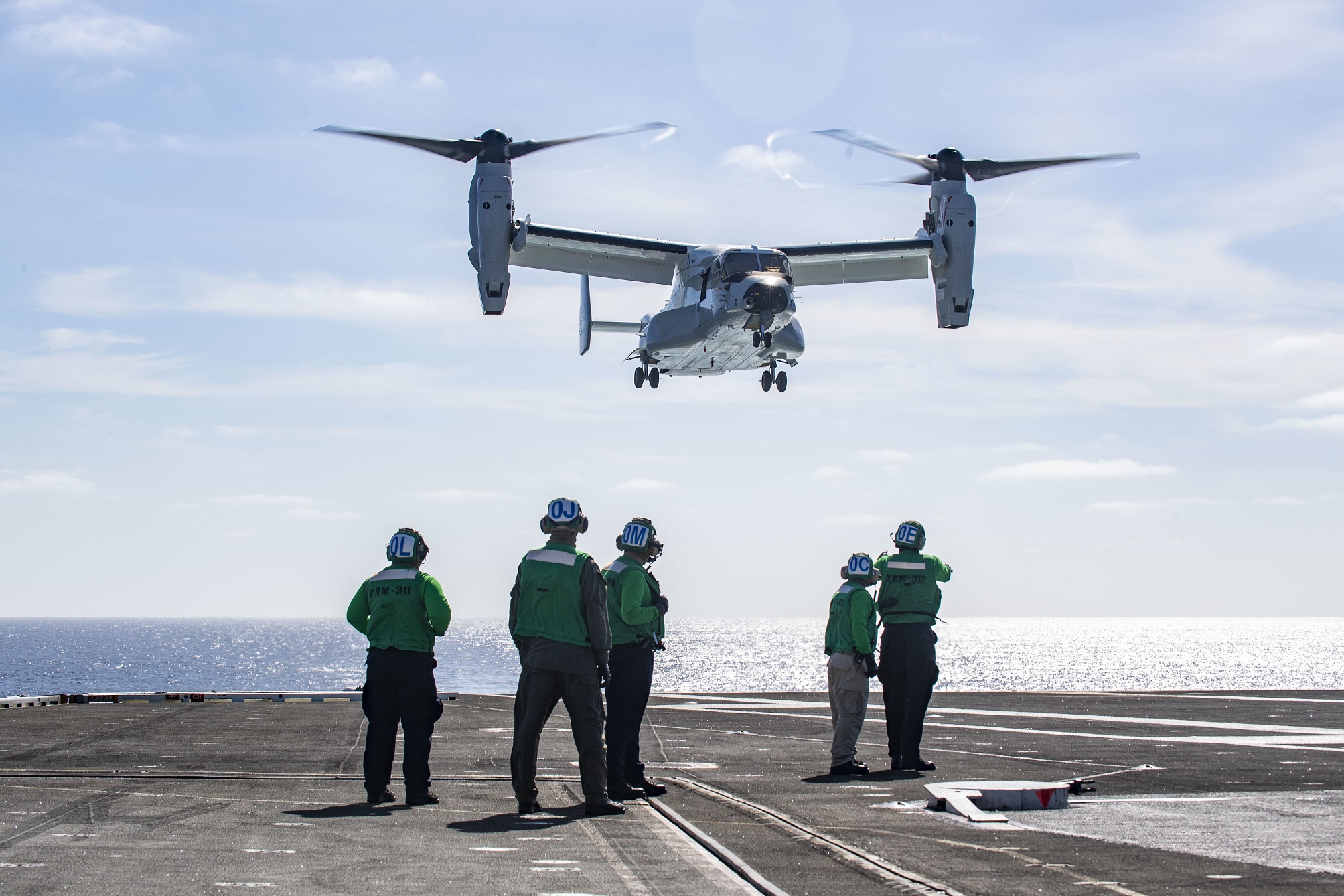
A U.S. Navy CMV-22B Osprey tilt-rotor aircraft conducted its first take-off from an aircraft carrier, according to a press release issued Friday by the service press department.
For the first time, the Navy version of the Osprey, vertical takeoff and landing (VTOL) tilt-rotor aircraft conducted the first ever landings, take-offs, and refueling from the flight deck of Nimitz-class nuclear aircraft carrier USS Carl Vinson (CVN 70).
This evolution marked the first time the Navy’s CMV-22B Ospreys have landed on a carrier.
Under the guidance of the Fleet Logistics Multi-Mission (VRM) Wing, Navy pilots and maintainers trained with Marine Corps pilots and maintainers who have operated with the MV-22 since 2007.
“This is the one of many firsts that VRM-30 and the VRM community will attain as we move to transition from the venerable C-2A Greyhound to the capable CMV-22 Osprey,” said Capt. Dewon Chaney, commodore, VRM Wing. “What the Sailors have accomplished here is inspiring given the tight timeline for these milestones and the complexity of this aircraft. The Marines have flown this aircraft for decades and we are leveraging that experience to springboard into supporting the advanced carrier air wing.”
Compared to the C-2A, the CMV-22B offers increased operational range – capable of transporting cargo and passengers as far as 1,150 nautical miles, increased survivability, enhanced beyond-line-of-sight communications, greater cargo capacity, and faster cargo loading/unloading.
“The landings, take-offs, and refueling were a culmination of well-planned strategic efforts to bring increased capabilities to the fleet,” said Cmdr. Steven Parente, commanding officer, VRM-30. “The CMV-22B will deliver lethality to the fleet, and enable the carrier strike group to achieve dominance across the air, land, and sea through the provision of high priority cargo and personnel from shore bases to aircraft carriers at sea. Additionally, the increased flexibility and capabilities of the CMV-22B will further expand the carrier strike group’s influence and agility, broadening its ability to meet a wide array of operational tasking.”
VRM-30 is projected to reach initial operational capability in 2021 and deploy as part of Carrier Air Wing (CVW) Two embarked aboard Carl Vinson, under the command of Carrier Strike Group (CSG) One.
“This is an exciting time for our Navy and especially for carrier strike groups,” said Rear Adm. Timothy J. Kott, commander, CSG 1. “The MV-22 Osprey has already proven effective in a wide range of operations, including humanitarian assistance and disaster relief, amphibious assault, and medical evacuation missions. We are eager to take full advantage of the Navy’s variant of the Osprey, which gives us options we did not have before.”
As the Carrier Onboard Delivery (COD) aircraft, the CMV-22 will transport personnel, mail, supplies and high-priority cargo from shore bases to aircraft carriers at sea.
“The CMV-22B is a great addition to the advanced carrier air wing,” said Capt. Matt Thrasher, commander, CVW-2. “With our increased capacity of the E-2D Advanced Hawkeye and EA-18G Growler, kinetic capacity of the FA-18 E/F Super Hornets, fifth generation capabilities of the F-35C Lightning II, and the agile logistical support of the CMV-22B Osprey, CVW-2 provides the most modern and lethal capabilities to the strike group and fleet commanders.”
In order to support fifth generation aircraft, Vinson received major upgrades during a 17-month maintenance availability, making Vinson the first aircraft carrier equipped to support both the F-35C Lightning II and the CMV-22B Osprey.
“These historic events are all in support of one goal,” said Capt. Matthew Paradise, Vinson’s commanding officer. “Ensuring our personnel are well equipped and well taken care of. Having the newest technology, coupled with the superb skill of our personnel, is what continues to ensure we are the mightiest Navy in the world.”
