


U.S. Marines and Swedish amphibious troops conducted joint island assault and reconnaissance drills this month as part of Exercise Archipelago Endeavor 2025, reinforcing their interoperability and advancing future littoral combat tactics.
According to the U.S. Marine Corps, Marines from Alpha Company, 2d Light Armored Reconnaissance Battalion, 2d Marine Division, were inserted aboard Swedish CB90 fast assault craft to conduct an island raid near Korsö on September 7.
A day earlier, Marine units had carried out reconnaissance operations to prepare for the coordinated assault. The activity forms part of a larger bilateral exercise that has become a recurring training event since its inception in 2018.
The Swedish Armed Forces said the annual exercise has evolved into a key platform for strengthening ties between Sweden and the United States, particularly in the context of amphibious operations. Swedish participants included elements from the 2nd Amphibious Battalion and the 2nd Naval Base Battalion. The U.S. contingent operates under Marine Rotational Force – Europe (MRF-E).
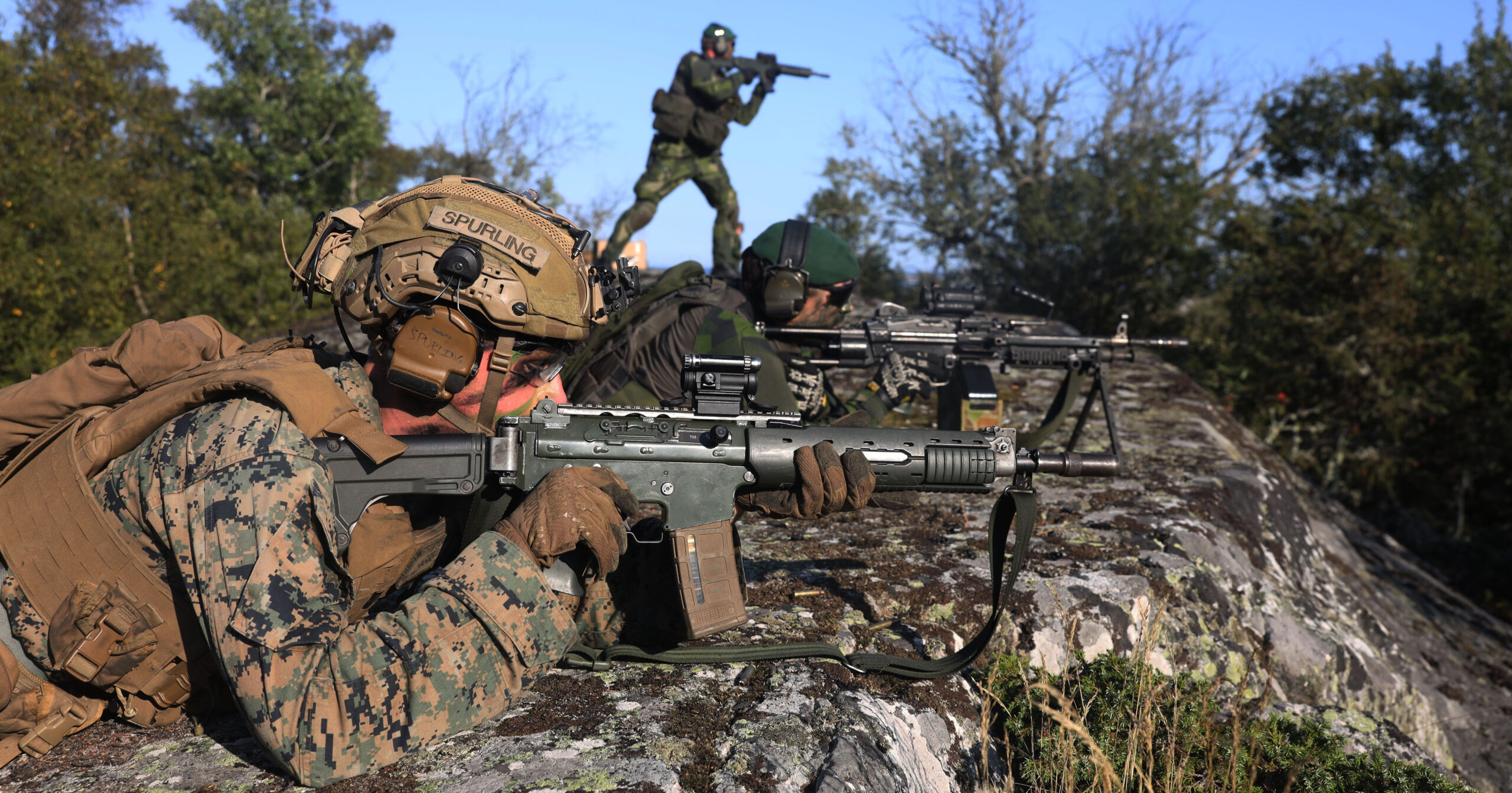
The Swedish Navy described the 2025 edition of the exercise as focused on enhancing future amphibious warfare capabilities. The training scenario includes coordination between sea-based and land-based units, long-range fires integration, and the testing of new command and control structures.
In a statement, Rear Admiral Johan Norlén, Chief of the Swedish Navy, said:
“Sweden is a strong and reliable partner to the United States and a capable NATO ally. Through partnerships like this, we demonstrate that we are ready to defend our own and the alliance’s territory and contribute to regional security.”
Exercise Archipelago Endeavor 2025 marks the seventh iteration of the series and reflects deepening military cooperation between Sweden and the United States, particularly following Sweden’s entry into NATO earlier this year.
The U.S. Marine Corps emphasized that the training provides both nations’ forces with an opportunity to sharpen their skills in complex coastal environments, which are increasingly important in light of evolving strategic conditions in Northern Europe.
The training comes amid growing concern over maritime access and control in the Baltic Sea, where NATO nations are adjusting their posture in response to security developments following Russia’s full-scale invasion of Ukraine in 2022.