

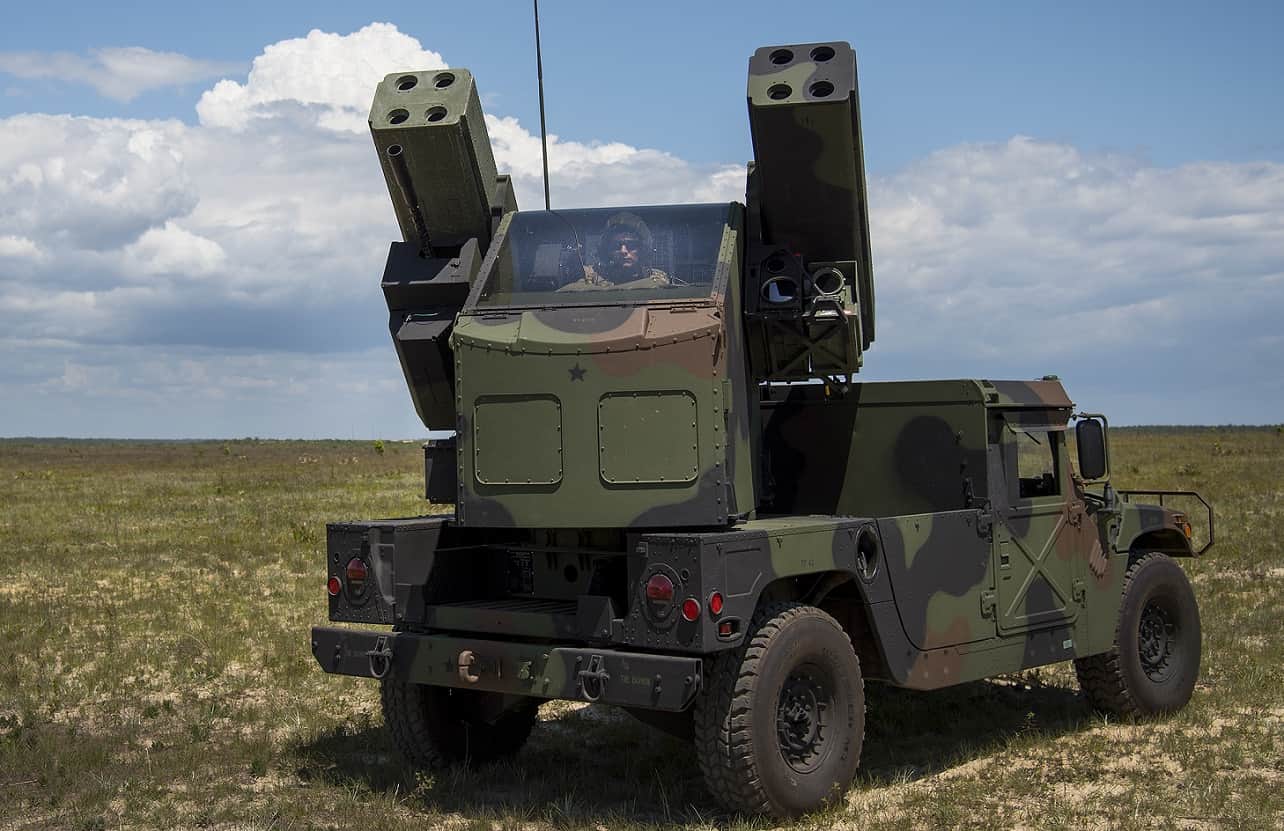
The Army News Service has confirmed that the U.S Army has plans to upgrade all its Avenger short-range air defense systems.
The Avenger is a surface-to-air missile system often mounted on a High Mobility Multipurpose Wheeled Vehicle, commonly known as the Humvee. The combined weapon system provides mobile protection against missiles, low-flying aircraft and most recently – unmanned aerial vehicles.
The Avengers have multiple optics, range-finders and a forward-looking infrared receiver or FLIR monitor. It’s difficult to see some of the smaller drones with the naked eye, Sgt. 1st Class Arianna Cook, senior career advisor for 14Ps at the ADA School said, whereas radars can pick them up and direct the Avenger turret to lock onto them.
When the Avengers were pulled out of depot storage last year, some were modified with a new “Slew-to-Cue” Avenger Targeting Console. This enables the turret to automatically turn and lock onto targets provided by remote radars, Cook said.
“A Soldier still needs to pull the trigger though,” she said.
The remainder of the Avengers that didn’t get Slew-to-Cue last year will receive it as part of an ongoing two-phase Modification Service Life Extension Program known as SLEP, said Holler. All Avenger consoles should be upgraded by the end of September 2020, he said.
The second phase of the SLEP upgrade includes installation of a Mode 5 Identification Friend or Foe, a new fire-control computer, and converting analog communications equipment in the Avengers to digital communications. It also includes a new air-conditioning and heating unit and a new .50-caliber machine gun. The Phase II upgrades are scheduled to begin in the 4th quarter of FY 2020 and continue through FY 2023, Holler said.
Along with the battalion of Avengers that stood up last year in Germany, the active Army also has four separate Avenger batteries: one in Korea, one at Fort Sill, one at Fort Campbell, Kentucky; and one with the Global Response Force at Fort Bragg, North Carolina.
In addition to Avenger upgrades, proximity fuses are being installed in some of the Stinger missiles, Holler said. Stingers with proximity-fuse warheads will have greater lethality against small drones and unmanned aerial vehicles, he explained.