

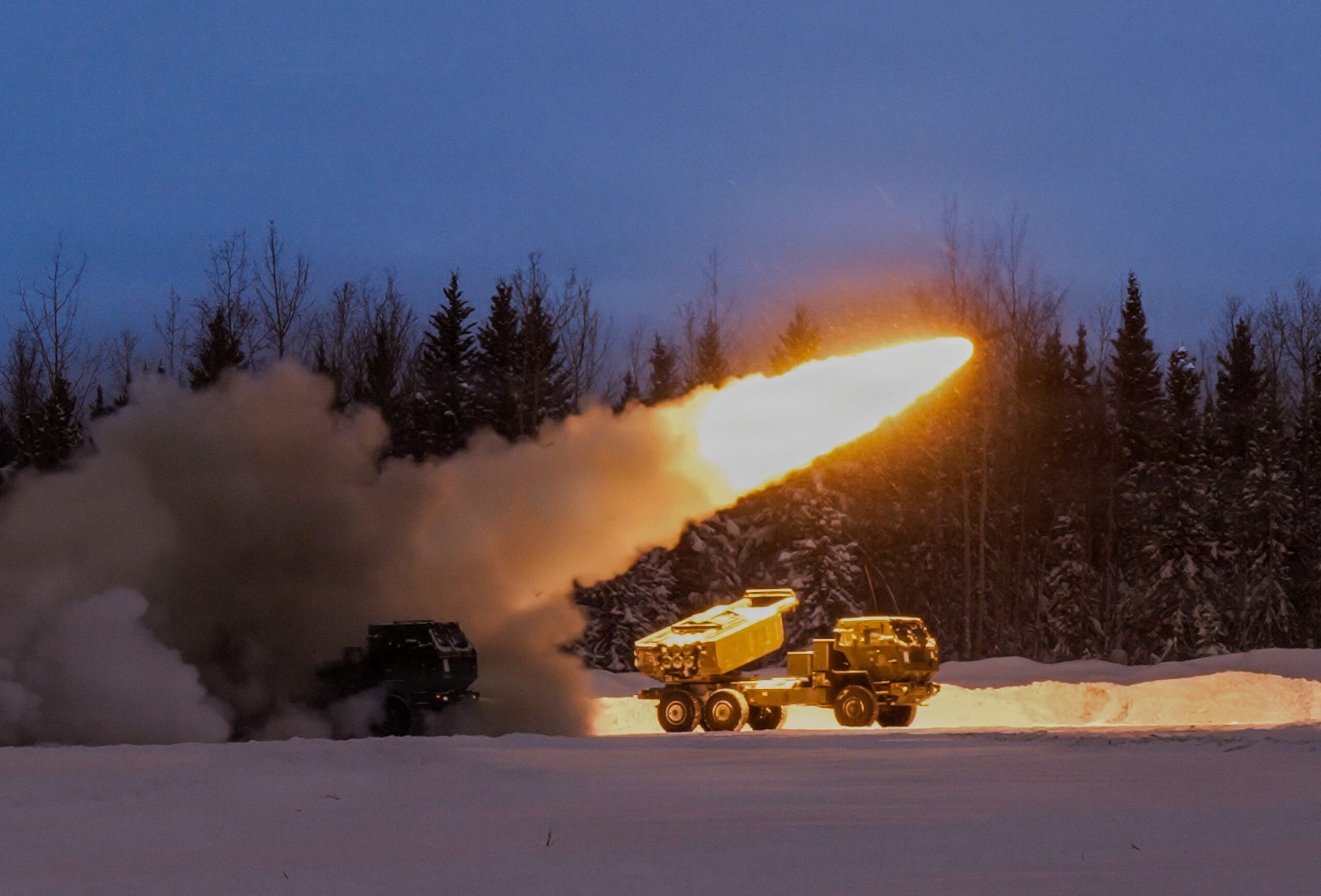
- United States Army soldiers conducted a HIMARS ground raid live-fire mission during Arctic exercise JPMRC 26-02 in Alaska to validate long-range precision fires in extreme cold conditions.
- The exercise demonstrated the ability of the 17th Field Artillery Brigade to deploy and operate HIMARS alongside the 11th Airborne Division despite equipment challenges caused by freezing temperatures and harsh terrain.
Soldiers assigned to the United States Army’s 17th Field Artillery Brigade conducted a ground raid mission using the High Mobility Artillery Rocket System (HIMARS) during Joint Pacific Multinational Readiness Center (JPMRC) 26-02 in Alaska, validating long-range precision fires in extreme Arctic conditions while supporting the 11th Airborne Division, the Army said.
The live-fire event focused on testing the brigade’s ability to rapidly deploy and employ HIMARS launchers in cold-weather environments where terrain, temperature, and logistics create operational constraints. The training reflects ongoing efforts by U.S. forces to maintain readiness in Arctic regions considered increasingly important for military mobility and deterrence operations.
According to an official Army release, the ground raid live fire demonstrated the brigade’s capability to “rapidly deploy, integrate and deliver accurate long range fires across extended distances despite extreme cold temperatures and challenging terrain.” Operating alongside elements of the 11th Airborne Division, the exercise reinforced the division’s ability to conduct combat operations in one of the Army’s most demanding environments.
The Army said integrating long-range fires into Arctic training ensures forces remain prepared to respond quickly in contested environments. Exercises such as JPMRC 26-02 are designed to validate systems, refine operational tactics, and confirm units can function effectively under severe cold-weather conditions.
Captain Benny Rodriguez, battery commander for the 17th Field Artillery Brigade based at Joint Base Lewis-McChord, Washington, emphasized the operational value of expeditionary training during the exercise. “It tests our ability to project power into austere environments, forcing us to confront and solve complex problems that we simply cannot simulate at our home station,” Rodriguez said.
During the mission, Arctic temperatures created technical challenges for HIMARS launchers, including freezing key components that threatened operational timelines. The Army said coordination with the 11th Airborne Division and the 354th Operations Support Squadron’s Airfield Operations Flight enabled the unit to secure resources needed to keep launcher systems within operational temperature limits, allowing the live fire to proceed successfully.
“Our battalion’s motto is ‘flexible,’ and this exercise made that word resonate with every Soldier in this Battery,” Rodriguez said, describing how personnel adapted to environmental obstacles encountered during the mission.
The HIMARS system is a truck-mounted rocket artillery platform designed to deliver precision-guided rockets and missiles at extended ranges. Its mobility allows units to conduct rapid “shoot-and-scoot” operations, reducing exposure to counterfire while maintaining the ability to support maneuver forces across dispersed battlefields. In Arctic operations, mobility and rapid deployment become especially important due to limited infrastructure and harsh terrain conditions.
Ground raid missions involving HIMARS simulate expeditionary deployments in which launchers move quickly into forward positions, conduct precision strikes, and redeploy before adversary forces can respond. Such scenarios are intended to replicate large-scale combat operations where long-range fires play a central role in shaping the battlefield and supporting airborne or light infantry formations.
The 11th Airborne Division, often referred to as the Army’s Arctic-focused formation, regularly trains in Alaska to maintain operational capability in cold-weather environments. Integrating artillery brigades with airborne forces allows commanders to synchronize maneuver and precision fires under conditions that differ sharply from temperate training locations.
Arctic training has gained attention as military planners emphasize the need for forces capable of operating across multiple climates and contested regions. Extreme cold affects equipment reliability, communications systems, fuel consumption, and personnel endurance, making realistic training necessary to identify limitations before deployment.