

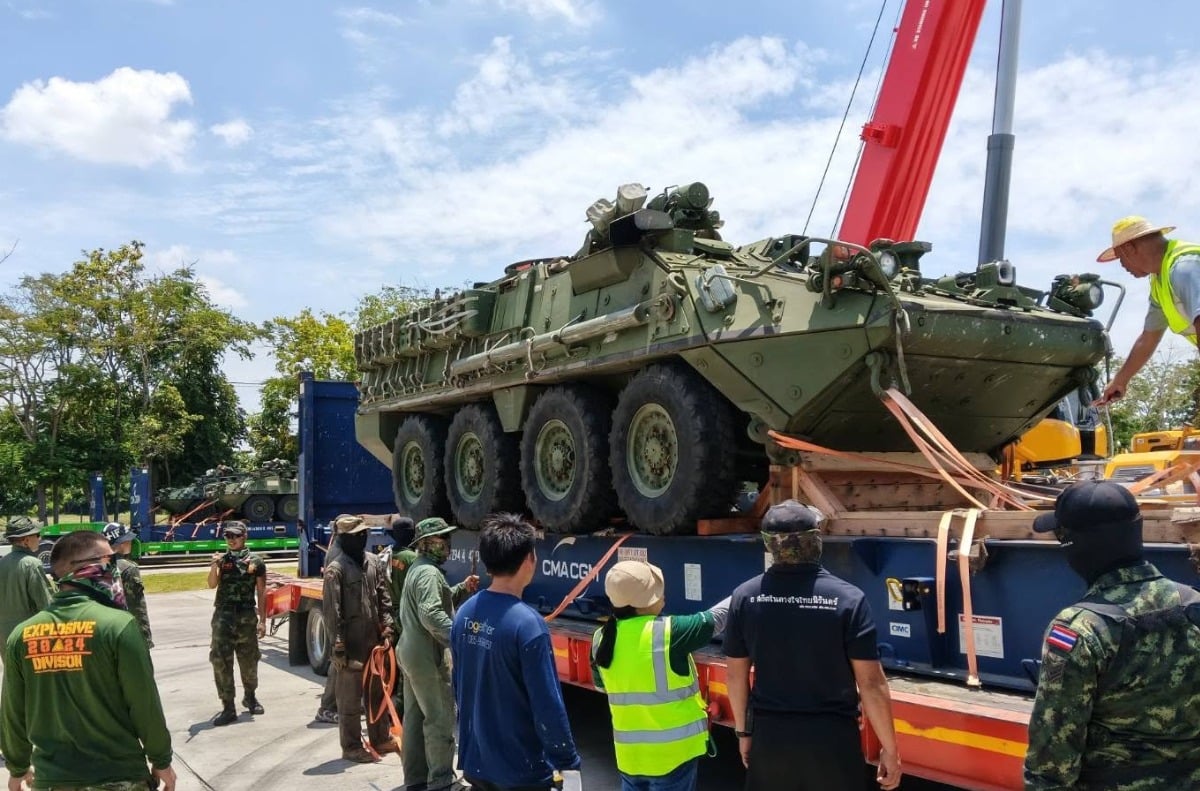
- The Royal Thai Army's 11th Infantry Division Support Regiment confirmed 19 U.S. Stryker vehicles arrived under the Excess Defense Articles program's Foreign Military Sale Phase 1.
- The shipment includes 10 Infantry Carrier Vehicles, 4 Reconnaissance Vehicles, 4 Command Vehicles and 1 Medical Evacuation Vehicle, now awaiting refurbishment.
Thailand’s military has confirmed the arrival of a new batch of American Stryker armored vehicles, resolving the mystery behind the grainy port videos that had been circulating on social media earlier this week.
The Royal Thai Army’s 11th Infantry Division Support Regiment posted the confirmation on its official Facebook page, saying its maintenance battalion deployed a repair team to help move 19 Stryker vehicles to a motor pool at Infantry Regiment 112 to await future refurbishment, part of the same U.S. Excess Defense Articles program that sent Thailand its last shipment back in March.
According to the unit’s post, the 19 vehicles arrived under Phase 1 of a Foreign Military Sale tied to the Excess Defense Articles program, the same Pentagon initiative that transfers surplus American military equipment to allied nations at reduced or no cost while the receiving country covers shipping, refurbishment and maintenance. The breakdown gives a clearer picture of what Thailand is actually building out than the earlier unverified footage could show on its own.
Ten of the vehicles are Infantry Carrier Variants, the standard troop-transport version of the Stryker built to move roughly nine soldiers into a fight while offering more protection than Thailand’s aging fleet of tracked personnel carriers. Four are Reconnaissance Vehicles, equipped to scout ahead of the main force and report back on enemy positions and terrain. Another four are Command Vehicles, which function as mobile command posts packed with communications equipment that let officers coordinate a battle from inside the protected hull rather than exposed in the open. The final vehicle is a Medical Evacuation Variant, built to pull wounded soldiers off the battlefield inside an armored shell rather than relying on a soft-skinned ambulance.
A Stryker unit built around just troop carriers can move infantry, but it can’t scout ahead of itself, coordinate effectively across a wide area, or evacuate its own wounded without borrowing capability from another unit entirely. Rounding out this batch with reconnaissance, command and medical variants alongside the carrier vehicles suggests Thailand is filling out a more complete, self-sufficient Stryker formation rather than simply adding numbers to its carrier fleet, a distinction that matters for how independently a Thai mechanized unit can actually operate once these vehicles are repaired and fielded.
Thailand has steadily built out its Stryker fleet since becoming the vehicle’s first foreign military sales customer in 2019, when the U.S. State Department approved a $175 million sale of 60 vehicles intended to replace the Royal Thai Army’s aging M113 tracked personnel carriers. That original purchase laid the groundwork for the dedicated Stryker regiments the Thai Army has built since, including its 111th and 112th Stryker Regiment Combat Teams, and continuing shipments like this one suggest Thailand intends to keep expanding that capability well beyond its initial order rather than stopping once the original 60 vehicles arrived.