

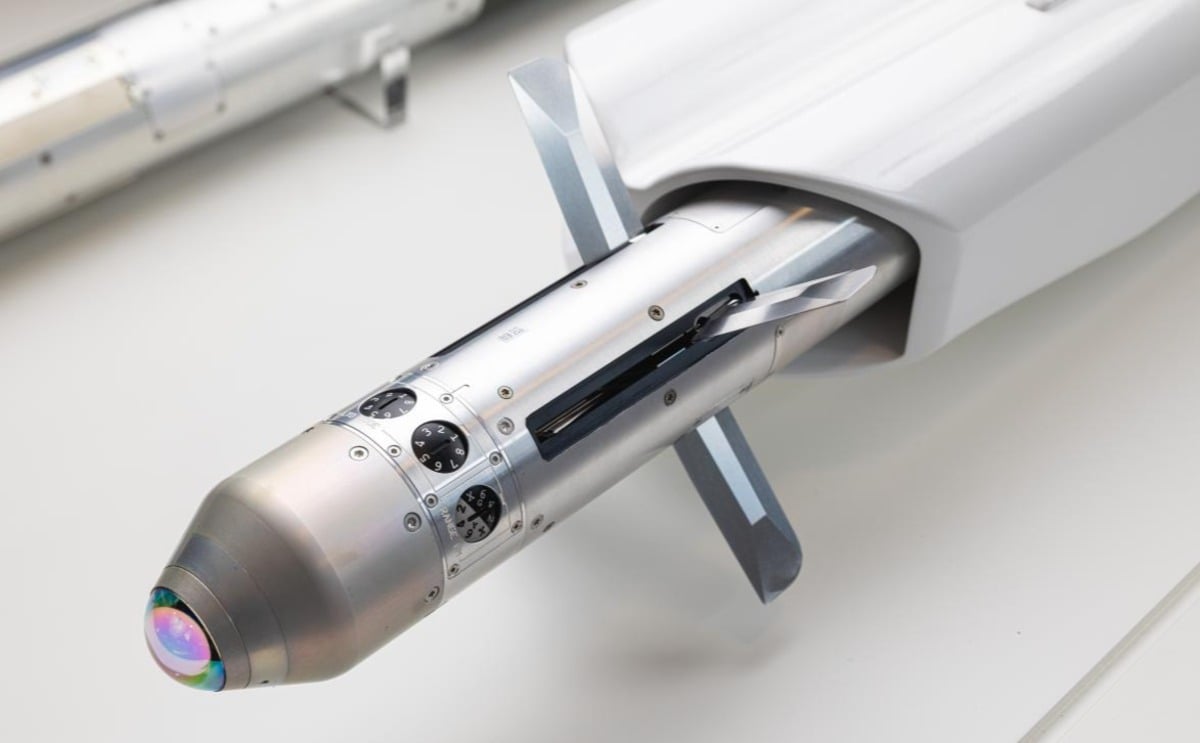
- Thales unveiled the LGR275 Proxy, a 70 mm laser-guided counter-drone rocket, at Eurosatory in Paris on June 15, 2026.
- Thales Belgium plans to triple guided rocket production capacity to 20,000 units a year by 2028.
Thales has unveiled a new way to shoot down cheap drones without burning through expensive ammunition to do it, unveiling the LGR275 Proxy at the Eurosatory defense show in Paris.
The system is a 70 mm laser-guided rocket fitted with a proximity sensor, built specifically to knock small unmanned aircraft out of the sky at a fraction of the cost of a traditional surface-to-air missile, and it lands at a moment when air defense planners across NATO are grappling with exactly the problem it claims to solve.
That problem has a name in defense circles: the cost-imbalance problem. A Shahed-style attack drone built in Iran or Russia can cost a few tens of thousands of dollars, while the missile interceptors many air defense systems use to bring one down often run into the hundreds of thousands or millions. Ukraine has spent more than three years learning this math the hard way, watching adversaries launch swarms of low-cost drones specifically designed to provoke defenders into firing million-dollar missiles at machines worth a tiny fraction of that price. Thales says the LGR275 Proxy is meant to close that gap, pairing laser guidance with a proximity sensor and what the company calls a military-grade warhead optimized for aerial targets, so that the rocket can detonate near a fast-moving drone rather than requiring a precise impact, which becomes especially difficult against small, erratic targets at speed.
The new rocket builds directly on hardware that has already seen combat. Its baseline is Thales Belgium’s FZ275 LGR, a 70 mm semi-active laser-guided rocket that the company has already supplied to Ukraine in a related counter-drone configuration fitted with an airburst warhead designed to shred Shahed-type loitering munitions with a cloud of steel fragments roughly 24 meters (80 feet) wide. That rocket family is also compatible with launch platforms already fielded by Western militaries, including L3Harris’ VAMPIRE truck-mounted counter-drone system, which fired Thales Belgium 70 mm rockets in testing earlier this year, and Thales’ own RapidStriker ground vehicle, unveiled at the same Eurosatory show, which pairs guided and unguided 70 mm rockets with a gun turret for a layered response to drone threats ranging from precision intercepts to lower-cost saturation fire.
What sets the LGR275 Proxy apart is the proximity sensor, a feature aimed squarely at the kind of small, erratic Class 1 and Class 2 drones that NATO threat categories define as the smallest and most numerous unmanned aircraft on the battlefield, the same drones that conventional impact-fuzed weapons often struggle to hit directly because they are slow to detect, quick to maneuver, and easy to mistake for birds or debris on radar. Thales says the rocket works for both air-to-air and surface-to-air engagements, meaning it can be fired from an aircraft or helicopter at another aircraft, or from the ground at a target overhead, giving militaries a single round that fits multiple launch platforms rather than separate weapons for separate missions.
Thales Belgium is backing the announcement with a serious production commitment, telling reporters it will triple its 70 mm guided rocket manufacturing capacity between 2026 and 2028, with assembly work split between facilities at Herstal and Fort d’Evegnée in Belgium. Company officials have said they expect guided rocket output to reach 20,000 units a year by 2028, or roughly 100 rockets rolling off the line every production day, a scale that reflects how seriously European defense manufacturers are now treating drone defense as a sustained industrial requirement rather than a one-off emergency response. Thales Belgium already produces around 30,000 standard 70 mm rockets annually and has said it could double that figure if its supplier base can keep pace, underscoring how quickly demand for this category of weapon has outpaced what the company originally built capacity to deliver.
Alain Quevrin, country director for Thales Belgium and Luxembourg, framed the launch as a continuation of an established product line rather than a clean-sheet design. “Building on our already proven laser-guided rocket solutions, Thales provides a solution to strengthen nations’ defence readiness against drone threat, one of the key challenges of our times. Thales Belgium is the leader in NATO standard rockets and our solid production ramp-up allows us to meet the needs of the armed forces,” Quevrin said.
The LGR275 Proxy also slots into a larger system Thales has been building out called SkyDefender, an AI-assisted command-and-control platform designed to coordinate sensors and effectors across multiple domains so that radar, laser designators, and rocket launchers can work together against a single incoming threat rather than operating as isolated pieces of equipment. Thales has described SkyDefender as a multi-layer, multi-domain air and missile defense dome, language that signals an ambition to compete with broader integrated air defense architectures rather than just sell individual rockets, and the LGR275 Proxy gives that system another low-cost effector to draw on when the threat is a swarm of small drones rather than a single high-value missile.