

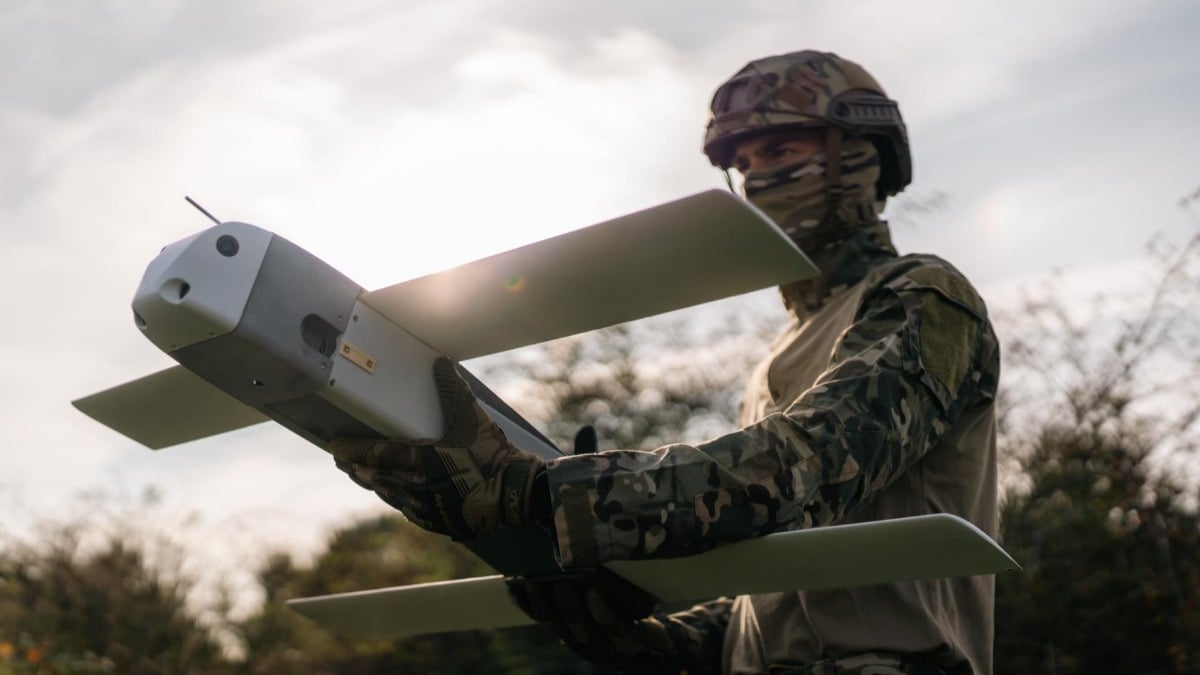
- Thales and Renault Group signed a partnership on June 16, 2026, to mass-produce the TOUTATIS loitering munition in France.
- Production could start in 2027 with a target capacity of 1,000 units per month within the first year, the companies said.
Thales and Renault Group are joining forces to mass-produce a French kamikaze drone, betting that the country’s largest carmaker can do for loitering munitions what it has long done for hatchbacks: build them at scale and at optimized cost.
The two companies signed a partnership agreement on June 16, 2026, to jointly develop and industrialize large-scale manufacturing of Thales’ TOUTATIS loitering munition, a short-range strike drone that the partners want flowing off assembly lines by the thousand.
The real story is in the production numbers, which dwarf anything France has managed in this category so far: under the deal, production could start as early as 2027, and the companies say capacity could reach 1,000 units per month from the first year, a figure that represents an order-of-magnitude jump from how France has historically built loitering munitions.
For comparison, France’s DAMOCLES short-range remotely operated munition program, developed by KNDS France and Delair, foresees 460 units delivered to the armed forces by July 2026, the result of a multi-year development cycle. Thales and Renault are now proposing a single production line capable of building more than double that entire fleet every month, even though DAMOCLES and TOUTATIS come from different programs and different design lineages.
TOUTATIS itself is not a new concept but a system Thales has been quietly maturing for years: the company first showed it publicly at Euronaval in 2024, developed in partnership with French drone maker Aeromapper, and has spent more than two years refining it through successive defense trade shows.
The munition weighs around 5 kilograms (11 lb), can be carried and launched by a single soldier from a tube, and folds its 850 mm (33 in) wingspan down for transport. It is tube-launched, can also be fired from combat vehicles, helicopters, naval platforms or other drones, and carries a 1 kilogram (2.2 lb) warhead capable of disabling lightly armored vehicles or, according to Thales, heavier armor depending on the warhead variant fitted. In its standard configuration it has a range of roughly 10 km (6.2 miles) and more than 30 minutes of flight endurance; an extended version pushes that out past 30 km (18.6 miles). Thales says the system resists GPS jamming and electronic warfare, a feature that has become a baseline requirement rather than a luxury since Russian and Ukrainian forces began routinely jamming each other’s drone links across the front.
That jamming problem is exactly why loitering munitions like TOUTATIS have become one of the hottest categories in Western defense procurement. The weapons occupy a niche between artillery and traditional guided missiles: cheaper than a precision-guided shell, more loitering and adjustable than a one-shot rocket, and able to circle a target area while a human operator decides whether and when to strike. Russia’s use of Iranian-designed Shahed drones and Ukraine’s own rapidly scaled domestic drone industry turned the loitering munition from a niche capability into a mass-production requirement almost overnight, and France has been scrambling to catch up ever since. Paris launched the Colibri program back in 2022 specifically to fast-track a domestic loitering munition, eventually selecting MBDA-Novadem and KNDS-Delair as initial winners. Thales was not chosen for that program and kept developing TOUTATIS independently, which makes this new partnership with Renault something of a vindication for a system that missed the first government cut but is now positioning itself for one of the largest production efforts in the segment.
Renault’s role is the more unusual part of this story, since car manufacturers do not typically end up building munitions, but the company’s chief executive, François Provost, framed the move as a natural extension of what Renault already does well. “Renault Group brings its industrial expertise to the TOUTATIS project, along with the highest standards of automotive manufacturing, to design, industrialise and produce at scale, within shortened timelines and at optimised costs,” Provost said. The pitch is straightforward: automotive assembly lines are built for exactly the kind of high-volume, cost-controlled, just-in-time production that a wartime drone program suddenly needs, and Renault has decades of expertise in squeezing efficiency out of complex supply chains that Thales, primarily a sensors-and-systems company, does not have in-house at the same scale.
Thales chairman and CEO Patrice Caine described the agreement as part of a broader buildout of sovereign capability. “This partnership with Renault Group marks an important milestone in strengthening sovereign, large-scale, world-class capabilities in the field of drones,” Caine said, adding that combining “Thales’ excellence in advanced technologies with Renault Group’s industrial strength” would let the companies meet both military requirements and what French officials have taken to calling the “wartime economy,” a term that has crept into French industrial policy since 2022 to describe defense production scaled and funded as though the country were actively fighting a war rather than preparing for a hypothetical one.