

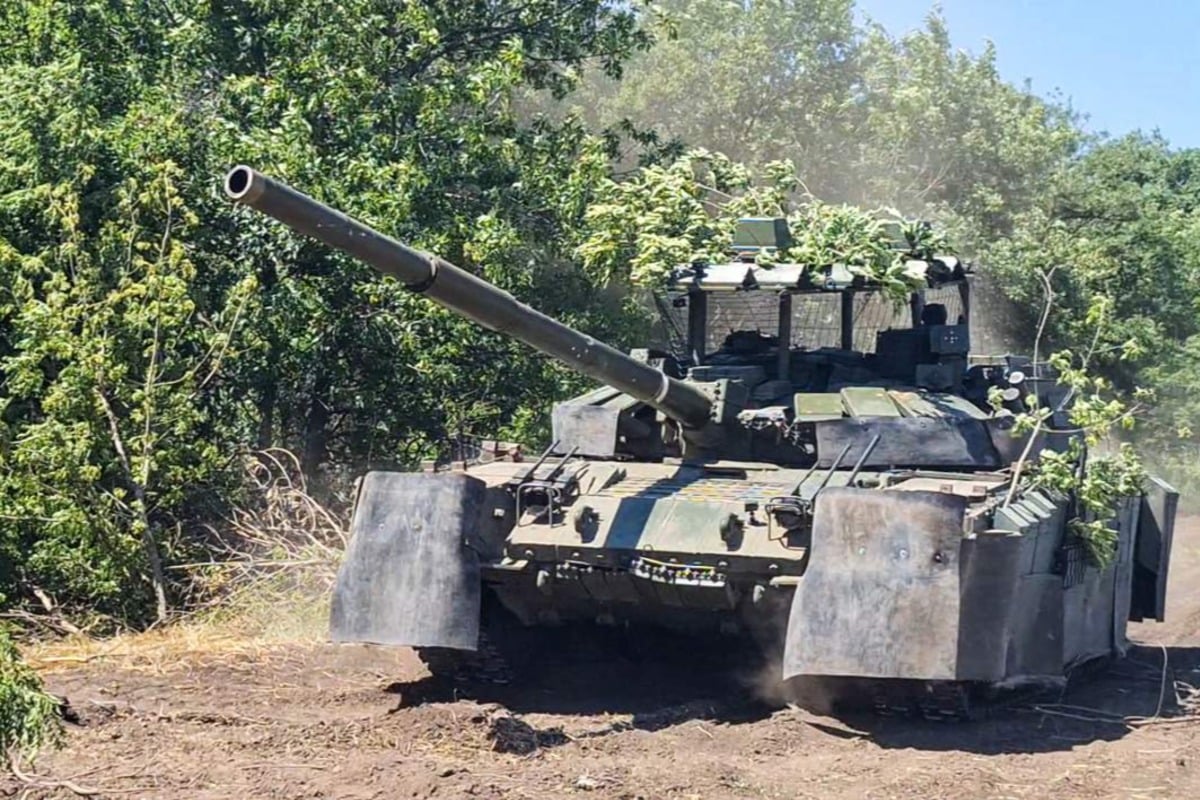
- Russian media confirmed that frontline units received T-72B3A tanks equipped with an upgraded Arena-M active protection system.
- The system reportedly uses radar switching between long-range and short-range modes to detect both missiles and FPV drones before firing defensive countermunitions.
Russian state-aligned outlet Izvestia has confirmed that Russian military units operating on the front have received T-72B3A tanks equipped with an upgraded version of the Arena-M active protection system, and that crews are now undergoing additional training before the vehicles are sent to support assault groups attacking fortified Ukrainian positions.
Arena-M belongs to a category of armor defense called a hard-kill active protection system, a technology that works fundamentally differently from the passive armor plating most people picture when they think of tank protection. Rather than simply absorbing an incoming strike, the system uses radar to detect an approaching threat, calculates its flight path, and then fires a small explosive countermunition timed to intercept and destroy the incoming projectile before it ever reaches the tank.
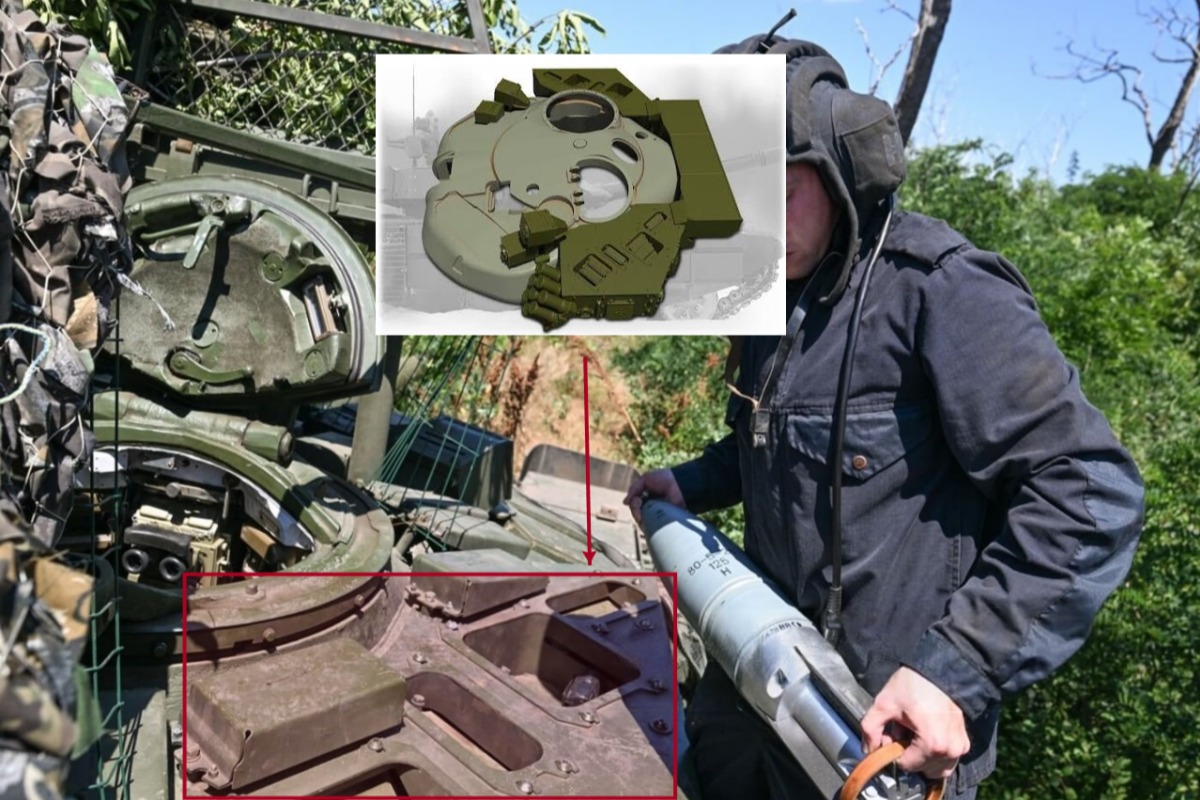
According to Izvestia’s reporting, the radar cycles between two operating modes, a long-range setting built to catch incoming missiles and artillery shells with enough advance warning to react, and a short-range setting specifically tuned to search for FPV drones, the small first-person-view quadcopters that Ukrainian forces pilot directly into tanks and armored vehicles at close range. The system reportedly carries 12 launch tubes positioned around the turret, arranged to provide protection against threats approaching from any direction rather than leaving blind spots an attacker could exploit.
The modernized system, internally designated T09-A6-1, entered qualification testing in 2024, when it was first fitted to Russia’s core T-72 and T-90 main battle tanks, and Russia signed a state contract at the Army-2024 military-technical forum to produce T-90M tanks equipped with the system. By 2025, a representative from tank manufacturer Uralvagonzavod confirmed at the IDEX defense exhibition that vehicles were already rolling off the production line with the new protection system installed, and Russia’s Ministry of Defense had patented an upgraded T-72B3M variant carrying Arena-M as early as October 2023, a vehicle that later received the T-72B3A designation now appearing on the front line.
Izvestia quoted several Russian military analysts framing the deployment as a meaningful shift in how Russia protects its armored vehicles. Military expert Yuri Lyamin argued that what matters most is where these tanks are actually going.
“It is important that tanks with the active protection system arrived specifically at units carrying out combat missions, not put on display at exhibitions or parades,” Lyamin said, according to Izvestia. “Right now the main threat to armored vehicles is small tactical drones. The ability to effectively fight them will help preserve not just the vehicles themselves, but the lives of their crews.”
Military expert Yuri Knutov described the technology as a substantial leap forward for Russian armor more broadly.
“Such systems multiply the combat capabilities of tanks many times over,” Knutov said, according to Izvestia.
A third expert, Dmitry Kornev, characterized the upgraded system as giving tanks an entirely new category of self-defense capability.
“In effect, the tank receives its own air defense and missile defense system,” Kornev said, according to Izvestia. “It is capable of independently repelling attacks from anti-tank missiles, rocket-propelled grenades, artillery munitions, and, especially important today, drones.”
Lyamin also argued that Russia’s approach differs meaningfully from similar systems under development elsewhere, pointing specifically to the drone-defeat capability as a distinguishing factor. “Active protection systems are being worked on today in Israel, China, and other countries,” Lyamin said, according to Izvestia. “However, their effectiveness against FPV drones has not yet received convincing confirmation under real combat conditions.”
That claim of superiority over foreign systems sits awkwardly alongside a body of independent reporting, including prior coverage from The Defence Blog itself, documenting serious and specific technical problems with exactly the capability Izvestia’s sources are now promoting. Russian defense analyst Viktor Murakhovsky, in commentary reported by Defence Blog in November 2025, said Arena-M’s radar has struggled fundamentally to detect and classify small, low-visibility drone targets, particularly ones built from radio-transparent materials like plastic, describing detection capabilities at that level as something Russian radar technology “had not yet achieved.” Murakhovsky specifically noted that conventional radar detection methods, including Doppler-based systems that work well against fast-moving missiles, perform poorly against drones that move slowly and unpredictably at low altitude, precisely the flight profile an FPV drone pilot uses to approach a tank. Military vehicle historian Andrey Tarasenko pushed the criticism further in commentary on his Telegram channel, arguing that since every FPV drone carries a metal warhead by necessity, a radar system that cannot detect that combination points to deeper problems with the system’s core sensors rather than simply a drone-specific blind spot.
Russian state media has a clear incentive to frame any new protection technology as a battlefield-ready solution to the drone threat that has proven devastatingly effective against Russian armor throughout this war, but the gap between that framing and the specific, named technical criticism raised by Russia’s own military analysts just months earlier suggests the real answer will only become clear once these tanks actually face the drones they are meant to defeat, and someone outside Moscow’s own media apparatus gets a chance to independently verify how they perform.