

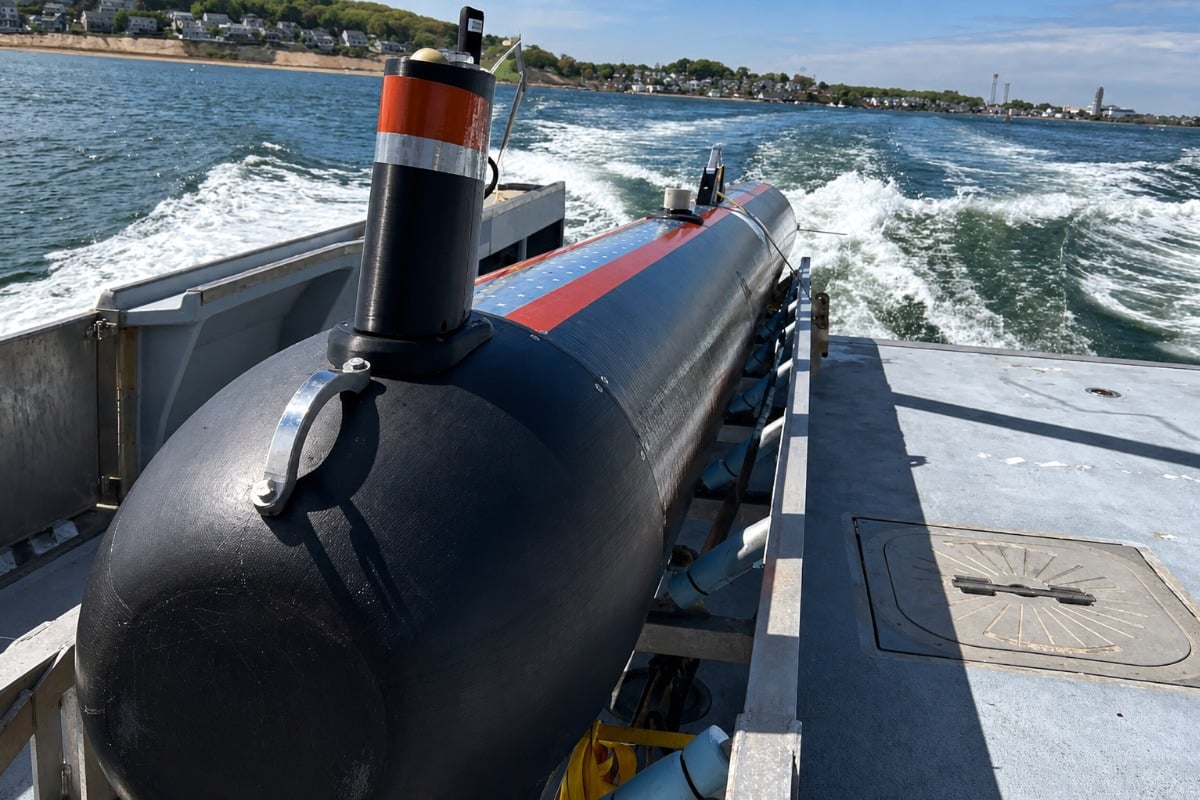
- The U.S. Navy awarded General Dynamics Mission Systems a $13.97 million contract modification on July 6, 2026, for MEDUSA prototype development.
- Work will be performed in Quincy and Taunton, Massachusetts, with an expected completion date of July 2028.
A torpedo-tube-launched robot built to secretly plant mines from American submarines just got another $14 million push toward becoming operational, as the U.S. Navy exercises new contract options with General Dynamics Mission Systems to keep developing the system.
The Navy Sea Systems Command awarded the Massachusetts-based defense contractor a modification worth roughly $13.97 million on July 6, adding prototype systems, software development, shore-based support equipment, and engineering services to an existing agreement covering the Mining Expendable Delivery Unmanned Submarine Asset, a mouthful the Navy shortens to MEDUSA.
MEDUSA is designed to solve a problem that has quietly worried Navy planners for years: how do you lay naval mines in contested or heavily monitored waters without ever putting a crewed vessel at risk. The system works as an expendable unmanned underwater vehicle, a robotic submarine roughly the size of a torpedo, that launches directly from a submarine’s own torpedo tube and then travels independently to deliver its mine payload far from where the launching submarine actually sits, according to General Dynamics. Because the vehicle is expendable, meaning it is not designed to be recovered and reused after completing its mission, the submarine that fires it can move away from the area immediately rather than lingering to retrieve the device, sharply reducing the window in which the launching vessel itself could be detected or targeted.
The Navy’s interest in this kind of clandestine mining capability traces back to a strategic problem that has become increasingly urgent as China’s navy has grown. The Chinese navy now outnumbers the U.S. Navy in raw ship count, according to Naval News, a gap that has pushed American planners toward asymmetric tools like offensive mining that can deny an adversary access to key waterways without requiring the United States to match Beijing ship for ship. Submarines have taken on outsized importance in that strategy specifically because they can operate covertly in contested waters where surface ships would be spotted and potentially engaged, making a submarine-launched mining system like MEDUSA a way to extend that same stealth advantage into offensive mine warfare rather than limiting submarines to their traditional reconnaissance and strike roles.
General Dynamics Mission Systems first won the MEDUSA development contract in September 2024, beating out competitors in a competitive bidding process that drew three total bids, according to InsideDefense, with the initial award worth $15.9 million and covering design, fabrication, and testing of early prototypes. That original agreement included options that could eventually push the contract’s total value to $58.1 million if the Navy chose to exercise them for additional prototype production and support work extending through 2032, a structure that gave the Navy flexibility to scale the program up gradually as MEDUSA proved itself through testing rather than committing to a fixed, multiyear production run from the outset. This week’s roughly $14 million modification represents exactly that kind of incremental exercise of contract options, expanding the scope of work General Dynamics performs under the existing agreement rather than establishing an entirely new contract.
Early testing has moved faster than typical for a new military prototype program. General Dynamics reported completing key risk-reduction testing off the coast of Massachusetts by January 2026, work the company described as demonstrating rapid early progress on the vehicle’s propulsion, navigation, and what it called specialized autonomy behaviors, the software and sensor systems that let the underwater vehicle navigate and complete its mission without direct human control once launched. That early prototype testing fed directly into the design and development decisions now shaping the next phase of the program, according to Army Recognition’s reporting on the trials, with the Navy’s Unmanned Maritime Systems program office, known by its designation PMS 406, overseeing the effort and eventually planning hands-on evaluation by Navy sailors once the system matures further.
Work under this newest contract modification will take place at General Dynamics facilities in Quincy and Taunton, Massachusetts, the same two Massachusetts locations named in the original 2024 contract award, with the current phase of work expected to run through July 2028. General Dynamics has previously described recapitalizing manufacturing space at its Taunton facility specifically to handle larger-scale production of systems like MEDUSA, while using its Quincy waterfront operations as a hub for development and prototyping of new unmanned underwater vehicles, a division of labor that lets the company simultaneously refine the system’s design in one location while preparing the infrastructure needed to eventually build it at scale in another.
MEDUSA is not the only underwater mining system General Dynamics has developed for the Navy in recent years, and understanding that broader portfolio helps explain why the Navy trusts the company with this particular mission. The company also produces Hammerhead, a moored, encapsulated torpedo mine built to sit in place underwater and wait until its sensors detect a specific enemy target signature before releasing a torpedo to strike it, a concept that traces back to a similar Cold War-era weapon called CAPTOR first tested in the 1970s. General Dynamics has said MEDUSA’s design could eventually extend beyond standard torpedo-tube launch to integration with other unmanned platforms, including Boeing’s 50-ton Orca extra-large unmanned underwater vehicle, an autonomous submarine roughly the size of a subway car that the Navy has separately been developing for a range of undersea missions.
For a Navy increasingly focused on how to contest Chinese naval dominance in the Pacific without matching Beijing’s raw ship numbers, a robotic mine-laying submarine that can strike from the shadows and never come back represents exactly the kind of asymmetric tool planners are betting on, and this week’s contract modification signals the Navy is still willing to keep funding that bet, one incremental milestone at a time.