

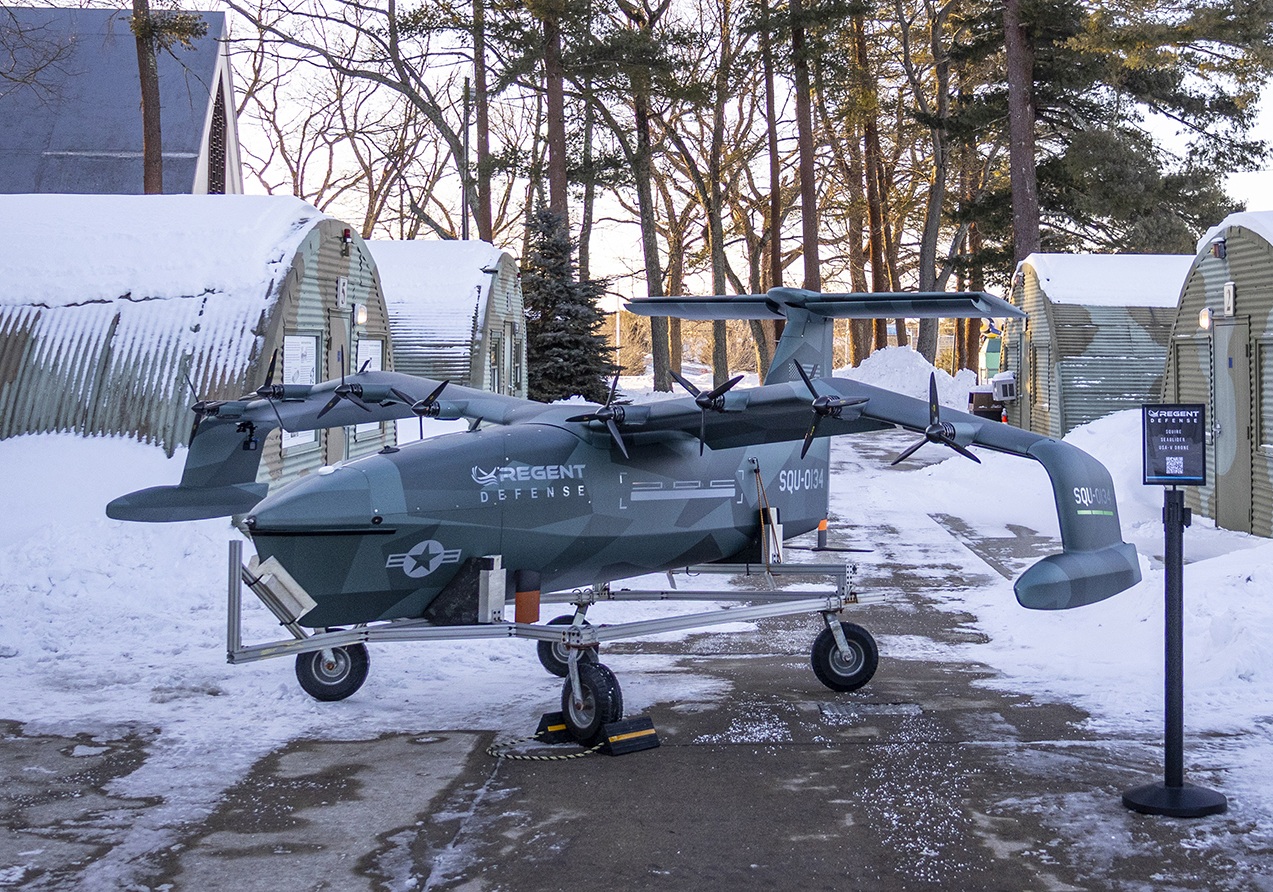
- REGENT unveiled the autonomous Squire Seaglider drone during a briefing attended by U.S. Secretary of War Pete Hegseth in Rhode Island.
- The platform is designed to support contested logistics, MEDEVAC, and ISR missions as part of U.S. military maritime operations.
U.S.-based innovation company REGENT unveiled its new autonomous unmanned surface and aerial vehicle, known as “Squire,” during a briefing attended by U.S. Secretary of War Pete Hegseth and senior defense officials in Quonset, Rhode Island.
The presentation took place at the historic Seabee Museum, where REGENT executives introduced the autonomous Seaglider drone as part of discussions on future maritime operational capabilities. The visit focused on REGENT’s Seaglider technology and its potential role in contested logistics, medical evacuation, and intelligence, surveillance, and reconnaissance missions.
REGENT Co-founder and Chief Executive Officer Billy Thalheimer, Co-founder and Chief Technology Officer Mike Klinker, and REGENT Defense General Manager Tom Huntley presented the Squire platform and outlined how Seaglider vessels are designed to support military operations in challenging maritime environments.
According to the company, Squire is an autonomous Seaglider unmanned surface and aerial vehicle developed under REGENT Defense. The system is intended to operate across maritime domains while maintaining a low operational signature and extended range compared with conventional surface platforms.
During the briefing, Secretary Hegseth emphasized operational challenges faced by U.S. forces. Company officials said he highlighted the need to address capability gaps in contested logistics and counternarcotics missions, stressing the importance of emerging defense companies delivering deployable systems at speed.
“Today’s briefing with Secretary Hegseth and senior staff shows that our military leadership is invested in fielding new technologies to fill critical gaps in maritime defense operations, and we’re proud to deliver Seaglider vessels to meet that urgent need,” Thalheimer said.
REGENT officials stated that Seaglider vessels are designed to provide high-speed, long-range maritime mobility for missions including contested logistics support, medical evacuation (MEDEVAC), and ISR operations. The vehicles operate close to the water’s surface, combining characteristics of marine craft and aircraft to improve efficiency and operational reach.
Tom Huntley, General Manager of REGENT Defense, described growing international interest in the technology. “Since we launched REGENT Defense, we’ve seen incredible traction with the U.S. Department of War and allies and partners around the world, from Taiwan to the Philippines to the U.K. and beyond,” Huntley said. “The signal is clear, and we’re moving quickly to develop, demonstrate, and deliver this transformative technology at scale.”
REGENT Defense is developing multiple Seaglider variants, including a defense adaptation of the company’s commercial, all-electric crewed Viceroy Seaglider, a fully autonomous Viceroy configuration, hybrid versions, and the Squire autonomous platform introduced during the visit.
The company plans to manufacture Seaglider vessels at its headquarters in Quonset, Rhode Island, where a new 255,000-square-foot production facility is scheduled to come online this year.
REGENT said the facility is intended to support scaled production and expand domestic manufacturing capacity for next-generation maritime systems.