

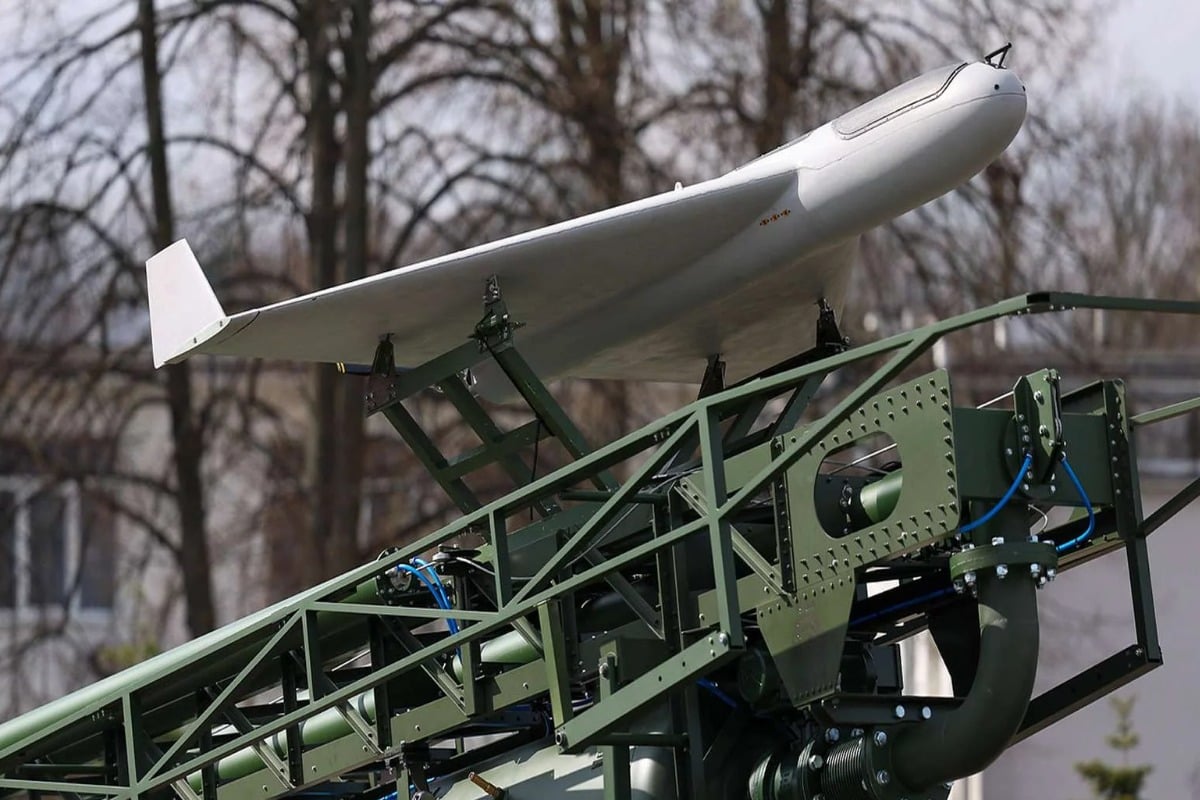
- Poland's Deputy Defense Minister Cezary Tomczyk announced $6.9 billion in 2026 spending on drones and counter-drone systems at a Hornet-Polskie Drony production line event in Sochaczewa.
- The Hornet PL-AT-1 drone, modeled on Russia's Shahed, is built by a joint venture between Poland's Air Force Institute of Technology and Grupa Boryszew.
Poland’s spending on drones and counter-drone systems has grown 260-fold in under three years, reaching roughly $6.9 billion (26 billion zloty) this year alone, Polish Deputy Defense Minister Cezary Tomczyk announced at a production line unveiling in Sochaczewa, according to Interia.
Tomczyk made the announcement Thursday while touring the new manufacturing facility of Hornet-Polskie Drony, a joint venture building Poland’s answer to Russia’s Shahed attack drone, a weapon that has terrorized Ukrainian cities and become the defining symbol of cheap, mass-produced aerial warfare since Russia’s full-scale invasion began.
“We are entering a new phase in terms of building capabilities in the Polish Armed Forces,” Tomczyk said, according to Interia’s report from the event.
The drone at the center of Thursday’s unveiling, called Hornet PL-AT-1 and nicknamed “Szerszeń,” Polish for hornet, was designed specifically to mirror the Iranian-designed Shahed-131 loitering munition that Russia has mass-produced under license and launched against Ukraine by the thousands. Measuring 2.6 meters (8.5 feet) long with a 2.2-meter (7.2-foot) wingspan and weighing 85 kg (187 lb), the Polish drone can reach speeds exceeding 200 km/h (124 mph) and carries an operational range that starts at 400 km (249 miles) in its base configuration and extends to between 900 and 1,200 km (559 and 746 miles) depending on how it is equipped, dimensions and performance figures that closely track the combat drones already flying over battlefields in ongoing conflicts around the world.
Tomczyk framed the drone’s origins as a direct response to a capability gap Poland had openly discussed for years without acting on.
“For a long time it was said that Poland must have its own Shahed, its own deep-strike capabilities, must build these drone and anti-drone capabilities specifically so that if necessary it can rise to the occasion,” Tomczyk said.
Unlike many defense programs built around a private contractor’s proprietary design, Poland’s Defense Ministry retains full intellectual property rights to the Hornet, a distinction Tomczyk specifically highlighted as strategically important. The drone originated at Poland’s Air Force Institute of Technology, known by its Polish acronym ITWL, a state research institute that developed the design under an internal program called PLargonia.
“It was precisely at the Air Force Institute of Technology that this project was born,” Tomczyk said. “From the very beginning, Polish engineers and designers worked to make the Polish kamikaze drone, the Polish Shahed, the Hornet, the Szerszeń, become part of our system. From Poland’s point of view, having our own capacity to produce and modify these kinds of systems is key today.”
That emphasis on domestic production capacity reflects lessons Poland has drawn directly from watching how the war in Ukraine has unfolded, where both sides have discovered that raw drone inventory matters less than the ability to replace losses quickly under sustained combat conditions.
“Drones are the future, I have no doubt about that,” Tomczyk said, adding that what matters is not simply owning tens of thousands of drones but having the capacity to produce them rapidly.
ITWL initially developed the airframe not as a weapon but as an aerial target drone, built to give Polish air defense crews realistic practice intercepting Shahed-type threats during training exercises, and that training variant, designated AT for aerial target, remains in active testing at Poland’s Central Air Force Proving Ground in Ustka, where it has flown alongside various counter-drone systems the Polish military is separately evaluating. A combat-configured version carrying an explosive warhead, designated OWA for one-way attack, has since been developed alongside the training variant and is expected to enter serial production later this year, according to earlier reporting from Polish outlet Polska Zbrojna, the Polish Armed Forces’ own news service. ITWL engineers have specifically prioritized the drone’s guidance and control systems in ongoing refinement work on the combat variant.
The manufacturing arrangement behind Hornet-Polskie Drony reflects a deliberate structure meant to keep both technical know-how and financial risk properly balanced between a state institute and private industry. ITWL holds a 52 percent majority stake in the joint venture, contributing the drone’s underlying technical know-how, while Grupa Boryszew, one of Poland’s largest private industrial conglomerates and the country’s leading nonferrous metals processor, holds the remaining 48 percent and provides financing along with existing industrial infrastructure at its ERG facility in Sochaczewa, where Hornet production is now based. The arrangement traces back to an October 2025 agreement between the two organizations, following Polish government approval, and Boryszew has said serial drone production would begin during the second quarter of 2026.
Tomczyk’s remarks Thursday extended well beyond a single drone program into a broader restructuring of how the Polish military trains its own troops to actually use these systems. He announced the expansion of what the ministry calls drone laboratories, dedicated training facilities currently operating at 10 Polish military units, into a network spanning 20 units over the coming months, giving soldiers standing infrastructure to learn drone operation, tactics, and strategy as routine, ongoing training rather than as occasional specialized instruction.
“I would also like to announce from here that we are entering a new phase in terms of building capabilities in the Polish Armed Forces,” Tomczyk said. “Throughout the ranks of the Polish Armed Forces, so-called drone laboratories are now being created. Until now they have operated in 10 selected military units. We are expanding this program. Over the coming months we will build drone laboratories in 20 military units in Poland, which will serve as the foundation for soldiers’ training, learning, functioning, and building techniques and strategies using drones on a daily basis.”
Tomczyk described the goal as putting drone capability directly into the hands of every individual soldier rather than concentrating it in specialized units, a shift he said reflects how thoroughly unmanned systems have already reshaped modern combat.
“Every soldier must have the ability and the technical foundation to use drone systems, which today will be available at the level of every platoon,” Tomczyk said, adding that each squad would be equipped with observation systems. “A soldier’s life and health is the most important thing,” he said.
Tomczyk compared the current $6.9 billion figure to an estimate from December 2023, when Poland’s annual spending on drones and counter-drone systems totaled roughly $27 million (100 million zloty), a jump he said illustrates just how completely unmanned systems have reshaped what the Polish military now considers essential rather than experimental capability. That scale of investment places Poland among the more aggressive NATO members pursuing domestic drone manufacturing capacity, a trend driven directly by proximity to a war that has demonstrated, in stark and repeated fashion, exactly what happens to a military caught without enough of its own unmanned systems when a full-scale conflict actually begins.