

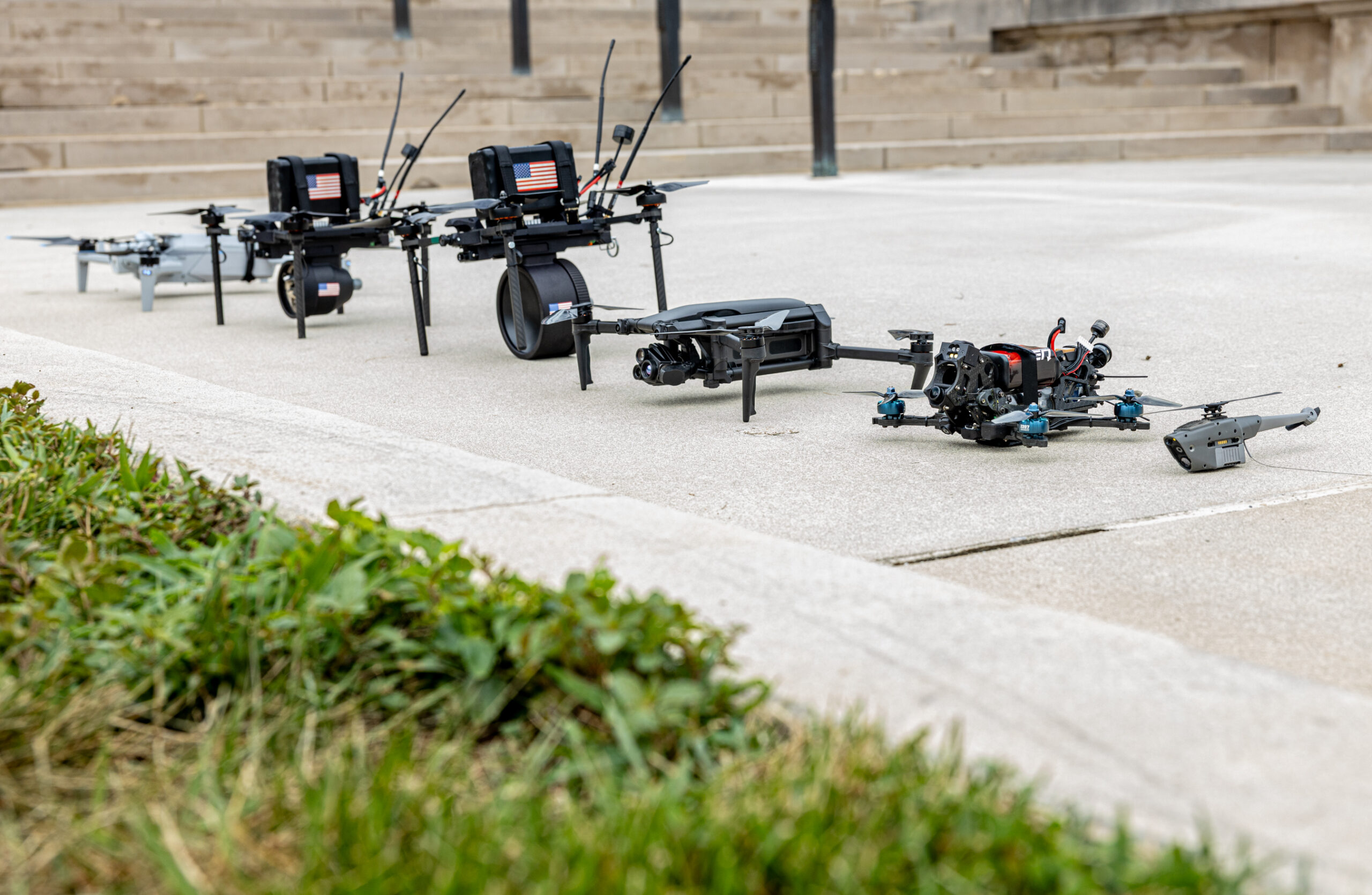
Secretary of Defense Pete Hegseth issued a new directive Thursday aimed at shaking up the Pentagon’s procurement system and rapidly expanding its arsenal of unmanned aerial systems (UAS).
In a memo titled “Unleashing U.S. Military Drone Dominance,” addressed to senior Pentagon leadership, combatant commanders and directors of defense agencies, Hegseth described uncrewed systems as “the biggest battlefield innovation in a generation.”
“Our adversaries collectively produce millions of cheap drones each year. While global military drone production skyrocketed over the last three years, the previous administration deployed red tape. U.S. units are not outfitted with the lethal small drones the modern battlefield requires,” Hegseth wrote.
The directive outlines several key initiatives, including approving “hundreds” of American-made products for purchase by the U.S. military, equipping combat units with a variety of “low-cost drones made by America’s world-leading engineers and AI experts,” and more widely integrating UAS into training exercises.

Key deadlines laid out in the memo include:
By Sept. 1: The Army, Navy, Marine Corps and Air Force must establish “deliberately screened, active-duty experimental formations purpose-built to enable rapid scaling of small UAS across the Joint Force by 2026, prioritizing initial fielding to U.S. Indo-Pacific Command units.”
Within 30 days: The Office of Strategic Capital and Department of Government Efficiency will present options such as advance purchase commitments, direct loans, or other incentives to accelerate the growth of the U.S. industrial base for outfitting combat units with U.S.-made drones. Each military service will establish program offices focused solely on UAS, prioritizing small systems.
By Jan. 1, 2026: Responsibility for maintaining the Blue List of DOD-approved unmanned aerial systems, components and software will transfer from the Defense Innovation Unit (DIU) to the Defense Contract Management Agency (DCMA). The Blue List will evolve into a dynamic digital platform, updated with certified parts, user ratings, and vendor information using AI tools.
Within 60 days: Military departments must identify programs that could be more cost-effective or lethal if replaced by drones.
Within 90 days: The services, in consultation with the Pentagon’s research and engineering directorate, must designate at least three national ranges with diverse terrain for deep UAS training.
Next year, Hegseth expects to see UAS capabilities integrated into “all relevant combat training, including force-on-force drone wars.” By 2027, all major training events across the Department must include drones. Additionally, by the end of 2026, “every squad” is to be equipped with “low-cost, expendable drones,” with priority going to Indo-Pacific combat units.
“Our adversaries have a head start in small UAS, but we will perform a technological leapfrog and establish small UAS domain dominance by the end of 2027. We will accomplish this urgent goal by combining the Nation’s best qualities, including risk-taking. Senior officers must set the tone. Accelerating this critical battlefield technology requires a Department of War culture,” Hegseth wrote.
The Pentagon’s initiative underscores rising concerns about the U.S. military’s ability to match adversaries in drone warfare, as conflicts in Ukraine and elsewhere highlight the decisive role of small, expendable drones on the battlefield.