

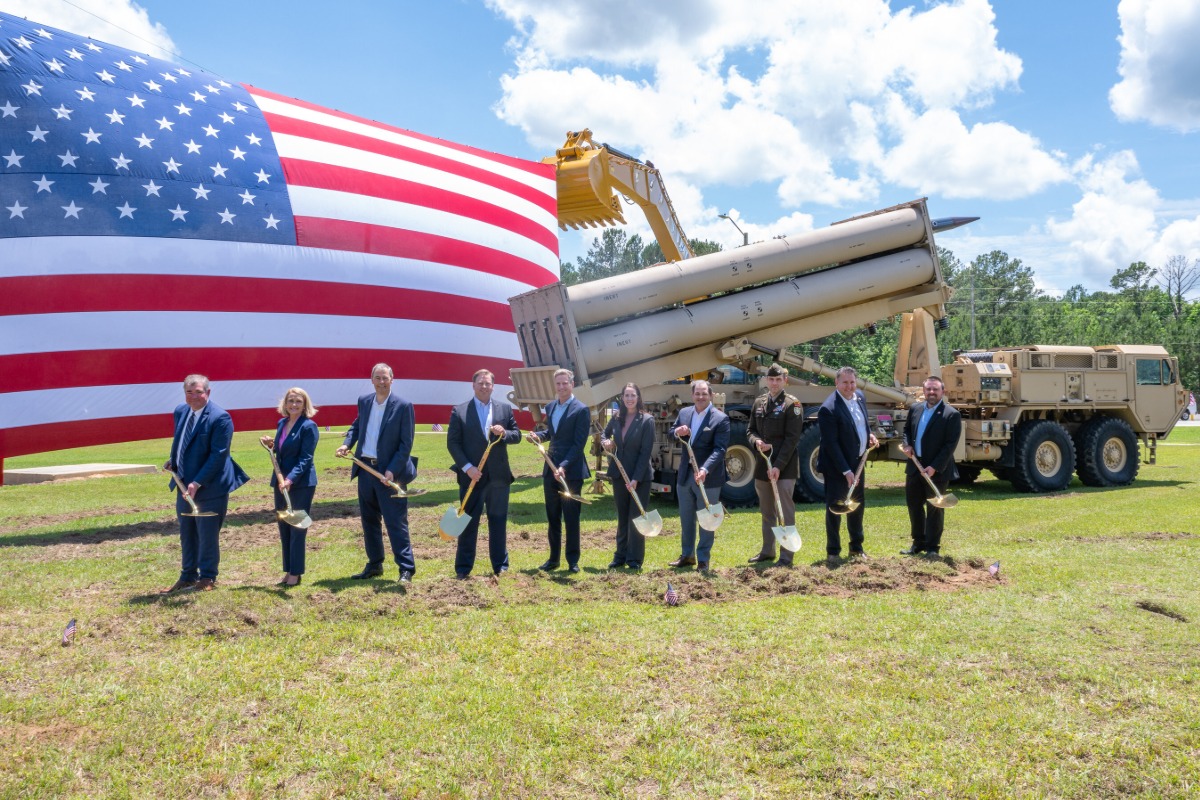
- Lockheed Martin broke ground on an 87,000-square-foot THAAD production facility in Troy, Alabama on May 21, 2026.
- The expansion is part of a company investment exceeding $9 billion through 2030 across more than 20 U.S. facilities.
Lockheed Martin broke ground Wednesday on a new production facility in Troy, Alabama, adding 87,000 square feet of manufacturing space dedicated to Terminal High Altitude Area Defense interceptors and laying infrastructure for future Next Generation Interceptor work.
The ceremony drew senior Pentagon leadership, with the Under Secretary of War for Acquisition and Sustainment, Michael Duffey, attending in person — a signal of how urgently Washington views the push to replenish and expand the nation’s missile defense stockpiles.
THAAD is one of the most capable and expensive air defense systems in the American arsenal. Designed to destroy ballistic missiles during their terminal descent phase, both inside and outside the upper atmosphere, it fills a gap that lower-tier systems like the Patriot cannot. A single THAAD battery costs roughly $800 million, and the interceptors themselves run approximately $11 million apiece, making every round fired a significant expenditure.
The system has been deployed by the U.S. Army on Guam and in South Korea, and is also operated by Saudi Arabia and the United Arab Emirates, the only foreign customers cleared to field it. No other U.S.-built system can intercept ballistic targets at such altitude and range, which is precisely why demand has spiked as missile threats from North Korea, Iran, and Russia have grown more sophisticated and more numerous.
The Troy expansion will nearly double the site’s current footprint and is expected to generate a meaningful number of new jobs over the next three years. Lockheed Martin already employs close to 4,000 people in Alabama, and the company has signaled that Troy is not the only site set for expansion in the state. Additional groundbreakings are planned to support the AGM-158 Joint Air-to-Surface Standoff Missile, the Air-Launched Rapid Response Weapon (ARRW), and the Next Generation Interceptor, a program to build a new homeland defense interceptor intended to replace the aging Ground-Based Interceptors currently stationed in Alaska and California.

The pace of investment reflects a wider industry reckoning with just how thin Western missile defense stockpiles have become. Years of post-Cold War drawdowns, combined with the unexpected scale of missile expenditure revealed by the war in Ukraine, exposed structural limits in production capacity that no single contract could fix overnight. Lockheed Martin’s response has been to commit more than $9 billion in internal investment through 2030, funding used to upgrade or build more than 20 facilities across the country. The Troy facility is the latest visible product of that plan, but it sits within a much larger industrial mobilization that the company insists is already producing results.
Under the Department of War’s Acquisition Transformation Strategy — a framework designed to compress the typically slow procurement cycle and push contractors to scale faster, Lockheed Martin became the first defense firm to sign a munitions acceleration agreement. That initial agreement focused on the PAC-3 Missile Segment Enhancement interceptor, tripling production capacity for the combat-proven system that provides lower-altitude protection and works in tandem with THAAD to cover a layered battlespace. Subsequent agreements extended the logic: the company has since committed to quadrupling output of both THAAD interceptors and the Precision Strike Missile, a long-range ground-launched weapon with a reported range exceeding 499 kilometers that the Army has used in exercises and begun fielding to allied partners.
Jim Taiclet, Lockheed Martin’s chairman, president and CEO, put the company’s posture plainly at the Troy ceremony: “Lockheed Martin is ready now to meet the urgent demand to expand production capacity. We have already invested well over a billion dollars in this expansion, which directly strengthens deterrence and helps ensure our service members and allies have the capabilities they need when they need them.” Duffey was more pointed about what the partnership represents operationally: “This partnership is critical to surging our munitions capacity, and Lockheed Martin has leaned in aggressively. Today is a testament to that partnership and that progress.”
Supply chain health is also receiving attention alongside factory floors. Last week Lockheed Martin convened a supplier summit focused specifically on the bottlenecks that could throttle production even as assembly lines expand. The company draws on nearly 750 U.S.-based suppliers across 42 states for THAAD alone, spread across more than 340,000 square feet of dedicated operations space at nine American sites. Coordinating that network, ensuring that small manufacturers can ramp output in step with prime contractor demand, is the kind of industrial challenge that rarely makes headlines but consistently determines whether ambitious production targets get met or quietly missed