

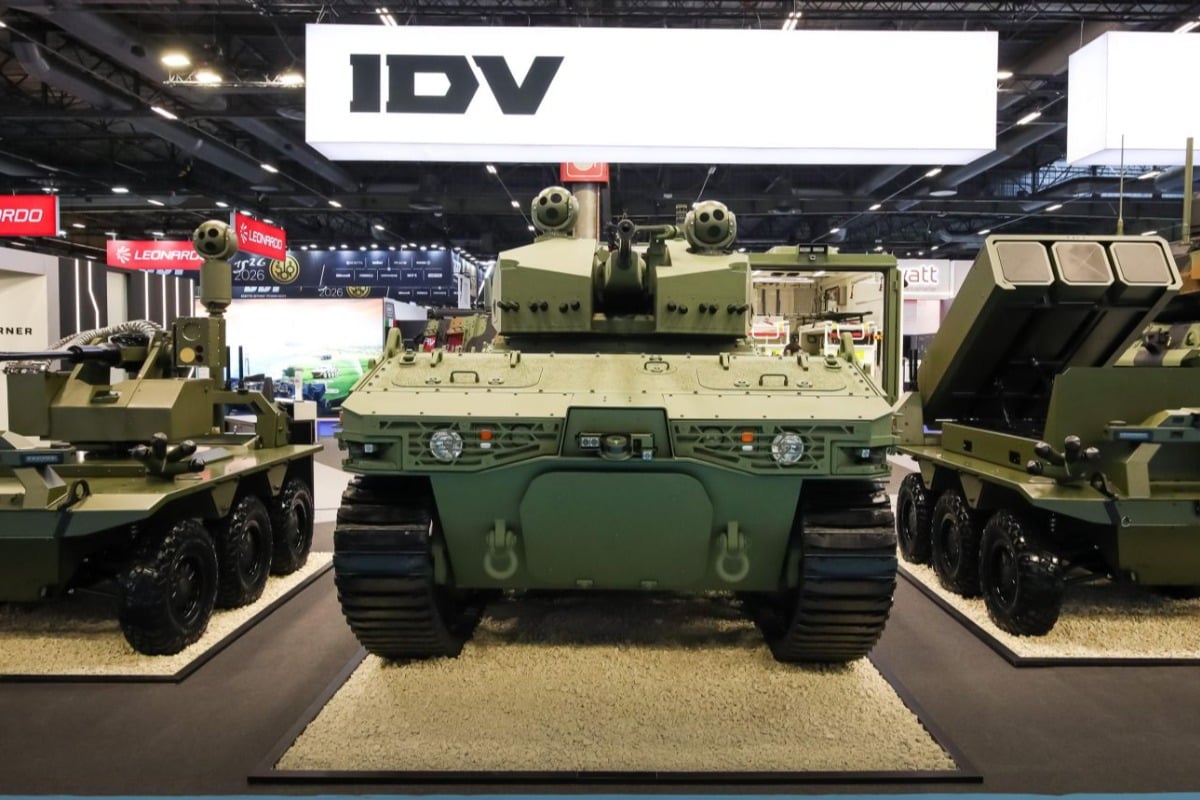
- IDV unveiled the CL2X uncrewed light tank at Eurosatory in Paris, the UK Defence Journal reported this week.
- The 16-ton hybrid vehicle has a 500-kilometer range, a 70 km/h top speed, and a Leonardo 30mm turret.
A Leonardo-owned vehicle maker has revealed an uncrewed light tank designed to fight directly alongside crewed armor, the UK Defence Journal reported, marking one of the more striking unveilings at this year’s Eurosatory defense show in Paris.
IDV, the Italian manufacturer behind the platform, calls it the CL2X, and the company is showing it off this week alongside an upgraded version of its existing VIKING uncrewed ground vehicle and a live demonstration of how fleets of robotic vehicles could be folded into battlefield command structures, according to the outlet’s reporting from the exhibition floor.
IDV is not a name most readers will recognize, but it carries serious institutional weight in European defense circles. The company, formally known as Iveco Defence Vehicles, became a Leonardo subsidiary as part of Leonardo’s broader push to consolidate ground vehicle production under one roof, and it already builds the SUPERAV amphibious armored vehicle that serves as the chassis for the U.S. Marine Corps’ Amphibious Combat Vehicle. That existing relationship with the Pentagon’s vehicle programs gives the CL2X unveiling more weight than a typical trade show reveal, since it suggests IDV has both the engineering pedigree and the contractor relationships to eventually pitch this kind of robotic combat vehicle to American buyers as well as European ones.
The CL2X itself is a tracked, 16-ton combat vehicle built around what engineers call a series hybrid powertrain, an arrangement that pairs an electric drive system with a smaller range-extender engine whose only job is recharging the batteries rather than turning the wheels directly. That setup, combined with rubber tracks instead of traditional steel ones, lets the vehicle run on battery power alone for stretches of a mission, cutting down the engine noise and heat signature that normally give armored vehicles away to enemy sensors and human spotters long before they come into view.
According to the UK Defence Journal, the CL2X carries a payload of up to five tons, hits a top speed of 70 kilometers per hour (43 mph), and can travel up to 500 kilometers (310 miles) on a full tank and battery charge, with roughly 30 kilometers (19 miles) of that range coverable in fully silent, battery-only mode.
In the configuration shown at Eurosatory, the vehicle carries a Leonardo HITFIST 30 UL turret armed with a 30-millimeter cannon firing air-burst ammunition, rounds designed to detonate near a target rather than requiring a direct hit, which makes them particularly effective against small, fast-moving threats like drones that are hard to strike head-on. The HITFIST family is not an experimental design picked off a drawing board. Leonardo’s HITFIST turrets, in their crewed and uncrewed configurations combined, have logged over two decades of service on vehicles including Italy’s Dardo and Freccia infantry fighting vehicles, and the 30 UL variant fitted to the CL2X uses Leonardo’s newer, electrically powered X-Gun cannon, a weapon the company designed in-house specifically so the system would not be subject to U.S. export-control restrictions, freeing Leonardo to sell it more easily to a wider range of international customers.
The role IDV has in mind for the CL2X is what the company describes as a “wingman” to main battle tanks, providing fire support and engaging both ground targets and aerial drones while the actual tank crew stays at a safer distance from the most dangerous parts of a fight. That concept fits into a broader doctrine the defense industry has started calling Manned-Unmanned Teaming, in which a single crewed vehicle with its small human command team directs several robotic combat vehicles at once, effectively multiplying the combat power a handful of soldiers can bring to bear without putting more people directly in the line of fire. The approach has gained urgency since Russia’s invasion of Ukraine demonstrated, often brutally, how vulnerable crewed armor has become to cheap drones, guided anti-tank weapons, and dense minefields, all threats that a robotic vehicle can absorb without costing a soldier’s life.
IDV is not the only company chasing this idea at Eurosatory this year. Finnish vehicle maker Patria and German drivetrain specialist RENK separately unveiled their own crewless tracked vehicle concept at the same Paris show, built around a digital, drive-by-wire transmission designed specifically to support remote operation and future autonomy. Patria’s chief executive, Panu Routila, said at that unveiling that the war in Ukraine had made the case for unmanned systems unavoidable for any modern army.
“Today, unmanned systems are essential and are a battlefield necessity,” Routila said.
That two competing manufacturers chose this same week to debut conceptually similar robotic combat vehicles signals something larger than a coincidence of trade show timing. European defense planners have spent the past several years watching unmanned ground vehicles graduate from logistics and reconnaissance roles in Ukraine, hauling supplies and scouting forward positions under fire, into platforms increasingly expected to carry weapons and fight directly, and manufacturers across the continent appear to be racing to have a fielded answer ready before any single country’s defense ministry forces the pace by picking a winner.