

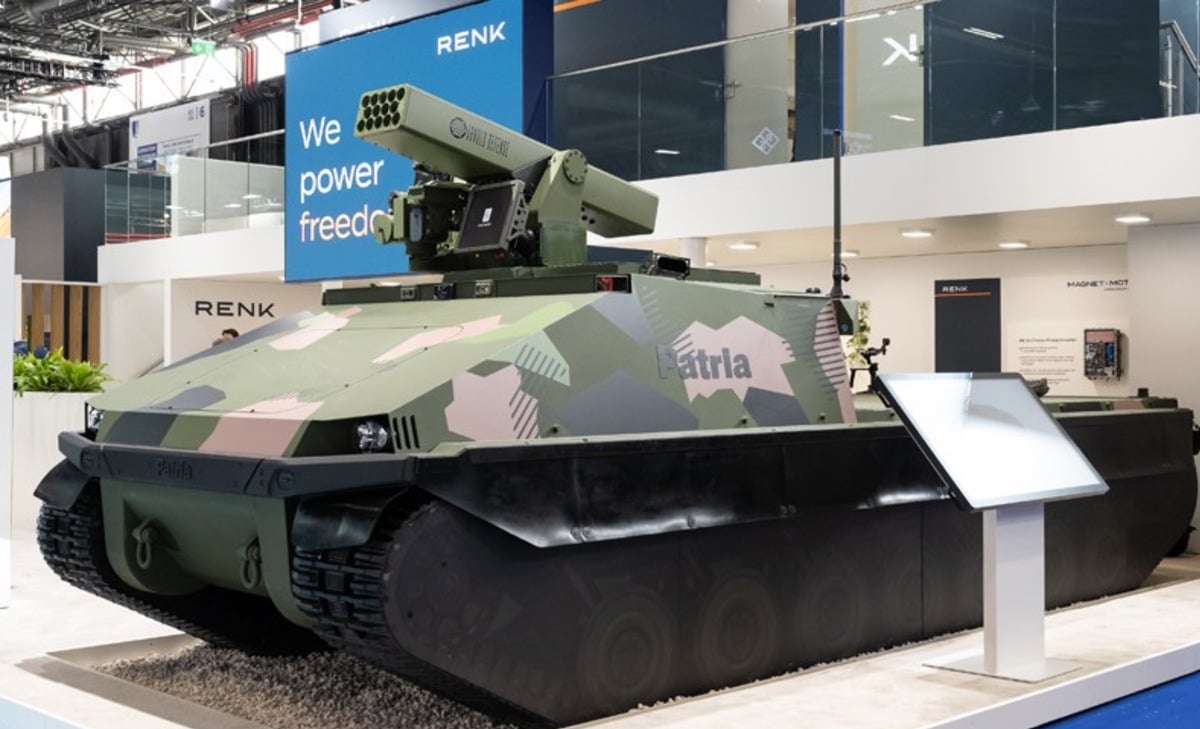
- Patria and RENK Group unveiled a full-scale heavy UGV concept mock-up at Eurosatory 2026 on June 15, combining the TRACKX tracked platform with the HSWL 076 drive-by-wire transmission.
- The TRACKX platform weighs up to 15.5 tonnes, reaches 80 km/h, and was originally designed as a crewed APC capable of carrying 12 soldiers.
The vehicle that Finnish defense company Patria and German transmission manufacturer RENK Group unveiled at Eurosatory 2026 in Paris on Monday is designed to go where commanders decide it should go and do what they need it to do without putting a single soldier in harm’s way to make that happen, because nobody sits inside it, nobody steers it with a wheel, and nobody fires its weapons from a seat inside a hull that could be hit.
The TRACKX-based unmanned ground vehicle concept, presented as a full-scale mock-up at Paris Nord Villepinte, represents the clearest statement yet from two serious European defense manufacturers that the era of the fully crewed armored vehicle is beginning to share the battlefield with something fundamentally different, driven by a war in Ukraine that has made removing humans from the most dangerous ground positions an operational necessity rather than a theoretical ambition.
Patria, the Finnish defense and technology company headquartered in Helsinki and owned jointly by the Finnish state and Norwegian defense group Kongsberg, brought its TRACKX tracked platform to the collaboration. The TRACKX itself is a recently unveiled light tracked armored personnel carrier designed to replace aging Cold War-era vehicles like the American M113, a vehicle first fielded in the 1960s that remains in service with dozens of armies worldwide including Ukraine, where its age has become a liability in intensive combat. Patria unveiled TRACKX at the DSEI defense show in London in September 2025, targeting the 13 to 18 metric ton weight class with a vehicle designed to carry 12 soldiers, including a driver, commander, and ten dismounts, with a maximum combat weight of 15.5 tonnes (34,170 lb). The tracked platform offers wide rubber tracks, independently adjustable hydropneumatic suspension on each road wheel, and a nearly flat hull bottom designed to maximize mobility across snow, bogs, forests, and paved roads with equal competence.
The TRACKX can reach a top speed of 80 km/h (50 mph) with an operational range of up to 500 km (310 miles), figures that place it well above older light tracked designs in mobility terms and make it a credible platform for the kind of rapid repositioning that modern high-intensity warfare demands. For the Eurosatory concept vehicle, however, Patria’s TRACKX is not carrying soldiers. It is carrying the argument that the same chassis built for troop transport can be converted into an unmanned system that operates without a crew, sharing the battlefield with the crewed vehicles it resembles.
RENK Group, the Augsburg-based German manufacturer whose transmissions power some of the most widely fielded armored vehicles on the planet, contributed the technical element that makes the unmanned concept function: the HSWL 076, a drivetrain developed specifically for the 10 to 20 tonne vehicle class that incorporates drive-by-wire capability. Drive-by-wire replaces the mechanical and hydraulic connections between a driver’s controls and the vehicle’s steering, braking, and throttle systems with electronic signals, the same architectural shift that made autonomous cars theoretically possible and that makes remotely operated military vehicles practically achievable. The HSWL 076 combines mobility functions within a compact digital architecture designed to support drive-by-wire operation, crewed-uncrewed teaming, and autonomous platform concepts. Without a drivetrain that accepts digital commands directly rather than mechanical inputs, a vehicle cannot be remotely controlled or autonomously operated regardless of how sophisticated its sensors or software become.
RENK has described the HSWL 076 as a safety-certified drivetrain that forms the basis for scalable and platform-independent UGV concepts, which is significant language in a defense context. Safety certification for a drivetrain intended for unmanned military use addresses one of the central anxieties around autonomous ground vehicles: what happens when the system fails, when communications are jammed, or when the vehicle encounters a situation its programming did not anticipate. A certified drivetrain provides the engineering foundation for answering those questions with hardware rather than promises.
Panu Routila, Patria’s President and CEO, made the operational context of the collaboration explicit in his statement at the unveiling. “The war in Ukraine shows what modern and future warfare looks like,” Routila said. “Today, unmanned systems are essential and are a battlefield necessity. Patria provides the platform expertise, and RENK digitalized transmission HSWL 076 with drive by wire capability, bringing greater commonality between Patria’s uncrewed and crewed vehicles for end users.” That framing is not marketing language. Unmanned ground vehicles have appeared in the Ukraine conflict with increasing frequency, used for logistics resupply under fire, casualty evacuation, and forward reconnaissance in areas where sending a crewed vehicle would mean sending crew members into near-certain engagement.
Dr. Alexander Sagel, CEO of RENK Group, placed the collaboration within a broader argument about where military vehicle design is heading. “The future of land operations will depend on digitally enabled and scalable vehicle architectures,” Sagel said, adding that the partnership demonstrates “how European defence cooperation can rapidly translate innovation into scalable and future-ready unmanned ground capabilities.” The phrase “scalable architecture” carries specific meaning here: a drivetrain that accepts digital commands does not care whether those commands come from a human operator sitting kilometers away or from an onboard autonomous system, which means the same hardware investment supports both near-term remote operation and longer-term autonomous function as the software matures.