

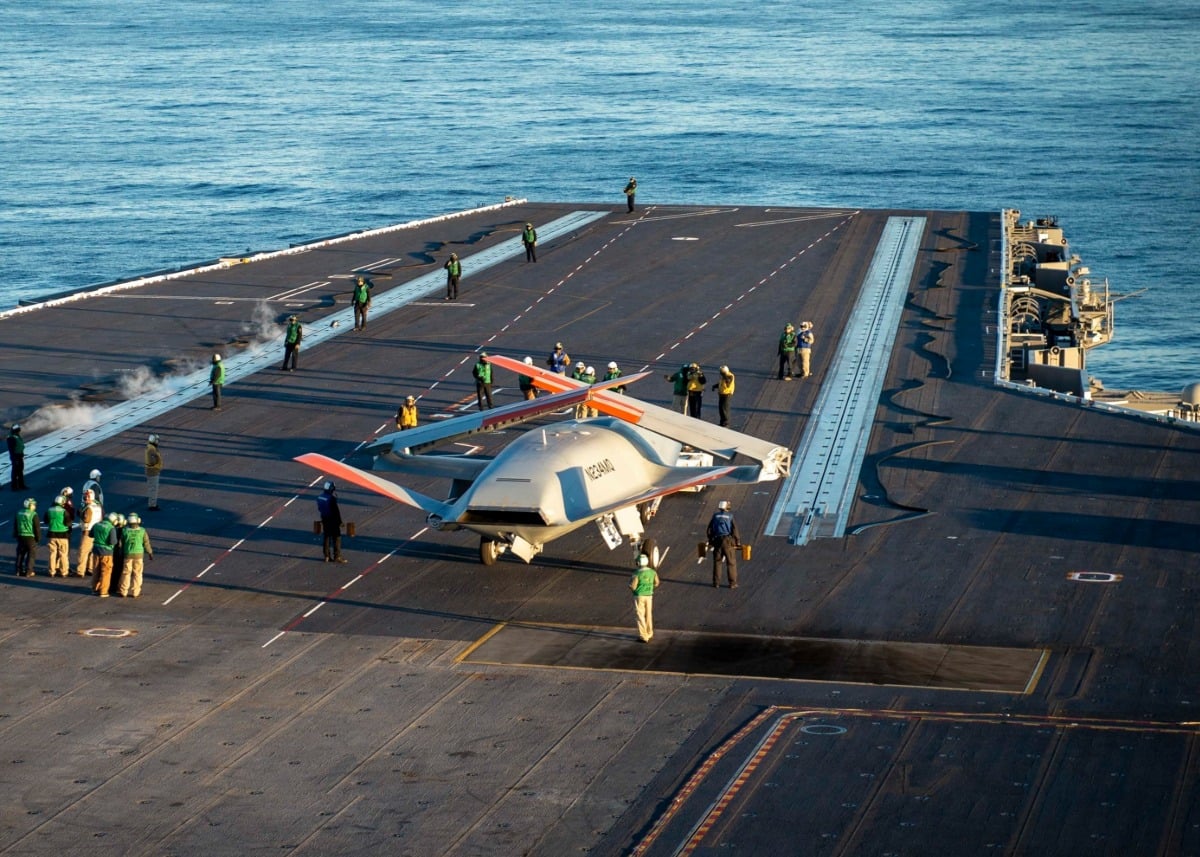
- The U.S. Navy published a Sources Sought notice on July 14 seeking industry proposals for unmanned aircraft to operate from Ford-class and Nimitz-class carriers.
- Responses are due by August 13, 2026, and must address a minimum 1,000 nautical mile (1,852 km) combat radius without refueling.
Somewhere on the flight deck of a future U.S. aircraft carrier, a jet could be preparing to launch into contested airspace nearly 1,900 kilometers (1,151 miles) away, refuel itself mid-flight if needed, evade enemy threats, and strike a target, all without a single pilot strapped inside the cockpit. That’s the future the U.S. Navy just asked the defense industry to help build.
The Navy’s Portfolio Acquisition Executive for Aviation, the office within Naval Air Systems Command responsible for shaping how the service buys its future aircraft, published a formal Sources Sought notice on July 14 seeking companies capable of designing, building, and fielding a new generation of unmanned aircraft built specifically to operate from the decks of nuclear-powered aircraft carriers. A Sources Sought notice, sometimes called a Request for Information, is not an actual purchase order or even a formal solicitation for bids. It is the government’s way of surveying what industry can realistically deliver before it commits taxpayer money to a specific program, and this one gives companies until August 13 to respond with their concepts.
The request fits into what the Navy calls its Air Wing of the Future, a long-term plan to shift the carrier air wing away from today’s fleet, which still relies heavily on fourth-generation jets like the F/A-18 Super Hornet, toward a mix of fifth and sixth-generation manned and unmanned aircraft working together. That shift is itself part of a much larger initiative called the Golden Fleet, the Trump administration’s push to expand and modernize the Navy’s overall shipbuilding and aviation programs, championed publicly by Secretary of the Navy John Phelan as a way to field new classes of ships and aircraft faster than the service’s historically slow acquisition process has managed in recent decades.
Two programs already give a sense of what the Navy is building toward. The MQ-25A Stingray, a Boeing-built unmanned aerial refueling tanker, completed its first operational test flight in April 2026 and is working toward deployment aboard Nimitz and Ford-class carriers, the two classes of nuclear-powered supercarriers, known by the military designation CVN, that anchor America’s carrier strike groups around the world. The Collaborative Combat Aircraft program, meanwhile, is developing lower-cost drones designed to fly alongside crewed fighters as what the military calls loyal wingmen, extending a pilot’s reach and absorbing risk that would otherwise fall on a human aircrew, with Anduril, Boeing, General Atomics, and Northrop Grumman all currently developing competing concepts for a carrier-capable version and Lockheed Martin building the software architecture meant to let a single operator help coordinate multiple drones at once.
This new Sources Sought notice asks industry to go further, outlining requirements that read like a wish list assembled from lessons learned across both those earlier efforts. The Navy wants any proposed aircraft fully compatible with the launch and recovery systems on both Nimitz and Ford-class carriers, systems that use catapults to fling aircraft off the deck and arresting wires to catch them coming back down, but the notice also flags interest in vertical takeoff and landing designs that could operate from a wider range of Navy vessels, including destroyers and mobile sea bases, without needing a full-length flight deck at all. For any aircraft intended to strike targets, the Navy set a minimum combat radius of 1,000 nautical miles (1,852 kilometers, or 1,151 miles) from the carrier without refueling, a range requirement driven directly by the growing reach of long-range anti-ship missiles that have pushed adversary threats far enough out that carriers increasingly need aircraft capable of striking well beyond visual range of the ship itself.
The document also asks companies to address what the Navy calls spot factor, essentially how much flight deck space an aircraft occupies relative to the combat capability it delivers, since deck space aboard a carrier is one of the most tightly constrained resources in the entire fleet and every additional aircraft that requires storage or launch space competes directly with everything else the air wing needs to operate. Beyond the aircraft itself, the Navy wants any new system to plug directly into its existing Unmanned Carrier Aviation control systems, the software and hardware infrastructure that already manages the MQ-25 program, rather than requiring the fleet to stand up an entirely separate control architecture for every new drone that comes online.
Perhaps the most telling section of the request is not about the aircraft’s specifications at all, but about how fast and how cheaply a company can actually build it. The Navy is asking for detailed manufacturing plans built around rapid scaling in what the notice calls a surge scenario, along with cost engineering approaches meant to keep what the military terms unit recurring flyaway cost, essentially the price to build each additional aircraft once a production line is running, within sustainable limits over the long run. Respondents also need to lay out a development timeline covering first flight, what naval aviators call the “first trap,” meaning an aircraft’s first arrested landing aboard a carrier, and the point at which the system reaches initial operational capability, giving Navy planners a realistic sense of how many years separate a paper concept from an aircraft actually landing on a flight deck.
None of this guarantees a contract will follow, and the Navy has been explicit that the notice carries no commitment to purchase anything industry proposes. But the questions it is asking, about cost, deck space, autonomy, and how quickly a company can scale production if a real conflict demanded it, describe a Navy actively rethinking what a carrier air wing needs to survive the next war rather than refighting the last one, and that rethinking will shape flight decks for a generation of sailors who have not yet been born.