

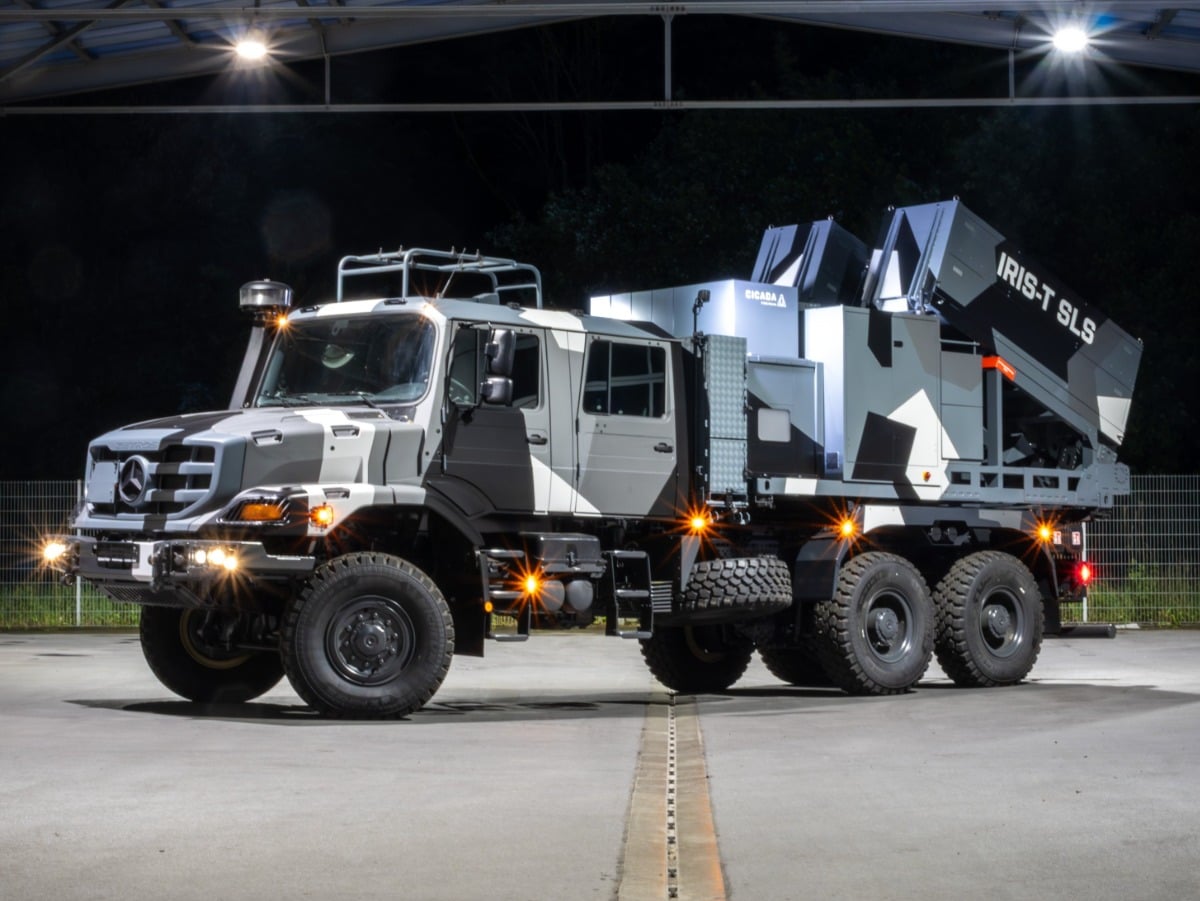
- Diehl Defence unveiled the IRIS-T SLS MK 4 on June 9, 2026, ahead of ILA Berlin, featuring a range of 12 km, altitude coverage of 6 km, and an eightfold missile load on a single vehicle.
- The all-in-one system integrates radar, command and control, and launcher on one platform and is designed to protect troops on the move with future fire-on-the-move capability planned.
Diehl Defence has developed a new generation of its compact mobile air defense system and unveiled it on the eve of the ILA Berlin Air Show.
The German defense company announced the IRIS-T SLS MK 4 on June 9, the day before ILA Berlin opens its doors to the defense industry. The fourth-generation version of Diehl’s Short Range Air Defense system extends the platform’s engagement envelope to 12 km (7.5 miles) in range and up to 6 km (3.7 miles) in altitude, upgrades that expand the protected bubble the system can throw around whatever it is defending. The MK 4 also increases the number of ready missiles from the previous configuration to an eightfold load, substantially boosting the number of engagements a single vehicle can conduct before needing to resupply.
The IRIS-T SLS system has been one of the most prominent short-range air defense platforms to emerge from the war in Ukraine. Germany supplied IRIS-T SLM systems to Ukraine beginning in late 2022, and their performance against Russian cruise missiles and ballistic threats was documented in multiple engagement reports and publicly praised by Ukrainian officials. The SLS variant, standing for Short Range Land-based System, is a more compact, more mobile version of the broader IRIS-T ground-based family, using the same IRIS-T air-to-air missile as its effector but optimizing the platform for rapid repositioning and close-in force protection rather than the area defense role of the larger SLM. The distinction matters operationally: where the SLM protects a wide geographic area from a semi-fixed position, the SLS is designed to move with troops and defend them while they are displacing, an increasingly critical requirement on battlefields where stationary air defense assets attract precision strikes within minutes of their first radar emission.
The core design philosophy of the MK 4 is consolidation. Where many air defense systems distribute their components across multiple vehicles, with separate trucks for radar, command and control, and launchers that must coordinate and position together, the IRIS-T SLS MK 4 integrates all three functions on a single vehicle. The radar detects and tracks threats. The command system classifies them and selects engagement solutions. The launcher fires the missile. One vehicle, one crew, one set of logistics requirements. Diehl describes this as an “all-in-one” solution, and the operational advantages are significant in a maneuver environment where the ability to relocate quickly and independently, without waiting for other elements of a battery to reposition, directly affects survivability.
The IRIS-T missile at the heart of the system is a short-range air-to-air missile that Germany originally developed for its Eurofighter Typhoon and Tornado fighters, with thrust vectoring that gives it exceptional maneuverability at close range. The ground-based adaptation of a missile designed to chase agile aircraft makes it particularly capable against the drone threats that have dominated recent air defense discussions. Against a small fast-moving drone, the IRIS-T’s ability to execute extreme post-launch maneuvers is directly relevant, since drones can turn sharply to evade missiles that lack the same kinematic agility. Diehl says the missile’s hardware remains unchanged in the MK 4 configuration and that future development will include fire-on-the-move capability, meaning the system will eventually be able to launch missiles while the vehicle is still driving rather than requiring it to stop and stabilize before firing.
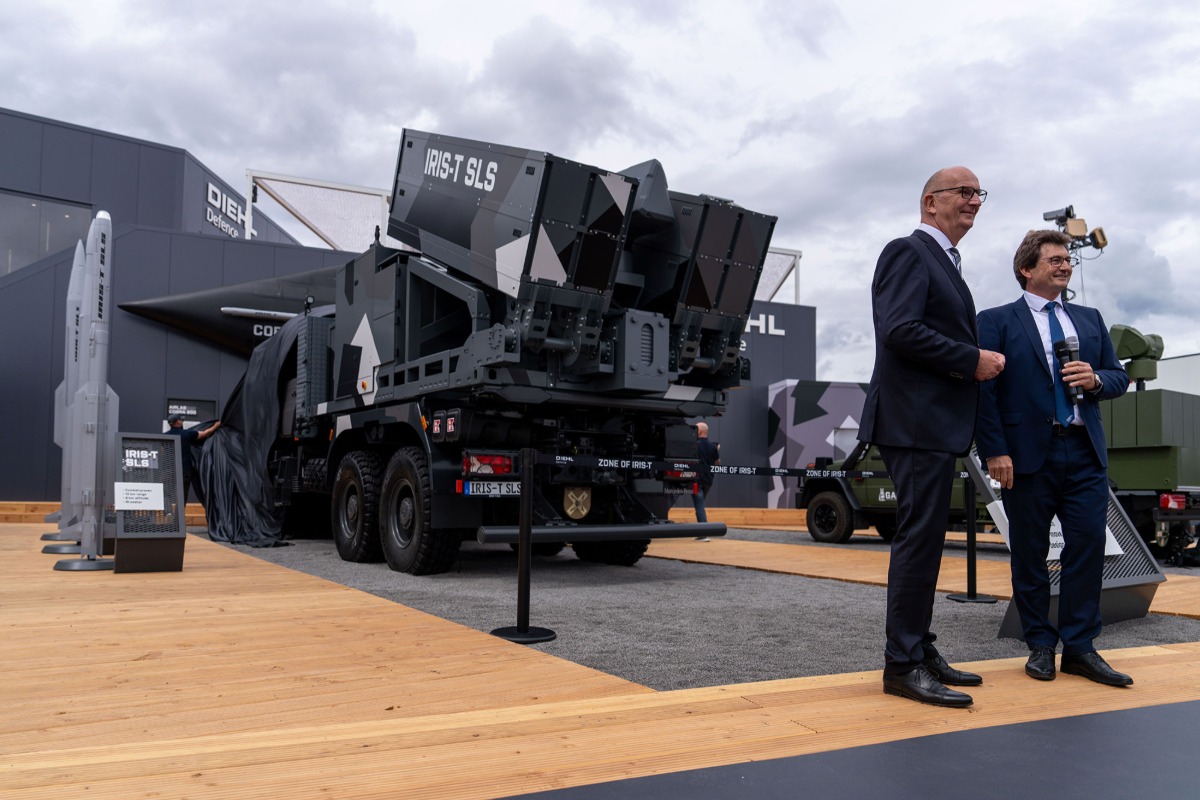
The MK 4 also opens the door to expanded effector options beyond the IRIS-T missile. Diehl specifically mentions the CICADA, its C-UAV eMissile, as an additional effector the system can integrate, along with a weapon station option. The CICADA is a dedicated counter-drone munition from Diehl’s own product line, designed specifically to intercept small unmanned aircraft at a lower unit cost than a full IRIS-T engagement. The ability to choose between a high-performance air-to-air missile for sophisticated threats and a cheaper dedicated counter-drone munition for small commercial drones gives operators an economic engagement ladder, avoiding the cost asymmetry problem where expensive missiles are used to destroy cheap drones.
The system’s vehicle-independent design, which Diehl highlights as enabling maximum flexibility for different customer requirements, means the MK 4’s components can be integrated onto different vehicle platforms depending on what a customer already operates or what terrain and logistics constraints require. That flexibility is a significant export advantage in markets where nations have standardized on specific wheeled or tracked vehicle families and do not want to introduce an entirely new platform into their maintenance pipeline just to add an air defense capability.
Diehl positions the IRIS-T SLS MK 4 as a fully integrated element of multi-layered air defense, meaning it is designed to interoperate with longer-range systems like the IRIS-T SLM and IRIS-T SLX and to function as the close-in layer of a defense architecture that spans from very short range out to medium and eventually long-range engagement.