


- A video on Chinese social media showed an experimental 6.8×50mm armor-piercing round with a tungsten carbide core.
- The round suggests China may be evaluating concepts similar to the U.S. Army’s 6.8mm Next Generation Squad Weapon program.
China may be exploring its own version of the U.S. Army’s Next Generation Squad Weapon (NGSW) program, according to footage that recently surfaced on the Chinese social media platform Douyin (TikTok).
The video shows a weapons collector examining what appears to be a Chinese experimental 6.8×50mm armor-piercing cartridge with a tungsten carbide core.
While there has been no official confirmation from the Chinese defense industry or the People’s Liberation Army (PLA), the presence of such a round suggests China is actively evaluating the 6.8mm caliber concept for future infantry small arms—mirroring trends initiated by the United States military.
The 6.8mm projectile in question is labeled as a test round and is not believed to be in operational use. However, its design—with armor-piercing capability and a compact intermediate case profile—suggests it is part of an experimental evaluation effort. The cartridge appears optimized for performance against modern personal armor, a key focus area of the U.S. NGSW program.
The U.S. Army launched its NGSW initiative in 2017 to replace the 5.56mm M4 carbine, the M249 light machine gun, and potentially the 7.62mm M240. The objective was to develop a unified weapon system around a new 6.8mm cartridge that offers greater penetration, accuracy, and range than existing service ammunition. As part of the program, manufacturers were allowed to design proprietary cases using a standard 6.8mm projectile to meet performance goals.
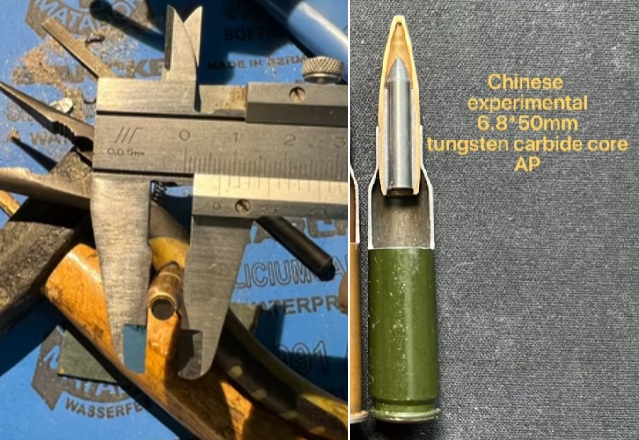
China’s appearance of a 6.8×50mm round suggests its engineers may be assessing similar ballistic solutions. The use of tungsten carbide—a dense, hard material often used in high-end armor-piercing rounds—further indicates a priority on defeating body armor commonly used by NATO-aligned forces.
While no weapon platform has been shown with the experimental cartridge, observers note that China’s defense sector has a track record of integrating foreign concepts into domestic weapons development. If the 6.8mm caliber gains traction within the PLA or related state research institutions, a prototype weapon may follow.
The timing of the cartridge’s appearance online suggests the concept is still in the early phases of internal evaluation. However, it aligns with broader global trends in infantry modernization, where nations are reassessing traditional calibers and investing in integrated fire-control systems, improved lethality, and modular weapon architectures.