

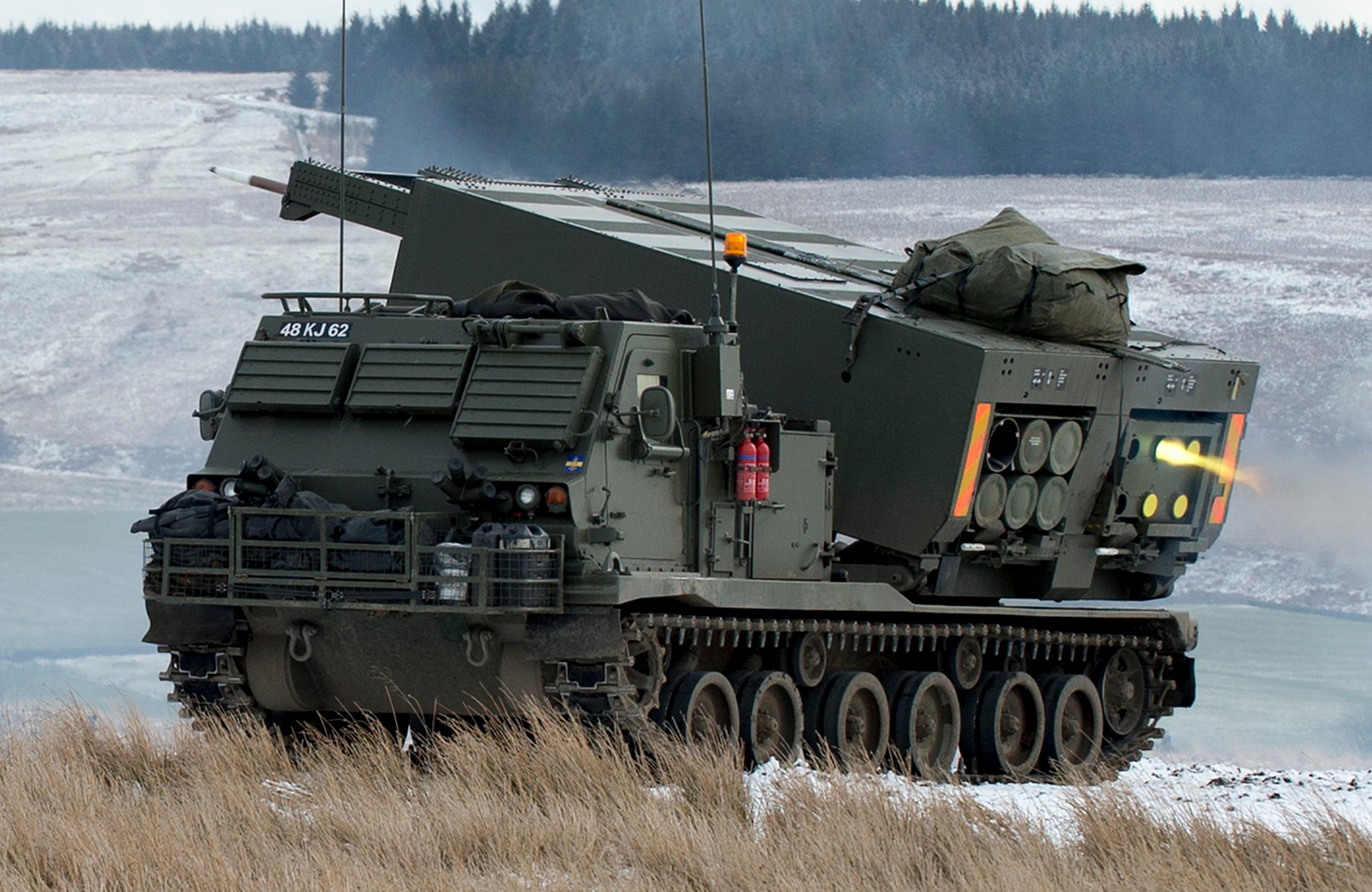
British Army is reportedly pushing ahead with plans to upgrade its multiple rocket launchers.
Just this week, the British Army press release said that following a recent agreement struck with the U.S. Department of Defense, they will be embarking on a five-year program to update its M270 Multiple Launch Rocket Systems (MLRS).
Currently, British rocket launchers provide pinpoint accuracy, delivering a 200 lb high explosive warhead to its target with over twice the range of other artillery systems used by the British Army. The MLRS also represents the bulk of the Army’s precision fires capability, with the GPS guidance capability integral to the system and highly accurate beyond 70 KM.
Also noted that the MLRS is a highly mobile automatic system that fires 12 surface-to-surface missiles in less than a minute.
The details were given in a 31 March media release, to announce upgrades will be made to 44 launchers, which are currently in-service, and will include a new armoured cab and upgraded automotive and launch mechanism components.
The upgrades will ensure that the Army’s Land Deep Fires capability remains strong for the next three decades and that the British Army has the technological capability to quickly meet the threats of today and tomorrow.
Taking advantage of the long-standing MLRS collaboration with the US and key allies, work will start on upgrading the first tranche of launchers in March 2022 with the fleet going through production over a four-year period. The upgrades will keep the equipment in service until 2050.
The work will be carried out under an existing production contract with Lockheed Martin Missiles and Fire Control with the work being carried out at Red River Army Depot and Lockheed Martin’s facility in Camden, Arkansas.
The UK is also developing UK-specific systems for the new launchers, including Composite Rubber Tracks (CRT), and a vehicle camera and radar system. A new Fire Control System will be developed collaboratively with the US, UK, Italy, and Finland.
The CRT will provide better fuel economy and allow the launcher to travel further, giving greater operational and tactical mobility to support deployed troops in a range of operating environments. A single launcher will be used to fire many payloads.
To ensure soldiers are not outranged, the Army will develop a new extended range missile with MLRS partners, to be fired from the updated launchers, which should be in-service by 2025. The Guided MLRS Extended Range (GMLRS-ER) missile will extend the Army’s reach from 84 to 150km.
The 44 updated launchers will also be able to fire the US’s Precision Strike Missile (PrSM) which has a range of 499km and is expected in-service from 2024. These weapons will place the British Army at the cutting edge of global deep fires capability, ready to respond to long range air defence and missile threats presented by hostile actors.