

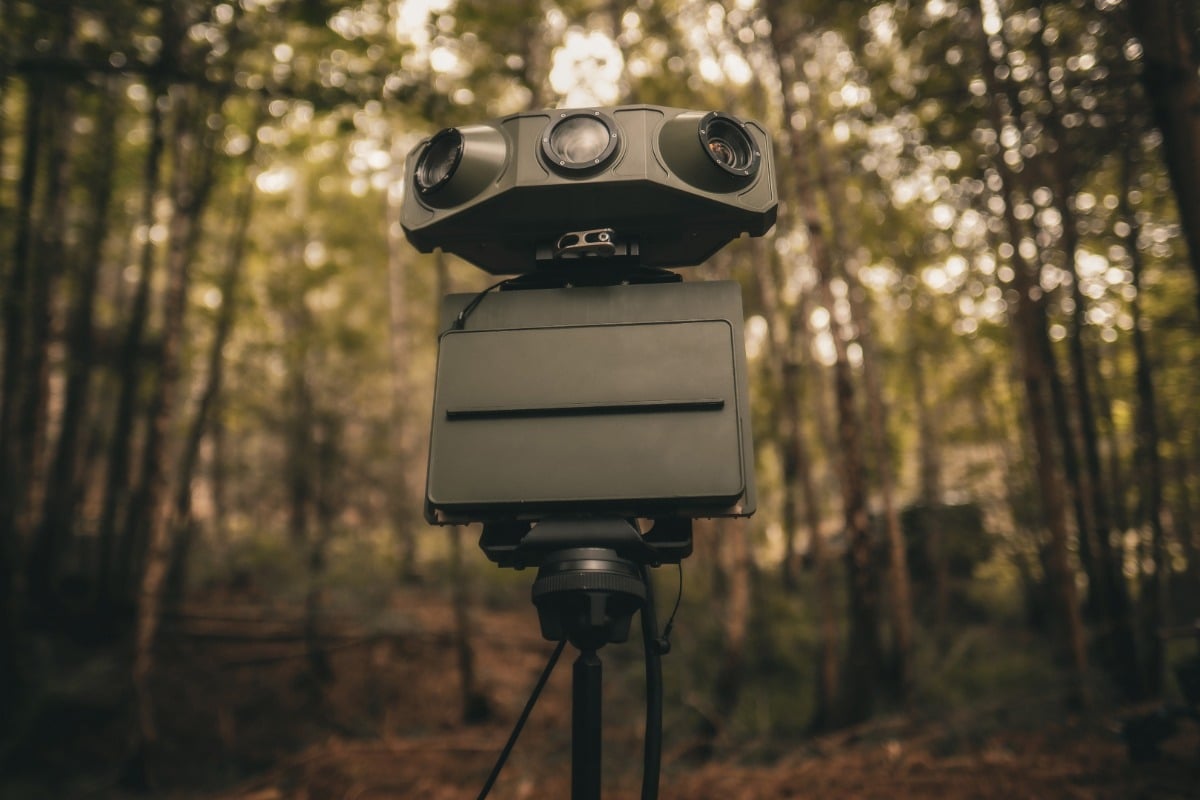
- OpenWorks Engineering said its Vision Guard system was selected for evaluation under Australia's Land 156 counter-drone program.
- Australia has committed $1.3 billion over 10 years to counter-drone capabilities, with Vision Guard designed to fit in a backpack and deploy in under two minutes.
A small British company best known for catching drones in mid-air nets just landed a much bigger job: helping Australia’s military spot the things before anyone needs to catch them at all. OpenWorks Engineering said its Vision Guard system has been selected for evaluation under Australia’s Land 156 counter-drone program, part of the country’s $1.3 billion, 10-year investment in counter-drone capabilities for the Australian Defence Force.
Vision Guard, described by OpenWorks as the smallest and lightest intelligent optics system in its lineup, is intended to serve as an early warning system, or what the company calls a “trip wire,” for dismounted close combatants, meaning infantry soldiers on foot rather than troops riding in vehicles.
Land 156 has become one of the more closely watched defense procurement efforts in the Asia-Pacific region over the past year, precisely because of how fast Australia has moved on it. The Australian government set aside the $1.3 billion specifically to acquire counter-drone capabilities over a 10-year span, naming Leidos Australia as the systems integration partner for the program. Land 156 has used rolling contracts and demonstrations to introduce at least 120 threat-detection and drone-defeat technologies, a structure designed to let the ADF keep adding and swapping out vendors as the drone threat itself keeps changing. Vision Guard’s selection for evaluation puts it alongside other sensor, effector, and command-and-control suppliers selected under Land 156, all competing to fill different pieces of what the ADF wants to be a layered, distributed defense against drones that can range from hobbyist quadcopters to deliberately weaponized systems.
What Vision Guard actually does, according to OpenWorks, is provide rapidly deployable panoramic staring capability, military shorthand for a sensor that watches a wide arc of sky continuously rather than requiring an operator to manually sweep a camera back and forth. The system is built for forward observation and covert surveillance, including in low light, and it runs on OpenWorks’ own artificial intelligence and data fusion software to detect, track, and identify what the industry classifies as Class 1 unmanned aerial systems, generally the smallest category of drones, at long range. Operators can configure the system with combinations of active and passive wide-area sensors, including radar and acoustic panels, depending on the mission, which means a unit heading into dense urban terrain might prioritize different sensors than one watching open desert.
The detail that matters most for understanding why the Australian Army would want this system comes down to weight and speed of setup. OpenWorks designed Vision Guard around minimal size, weight, and power requirements, often shortened to SWaP in defense engineering circles, meaning the system and its accessory sensors fit inside a standard military backpack and can be deployed in under two minutes. For an infantry unit already carrying body armor, water, ammunition, and a rifle, a counter-drone sensor that adds bulk or takes ten minutes to set up is a sensor that gets left behind or used too late to matter. A system that goes from backpack to operational in under two minutes changes that calculation entirely, letting small dismounted teams carry their own early warning capability instead of depending entirely on larger, slower-to-deploy radar trucks or fixed installations watching from miles away. OpenWorks frames this as reducing reliance on what it calls strategic assets, the bigger, less mobile systems that protect an entire base or formation, and instead giving individual soldiers and small teams the ability to see an incoming drone threat on their own and keep moving rather than waiting for someone else’s sensor network to flag it.
Vision Guard isn’t an unproven prototype walking into this evaluation cold. OpenWorks says the system has already been used by a number of European and U.S. customers, and it has played a role in Project Vanaheim, a joint U.S. and U.K. experimentation effort exploring interoperable counter-drone systems, according to the company. That track record matters because small drones have moved from a battlefield curiosity to one of the most persistent threats facing ground troops in recent conflicts, driven by their heavy and continually evolving use in the Russia-Ukraine war and by repeated incidents involving unauthorized drones near military installations and critical infrastructure around the world. Defense officials in Australia and elsewhere have described the problem in similar terms: cheap, widely available drones evolve faster than any single countermeasure can keep pace with, which is why Land 156 was designed from the outset to bring in a mix of vendors and sensor types rather than betting the program on one company’s technology.
James Cross, Chief Commercial Officer at OpenWorks, framed the Australian selection as recognition of trust the company doesn’t take for granted. “We don’t take lightly the trust placed in us by the Australian Defence Force to support enhanced situational awareness and operational intelligence as part of their Land 156 programme,” Cross said. “Vision Guard is a small but mighty system that makes a real difference to dispersed troops and we’re proud to support the Commonwealth in their fast-tracked efforts to enhance C-UAS capability.”
OpenWorks is also known for SkyWall, a net-capture counter-drone system that physically nets a drone out of the sky and lowers it to the ground under a parachute rather than shooting it down or jamming its signal. Vision Guard represents a different side of the company’s business, the detection half of the counter-drone equation rather than the takedown half, and its selection for evaluation in Land 156 doesn’t guarantee a production order. The rolling, multi-vendor structure that has already brought well over a hundred technologies into the program suggests more rounds of testing lie ahead before OpenWorks knows whether Vision Guard becomes a permanent fixture in Australian infantry kit or one of the systems that doesn’t make a later cut.