

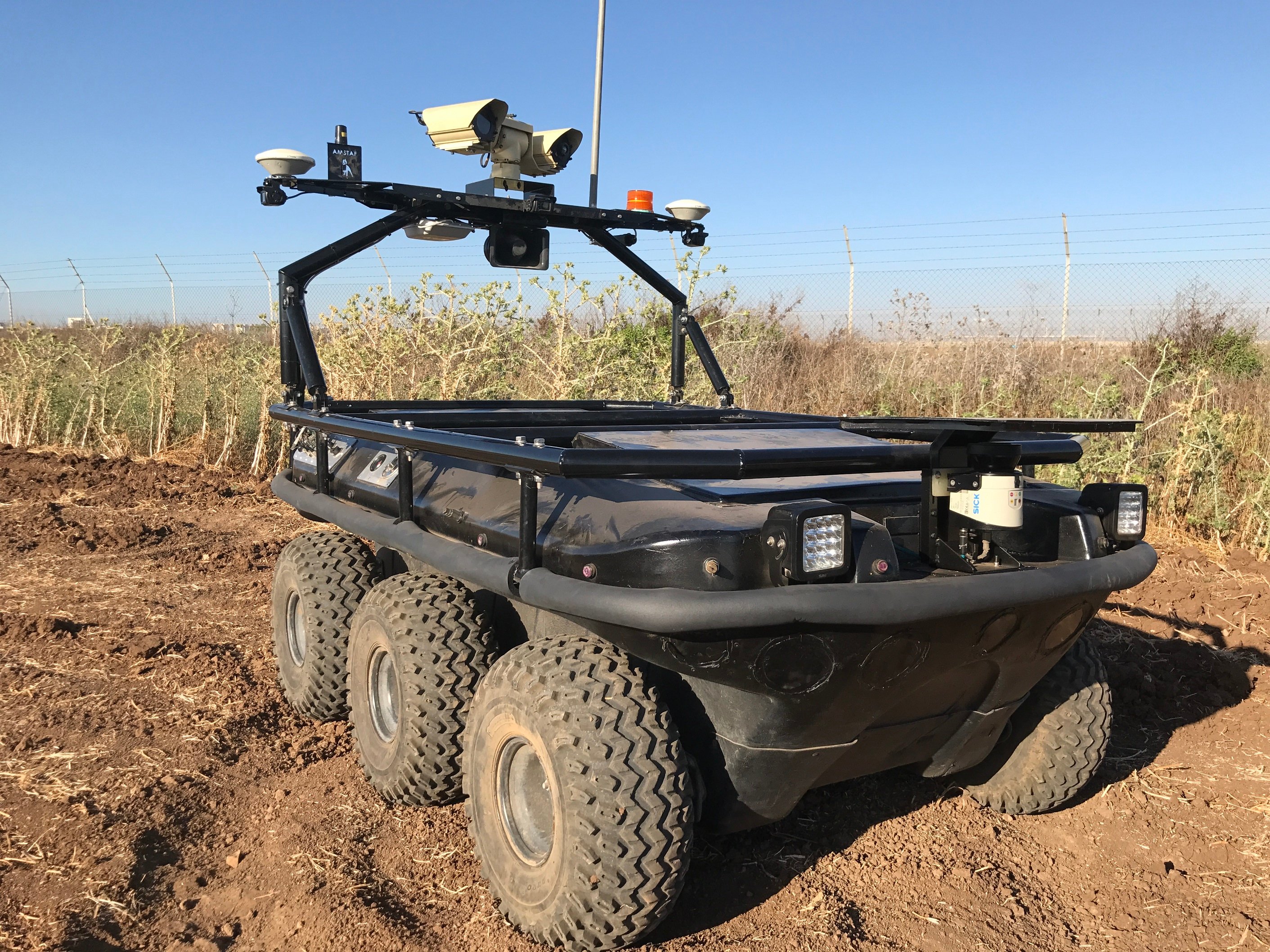
Automotive Robotic Industry Ltd. (ARI) – a leading developer of advanced mission-oriented Autonomous Unmanned Ground Vehicles (UGV) – highlights the AMSTAF family of autonomous, multi-mission robotic vehicles at AUSA Annual Meeting 2017. These vehicles will be offered in three (3) sizes – four (4), six (6) and eight (8) wheels, designed for carrying various payloads, for different purposes and missions.
“We developed the AMSTAF family of UGVs in order to meet the need for a cost-effective, modular, versatile platform that can be easily adapted to various types of missions,” said Ronen Fishman, CEO of ARI.
The versatile capabilities of the AMSTAF UGV can be tailored to the customer’s needs and missions. While various payloads can be installed on the vehicle, it was designed for use in diverse military, HLS and law enforcement applications including border patrol, riot control, ISR, search & rescue, CBRN detection, firefighting and can serve as a Multipurpose Logistics Vehicle (MLV). In missions such as border security, several vehicles can work together autonomously and in full synchronization with each other. In the case of failure of one of the vehicles, the others will perform the mission in its place. The AMSTAF is all terrain amphibious UGV.
The AMSTAF UGVs are highly maneuverable and robust. They have two electric motors with continuous torque to all axles, skid steering, and an integral generator allowing for up to forty-eight (48) hours of continuous operation, with a duty cycle of 70%.
The AMSTAF UGV features 4 day/night fixed wide-angle cameras that provide a 360° view, and a day/night PTZ camera with parallel IR LED spotlight. The vehicle also features an audio system and a remote-controlled kill switch using a different communication system for safety. The vehicle’s capabilities include: autonomous path planning, obstacle detection, avoidance, and rapid reaction. An integrated Geographic Information System (GIS) provides asset or threat location and real-time mission parameters via its Autonomous Operation Control Unit (AOCU) computer.
“The vehicle has been operational in several countries for almost two years,” said Fishman, “and is gaining praise among our customers because of its high reliability and technological capabilities that make it a leading solution in its category.”
