

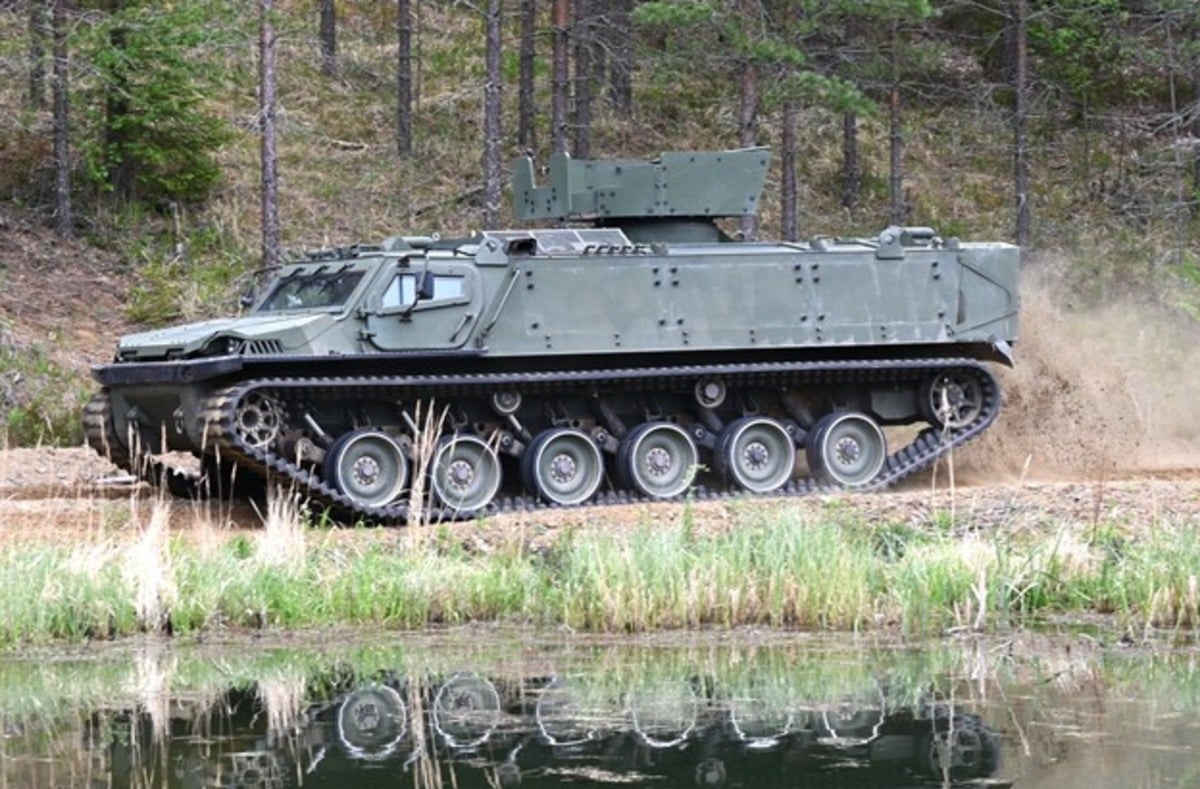
- Finland, Norway, and Latvia signed a Statement of Intent on the Patria TRACKX armored tracked vehicle at the NATO Summit in Ankara on July 7.
- The agreement allows the three countries to share field trial data and explore joint procurement, with serial production targeted to begin in 2027.
Finland, Norway, and Latvia signed a Statement of Intent at the NATO Summit in Ankara, Türkiye, on July 7, committing the three nations to jointly develop and potentially jointly buy a new Finnish-designed armored vehicle built specifically to move troops across terrain that stops most tracked vehicles cold, from deep Arctic snow to open bogs and marshland.
The agreement centers on the Patria TRACKX, a tracked armored personnel carrier developed by Finnish defense manufacturer Patria, and it allows the three countries to share data from ongoing field trials while exploring a coordinated procurement and development arrangement rather than each nation buying separately and paying full development costs on its own.
Understanding why three NATO and NATO-adjacent countries would team up on a single vehicle starts with a gap that has quietly persisted in European armored forces for decades. Many NATO militaries still rely on tracked personnel carriers dating back to the Cold War, chiefly the American-designed M113 and the Soviet-era MT-LB, both workhorse vehicles from the 8 to 15 ton weight class that remain in service today mostly because nothing modern has replaced them at a comparable price point. TRACKX is built to fill exactly that gap, weighing in at roughly 15 tons (33,000 lb) in combat configuration and capable of carrying ten fully equipped troops plus a two-person crew, all inside a hull that can climb 60 percent gradients, cross trenches 2 meters (6.5 feet) wide, and swim across rivers and lakes at up to 4 km/h (2.5 mph) using its own tracks for propulsion once its snorkels are raised and bilge pumps activated. The vehicle has already been tested at temperatures ranging from negative 46 degrees Celsius to positive 44 degrees Celsius (negative 51 to 111 degrees Fahrenheit), a range built specifically around Nordic winters and the kind of extreme cold that has historically immobilized less specialized armor.
It grew out of the Future Highly Mobile Augmented Armoured Systems program, known by the acronym FAMOUS, a multinational European effort co-funded by the European Defence Fund that first showed a concept prototype at the Eurosatory defense exhibition in 2024 before Patria formally launched the production version at the DSEI UK exhibition in London in September 2025. Finland’s own defense forces backed the vehicle’s initial design and have already placed an order for a pre-series batch expected for delivery this year, giving the country hands-on operational experience with the platform well before Tuesday’s trilateral agreement was signed. Serial production is expected to begin in 2027, and Finland has a separate, parallel arrangement with Sweden’s defense procurement agency to prepare for pre-series purchases and technology cooperation on the same vehicle, an arrangement the new three-nation Statement of Intent explicitly describes as continuing to run alongside the broader cooperation framework.
“Europe and allied nations need a new level of mobility that provides land forces with a capability that no single nation can deliver on its own,” said Panu Routila, President and CEO of Patria. “Multinational cooperation and joint procurement are the best way to turn shared requirements into fielded capability and interoperability. The Statement of Intent shows that all-terrain mobility is a strategic capability area for NATO and European defence, addressing the need to renew ageing armoured vehicle fleets with a European vehicle.”
Patria has built its recent business strategy almost entirely around getting multiple countries to co-develop and co-purchase vehicles rather than selling to one customer at a time, an approach the company already proved out with its wheeled Common Armoured Vehicle System, or CAVS, program built around Patria’s 6×6 vehicle. That program began in 2020 with just Finland and Latvia and has since grown to include Sweden, Germany, Denmark, Norway, and the United Kingdom, with nearly 1,000 vehicles ordered and more than 220 already delivered, making it one of the largest active armored vehicle programs in Europe and a template the company is now attempting to replicate for tracked vehicles.
“The success of the ongoing CAVS programme shows the value of multinational cooperation,” said Jussi Järvinen, Executive Vice President of Patria’s Protected Mobility business area. “This Statement of Intent confirms strong interest in a common tracked vehicle platform that can strengthen interoperability, joint capability and life-cycle efficiency. Patria TRACKX is designed for all conditions, with high mobility, protection, situational awareness and operational range. It is also well suited to Ukraine’s needs.”
That last line carries real weight given the operating environment TRACKX has been tested against. Ukraine’s battlefield has become the defining proving ground for what modern armored vehicles actually need to survive, from soft, churned-up mud that swallows heavier vehicles to constant drone surveillance that punishes anything too large or too slow to disperse quickly, conditions that closely mirror the boggy, forested terrain TRACKX was originally designed to master in Nordic Lapland. A vehicle engineered for low ground pressure and amphibious river crossings in Finland’s wilderness translates reasonably well to Ukraine’s flooded fields and waterways, even though Patria’s statement stops short of confirming any concrete plans to supply Ukraine directly.
The joint agreement signed in Ankara sets a specific target: enabling national serial production orders from participating countries starting in 2027, the same year Patria has said mass production of TRACKX will begin regardless of how many countries ultimately join the cooperation framework. That timeline gives Finland, Norway, and Latvia roughly a year to work out the details of a joint procurement arrangement, following the same broad playbook that turned CAVS from a two-country pilot project into a seven-nation program with hundreds of vehicles delivered.
What the Statement of Intent does not lock in is exactly how many vehicles each of the three countries plans to buy, what the eventual per-unit cost will look like once serial production scales up, or whether additional nations will join the arrangement before 2027 the way CAVS steadily attracted new partners after its own modest start. Latvia and Norway have not previously disclosed public armored vehicle requirements specific to TRACKX, meaning both countries are effectively signaling early interest and locking in a seat at the table for future joint procurement decisions rather than committing to a fixed order today.