

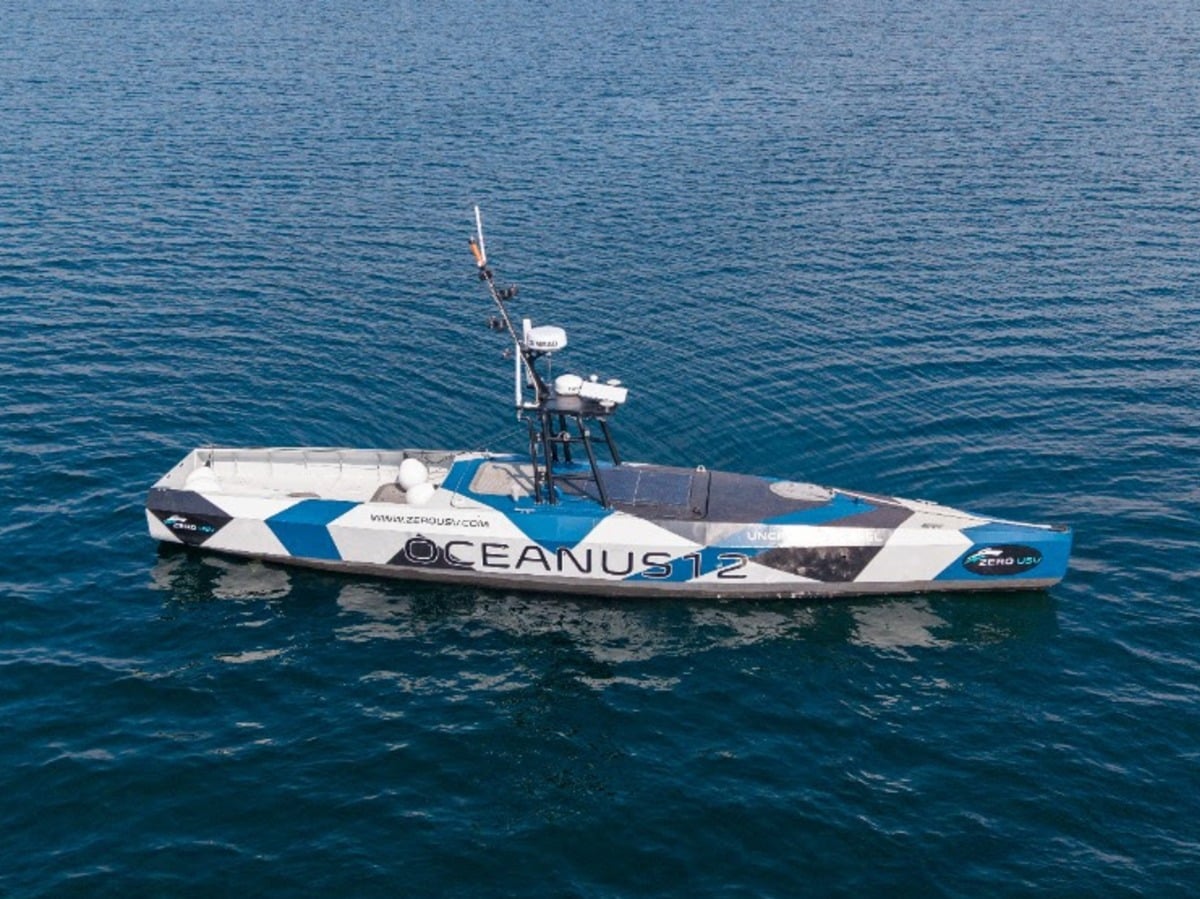
ZeroUSV has demonstrated its Oceanus12 uncrewed surface vessel to the Royal Danish Navy in Denmark, putting a British-built autonomous boat in front of a NATO fleet watching how crewless maritime systems could reshape patrol, surveillance, and seabed security missions.
The two-day demonstration took place at a location about two hours northwest of Copenhagen after Danish Defence competitively selected ZeroUSV to show the Oceanus12 in country. The company said the event allowed Danish Defence and the Royal Danish Navy to assess how quickly the vessel could be moved, launched, and reconfigured for different missions, rather than simply watch a scripted technology display from a distance.
The Oceanus12 is a 12 m (39 ft) uncrewed surface vessel, or USV, designed to operate without a crew on board while carrying sensors or other mission equipment across maritime areas. ZeroUSV says the platform was designed and built in the United Kingdom with a modular payload architecture, meaning operators can change the equipment package to suit different tasks rather than buying a separate vessel for every mission.
That modularity was one of the main points of the Danish demonstration, and ZeroUSV said the Oceanus12 showed the ability to shift between intelligence, surveillance, and reconnaissance missions and rapid environmental assessment missions on sequential days. ISR usually means collecting information through sensors such as cameras, radar, or electronic payloads, while rapid environmental assessment can help navies understand local sea, weather, seabed, or hydrographic conditions before operations.
“We were delighted to be selected by the Danish Defence to demonstrate our highly capable and technologically mature Oceanus12 USV in Denmark,” said Matthew Ratsey, Managing Director of ZeroUSV.
For a navy operating around Denmark, that mix of missions is not abstract. Danish waters connect the North Sea and the Baltic Sea through some of Europe’s most sensitive maritime approaches, with heavy commercial traffic, offshore energy infrastructure, military transit routes, and NATO surveillance requirements all competing for attention. A vessel that can patrol or collect data without putting sailors aboard can reduce risk in bad weather, contested areas, or repetitive missions that consume crew time.
“To be competitively selected by Danish Defence, and given the opportunity to showcase the platform in country to the Danish Royal Navy, allowed us to prove how easily our platforms can be mobilised and the ability to re-role the USV for different missions in sequential days – from ISR to REA on back to back mission. This is the future and template for how autonomous maritime systems can support future naval operations,” said Matthew Ratsey, Managing Director of ZeroUSV.
The Oceanus12 sits in a growing class of uncrewed maritime systems that are larger and more capable than small harbor drones, but still far cheaper and easier to deploy than crewed patrol vessels. ZeroUSV has previously described the vessel as using a hybrid-electric drive system with twin drives for redundancy and efficiency, plus onboard fuel for a cruising range of more than 4,630 km (2,877 miles), or roughly 2,500 nautical miles. That kind of endurance matters because maritime surveillance is often less about sprint speed than persistence across wide areas.
Oceanus12 is not presented as a suicide attack craft in the ZeroUSV release. Its value lies in persistence, payload flexibility, and the ability to perform dull, dangerous, or data-heavy tasks without tying up a crewed ship. A USV can screen an area, carry environmental sensors, support hydrographic work, monitor approaches to a port, or extend the reach of a naval task group by placing sensors where a crewed vessel would be too costly or exposed.
The company’s broader Oceanus family includes Oceanus12 and Oceanus17 vessels, reflecting a design approach that can scale mission capacity through hull size. ZeroUSV says the business combines more than 50 years of marine design, build, engineering, and operational experience, including the MSubs and MarineAI ecosystem behind earlier autonomous maritime work. That pedigree matters in a field where software, hull design, power management, and remote operations all have to work together.