

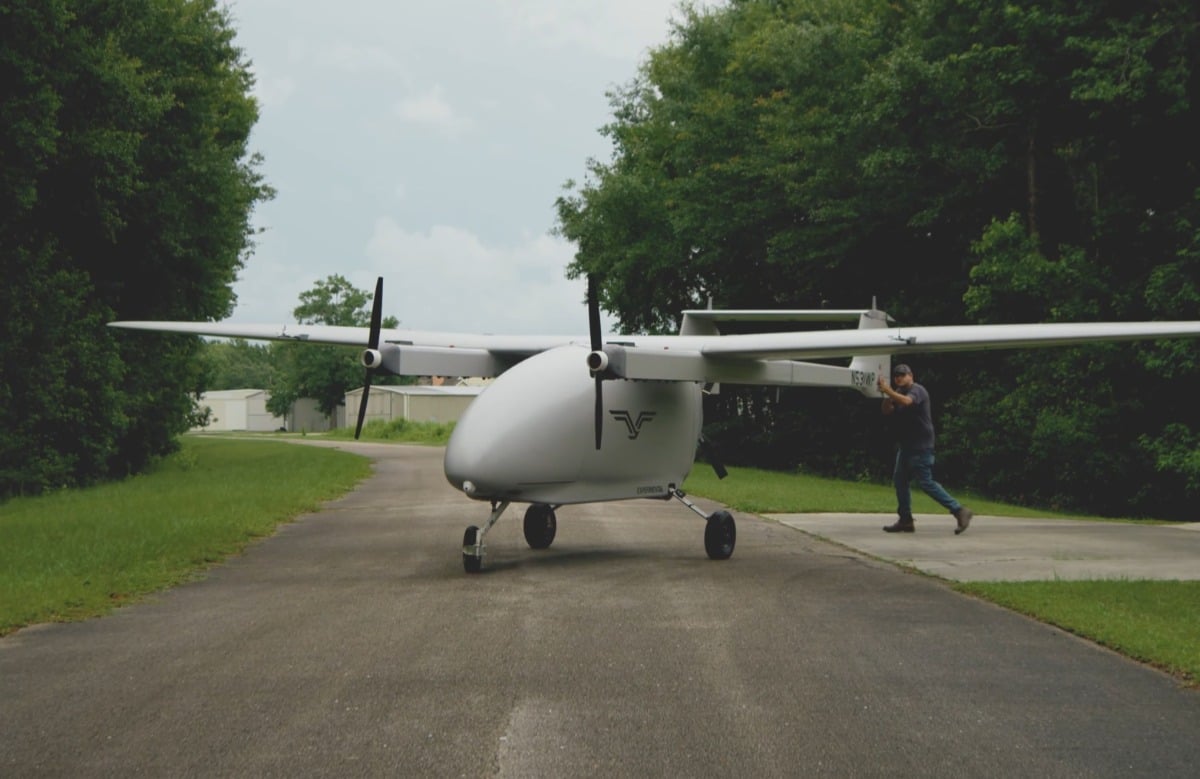
- Pyka's DropShip autonomous cargo aircraft completed a 20-mile resupply flight and 200-pound precision airdrop during the Army Reserve's CSTX exercise within Operation Sentinel Justice.
- The aircraft also landed on an unprepared grass runway and participated in a simulated casualty evacuation scenario with Army soldiers.
Pyka’s autonomous cargo aircraft DropShip flew a 32 km (20-mile) resupply mission entirely without a human pilot from Gulfport to Diamondhead, Mississippi, then executed a precision 91 kg (200 lb) airdrop, as part of the U.S. Army Reserve’s Combat Support Training Exercise within Operation Sentinel Justice, the company announced June 30, 2026.
The aircraft also landed on an unprepared grass runway during the exercise, validating its ability to operate from austere locations without traditional airfield infrastructure, and separately collaborated with Army soldiers in a simulated casualty evacuation scenario, demonstrating a use case for the aircraft beyond pure cargo delivery.
DropShip is a hybrid-electric, autonomous aircraft built by Pyka, designed specifically for what the military calls contested logistics, the problem of getting critical supplies to forward units when the routes and airspace available are too dangerous or too remote for conventional manned cargo aircraft.
The aircraft carries a maximum payload of 249 kg (550 lb), has a ferry range exceeding 5,633 km (3,500 miles), and operates on a hybrid propulsion architecture that combines internal combustion power for long-range endurance with a quiet, low-signature all-electric mode capable of approximately 45 minutes of flight, giving operators the option to switch to silent running during the most sensitive portions of a mission. The Defence Blog previously reported on DropShip’s June 11, 2026 precision airdrop demonstration, where the aircraft delivered multiple 91 kg payloads from 91 m (300 ft) altitude, landing each one within 15 m (50 ft) of its intended target, an accuracy figure that significantly exceeds the standard military expectation of 150 ft precision for autonomous airdrop systems.
The aircraft that flew at the Combat Support Training Exercise builds directly on Pyka’s commercial foundation rather than starting from an unproven concept. The Defence Blog also reported in May 2026 on DropShip’s first flight, a Group 3+ autonomous aircraft with a maximum takeoff weight of 635 kg (1,400 lb), which the company achieved in just six months from initial concept, a development pace made possible by transferring proven flight control software, electric propulsion systems, and autonomy stack directly from Pyka’s Pelican 2 agricultural aircraft, a commercial platform that has logged more than 10,000 flights and stands as the largest unmanned aircraft system certified for commercial use by the FAA.
Michael Norcia, CEO, CTO, and co-founder of Pyka, framed the Combat Support Training Exercise demonstration as direct validation of capability the Army Reserve has explicitly requested.
“Army Reserve leaders have been clear about the autonomous, runway-independent aircraft to support critical operations in austere environments,” Norcia said. “CSTX provided an outstanding opportunity to showcase how DropShip can help close logistics gaps, extend operational reach, and increase the resilience of sustainment operations.”
Operation Sentinel Justice, the broader exercise framework hosting Pyka’s demonstration, is the largest training exercise in the history of the U.S. Army Reserve, a multi-week event at Camp Shelby Joint Forces Training Center in Mississippi that has served as a proving ground for multiple emerging logistics technologies during 2026, including the autonomous railcar trials conducted by Intramotev under similar Army Reserve technology insertion authority. The pattern across these demonstrations reflects a deliberate Army Reserve strategy of using its largest annual exercise as a structured evaluation environment for commercial technology, allowing soldiers to operate emerging systems under realistic conditions before any formal procurement decision commits the service to a specific platform.
The grass runway landing demonstrated during the exercise addresses a specific operational vulnerability that has shaped military logistics planning since the early lessons of the war in Ukraine became apparent. Fixed airfields, with their predictable locations, paved runways, and concentrated support infrastructure, represent exactly the kind of high-value, easily targeted node that an adversary’s long-range precision strike capability is designed to destroy. An aircraft that can land and take off from an unprepared grass strip, requiring as little as 46 m (150 ft) of takeoff distance according to prior company statements, eliminates the dependency on a fixed runway entirely, allowing resupply missions to originate from and terminate at locations an adversary cannot easily predict or pre-target. That capability becomes particularly relevant in dispersed operating concepts the Army has been developing for potential conflicts in environments like the Indo-Pacific, where island distances and limited airfield infrastructure make traditional logistics chains especially vulnerable.
The casualty evacuation demonstration represents an extension of DropShip’s mission profile beyond the cargo delivery role the aircraft was originally designed around, and it reflects a broader trend across the unmanned logistics aircraft sector toward platforms that can serve multiple mission types without requiring separate, purpose-built aircraft for each function. A medical evacuation under contested conditions traditionally requires a crewed helicopter or aircraft to fly into potentially hostile airspace to retrieve wounded personnel, exposing both the aircraft crew and the medical team to direct enemy fire during the most vulnerable phase of the mission. An autonomous platform capable of even a limited casualty extraction role, operating without placing a pilot at risk, addresses a genuine capability gap that military medical logistics planners have identified as increasingly important given the proliferation of drones and precision weapons that have made traditional medevac flights considerably more dangerous in recent conflicts.
DropShip’s modular, open-architecture mission system allows the aircraft to be reconfigured for different roles, including intelligence, surveillance, and reconnaissance sensors, waveform-agnostic communications relay equipment, and mothership support for smaller unmanned vehicles, in addition to its core cargo and now demonstrated medical evacuation capabilities, all enabled through a secondary mission computer designed for rapid plug-and-play payload integration. That flexibility positions the aircraft as a single platform capable of addressing multiple distinct logistics and sustainment problems rather than requiring separate dedicated systems for each mission type, a design philosophy that matters considerably for budget-constrained military planners trying to build resilient, distributed logistics networks without procuring an entire fleet of specialized aircraft.
What the Combat Support Training Exercise demonstration ultimately proved is that DropShip’s capabilities work in the hands of actual Army personnel under realistic field conditions, not merely in controlled company demonstrations. A 20-mile resupply flight, a precision airdrop, a grass runway landing, and a casualty evacuation rehearsal, all conducted within a single exercise window, gives the Army Reserve a concrete data point on a platform it has explicitly said it needs.