

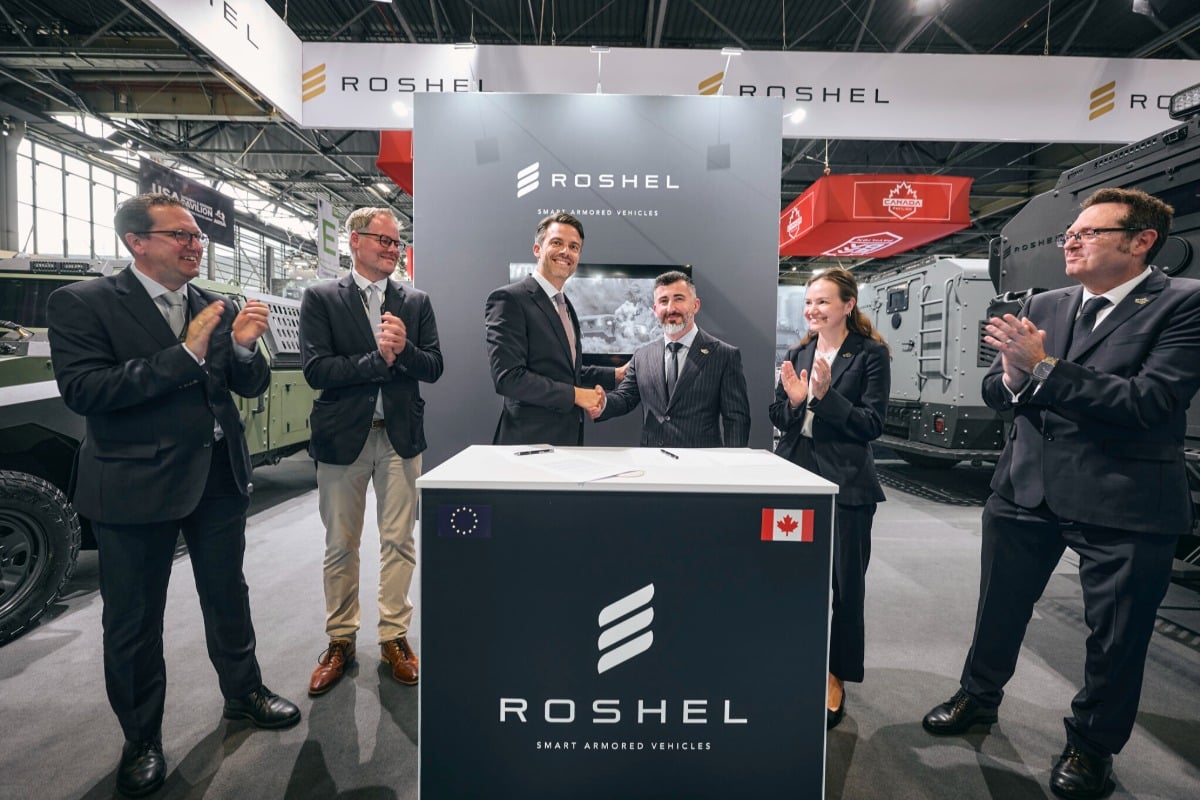
- Daimler Truck AG and Roshel Inc. signed an MOU at Eurosatory 2026 on June 16 to jointly develop, produce, and support armored military vehicles for NATO and allied customers.
- Roshel has delivered more than 2,500 armored vehicles to Ukraine; Daimler Truck contributes platforms including the Zetros, Unimog, Arocs 8x8, and FGA family.
Roshel Inc., the Canadian armored vehicle company that has delivered more than 2,500 protected vehicles to Ukraine since Russia’s full-scale invasion began in February 2022, signed a Memorandum of Understanding at Eurosatory 2026 in Paris on June 16 with Daimler Truck AG, the German commercial vehicle giant that earlier this week launched its own dedicated defense brand, to jointly develop, produce, market, and support a family of protected and armored military vehicles for NATO, allied, and partner-nation customers.
The agreement pairs a company that has proven it can build armored vehicles quickly and deliver them into an active war zone with a company that has the industrial scale, engineering depth, and global service network to take that capability to a far larger market than either could address independently.
Roshel, headquartered in Ontario, Canada, is not a household name outside defense procurement circles despite its remarkable recent track record, having grown from a relatively obscure vehicle uparmoring operation into one of the most significant suppliers to Ukraine’s military within the space of a few years by doing something that most established defense companies struggled to match: delivering finished armored vehicles fast, in volume, and with the specific configurations that frontline Ukrainian units actually needed rather than the configurations that looked best in a catalog. Roman Shimonov, CEO of Roshel, described the partnership in terms of what that combination of speed and scale can produce.
“In just a few years, Roshel has delivered more than 2,500 armoured vehicles to Ukraine, showing that speed, quality, and innovation matter in real-world conflict,” Shimonov said. “By bringing together Roshel’s proven protection systems, integrated manufacturing, and ability to deliver at scale with Daimler Truck’s world-class platforms, engineering experience, and global reach, we are creating a stronger and more complete offering for allied customers.”
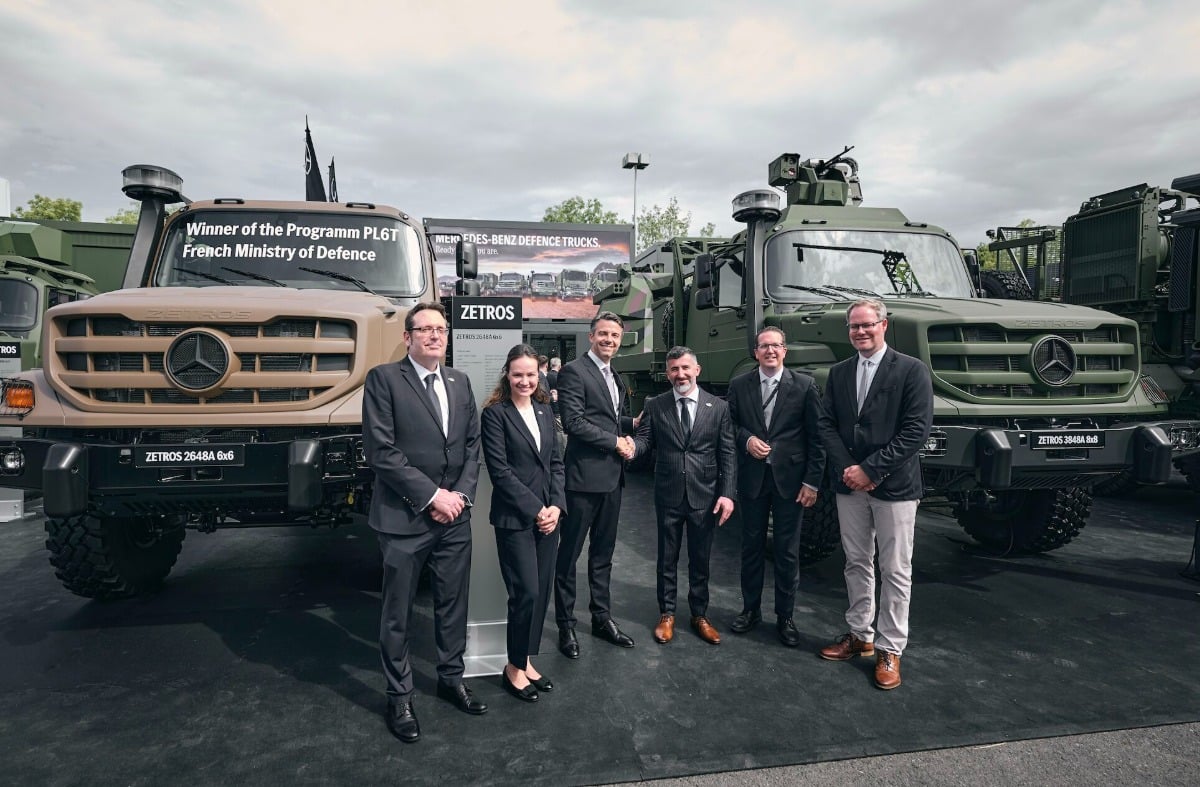
The vehicle platforms Daimler Truck brings to the partnership span the full range of military mobility requirements, from the Unimog, a highly capable off-road platform with decades of military service history across dozens of armies in engineering support, medical evacuation, and light tactical roles, through the Zetros, a heavy-duty tactical truck designed for extreme off-road conditions and already committed to France’s armed forces in a separate 7,000-vehicle framework agreement announced earlier this week, to the Arocs 8×8, a heavy-lift platform suited to armored logistics and support operations in demanding environments, and the FGA platform family, a tactical vehicle foundation adaptable to mine-resistant ambush-protected vehicle, armored personnel carrier, counter-drone, and mobile command-and-control configurations. That breadth gives the partnership a product range that covers the majority of the protected mobility requirements that NATO governments are currently trying to fill, from light reconnaissance through heavy armored logistics, without requiring the development of entirely new base vehicles.
Roshel’s contribution to the partnership sits on the other side of that equation, focused not on vehicle platforms but on what happens to those platforms after the basic chassis arrives at the production line. The company’s vertically integrated manufacturing model means it handles ballistic steel processing, armored plate fabrication, transparent armor production including ballistic glass, armored capsule engineering, drivetrain integration, and mission system installation including communications, intelligence systems, and counter-drone equipment all within its own facilities, a capability set that most defense vehicle manufacturers outsource to multiple suppliers and that creates both quality control advantages and delivery speed advantages when production demand surges. That in-house capability is what allowed Roshel to scale its Ukraine deliveries rapidly rather than being constrained by the lead times of external suppliers, and it is what makes the company a genuinely complementary partner to Daimler Truck rather than simply a customer for Daimler’s platforms.
Daniel Zittel, Chief Sales Officer of Daimler Truck Defence, framed the partnership’s value proposition directly. “Daimler Truck contributes proven vehicle platforms and industrial scale, while Roshel brings expertise in armoured vehicles, operational track record, and ability to deliver quickly,” Zittel said. “Together, we are offering allied governments a compelling and integrated solution.” That phrase, “operational track record,” carries specific weight in a defense market where the difference between a company that has produced vehicles used in active combat and a company that has produced vehicles used in training exercises is increasingly the deciding factor in procurement decisions, as governments that have watched Ukrainian forces fight with and die in various armored vehicles have developed sharply refined views about which design decisions actually save lives under the conditions of modern warfare.
The MOU framework covers joint development, industrialization, localization, lifecycle support, and sustainment, and includes flexible production models such as completely knocked down and semi-knocked down assembly options that allow allied governments to build domestic content into their vehicle programs by assembling finished vehicles from imported component kits within their own countries, a model that has become increasingly important to governments that want both the capability and the industrial jobs that come with producing it locally. That flexibility directly addresses one of the most common objections that defense ministries raise when evaluating imported vehicle programs, namely that buying finished vehicles from a foreign manufacturer does nothing to build the domestic industrial capacity that long-term defense resilience requires.