

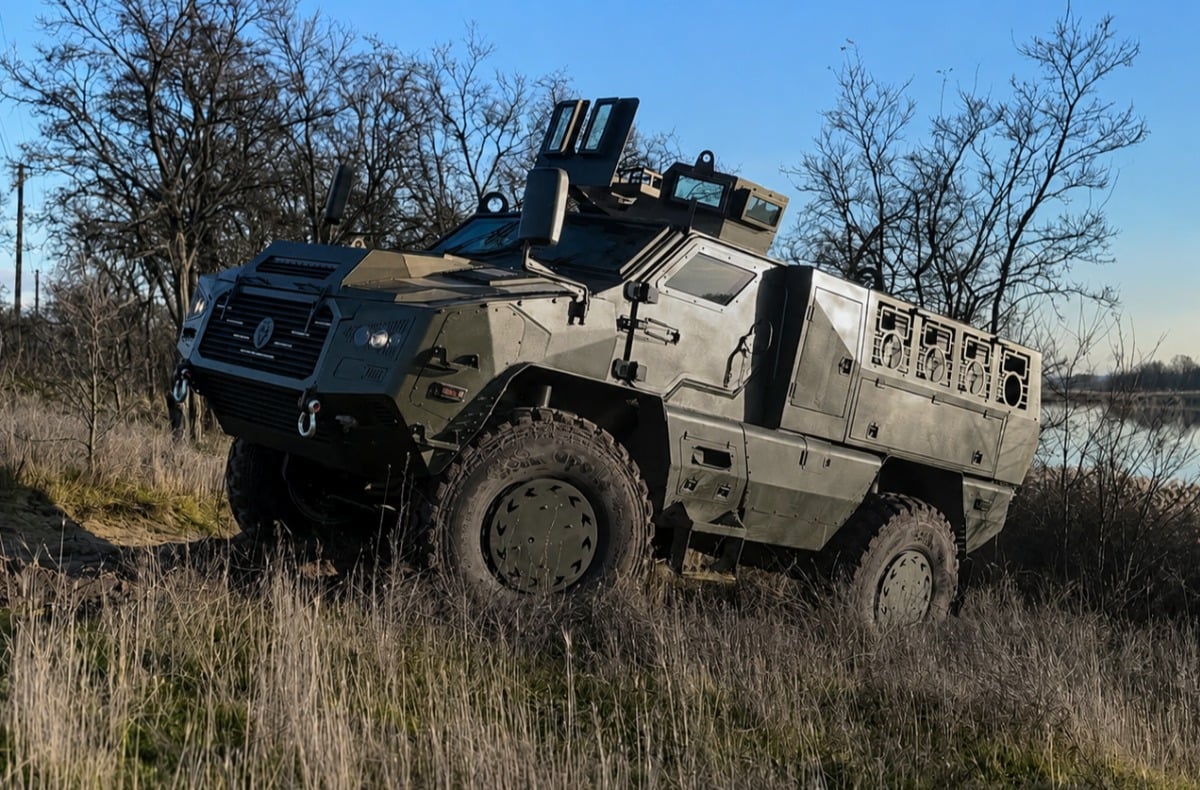
- Ukraine's Ministry of Defense certified the MAC OWL Sova armored vehicle as the most highly protected locally armored vehicle in its class.
- The MAC OWL meets STANAG 4569 Level 4a/4b mine protection against 10 kg TNT and is designed to mount up to ten electronic warfare modules against FPV drones.
Ukraine’s Ministry of Defense has formally approved and codified an armored vehicle for service with the Armed Forces of Ukraine, recognizing it as the most highly protected locally armored vehicle in its class, a designation that carries particular weight when the country producing that judgment has been fighting one of the most intense land wars in modern history for more than four years and has buried more soldiers lost to mine strikes, drone attacks, and artillery fragmentation than almost any other nation in recent memory. The vehicle in question is the MAC OWL, known locally by its Ukrainian name Sova, developed jointly by Ukrainian defense company MAC HUB and Paramount Industries Innovation Systems Greece, a subsidiary of the South African-founded Paramount Group that operates from Greece, and the certification was announced at Eurosatory 2026 in Paris on June 16.
The MAC OWL sits in the category of mine-resistant ambush-protected vehicles, commonly called MRAPs, a class of armored transport designed specifically around the threat of explosive devices detonating beneath or beside the vehicle rather than in front of it, which was the traditional focus of tank and armored personnel carrier design. The MRAP concept, which emerged from hard lessons learned by American and coalition forces in Iraq and Afghanistan where improvised explosive devices became the leading cause of casualties, produces vehicles with V-shaped or blast-deflecting hulls that redirect the energy of an explosion away from the crew compartment rather than attempting to absorb it directly. The MAC OWL incorporates a flat V-shaped blast-deflecting hull architecture derived from Paramount’s Mbombe 4 Infantry Combat Vehicle, a South African-developed platform whose hull geometry reflects more than three decades of experience designing mine-protected vehicles for conflict environments across Africa and beyond.
The vehicle is described as meeting STANAG 4569 Level 4a/4b mine protection, withstanding up to 10 kg (22 lb) TNT equivalent under the wheel and hull, a standard defined by NATO to measure armored vehicle resistance against blast threats and used by militaries across the alliance as a common benchmark for comparing protection levels across different platforms and national procurement programs. A 10 kg TNT-equivalent blast represents a substantial threat, roughly equivalent to a large anti-tank mine or a significant improvised explosive device, and certification against that threshold reflects the specific threat environment Ukrainian forces face daily on roads, fields, and approaches that Russian forces have mined extensively throughout the conflict. The press release also states that the MAC OWL features the thickest side armor among comparable domestic and foreign vehicles in its category, a claim attributed to the Ukrainian Ministry of Defense’s evaluation rather than the manufacturer, which gives it a degree of independent credibility that self-reported specifications cannot provide.
Beyond its blast protection architecture, the MAC OWL is designed to mount up to ten electronic warfare modules against FPV drones, a capability that would have been considered an unusual design requirement for any armored vehicle a decade ago but has become an operational necessity in Ukraine, where first-person-view drones, small unmanned aircraft controlled by a pilot wearing video goggles who sees the world through the drone’s camera, have been used by Russian forces in enormous numbers to hunt, track, and destroy armored vehicles of every type. Electronic warfare protection against FPV drones typically targets radio-frequency control, telemetry, or video links; fiber-optic drones are less vulnerable to such jamming, which means the ten-module architecture provides meaningful protection against the majority of radio-controlled FPV threats while the fiber-optic variant remains a distinct and harder-to-counter challenge that no electronic warfare system currently eliminates reliably.
MAC HUB Director Oleksandr Dubyna described how Ukrainian engineers approached the vehicle’s design with the operational realities of the current conflict as their primary reference point, drawing on frontline feedback and combat lessons rather than peacetime requirements.
“We drew on the very best of global expertise in the design and production of armoured vehicles and took into account the unique realities of the war being fought in Ukraine,” Dubyna said. “Our primary mission was to protect the lives of the MAC OWL armoured vehicle’s crew. To achieve that, we selected only the most reliable, combat-proven components, integrated the latest technologies, and spent countless hours refining every detail.”
His reference to soldiers being “forced to use civilian vehicles in what is known as the kill zone” describes a documented and persistent problem in Ukraine’s ground war, where the demand for vehicles of any kind has at various points in the conflict outpaced the supply of purpose-built armored platforms, leaving some Ukrainian units relying on commercial pickup trucks, vans, and civilian SUVs that provide no meaningful protection against any of the threat categories the MAC OWL was designed to address. A vehicle certified to the protection standard the MAC OWL has achieved, produced domestically within Ukraine, represents a direct answer to that vulnerability and a meaningful reduction in the risk that Ukrainian crews face when moving through areas where mines, artillery, and drone operators are all simultaneously hunting the same roads.
The MAC OWL’s development reflects the industrial partnership model that Paramount Group has employed across its operations in Africa, Asia, and now Europe, in which Paramount provides the foundational engineering expertise and proven design architecture while the local partner, in this case MAC HUB, contributes manufacturing capability, operational knowledge, and battlefield-driven engineering adaptations. Paramount Greece’s spokesperson described Ukraine’s operational environment in stark terms, noting there can be “few more demanding proving grounds for military equipment than the battlefields of Ukraine,” and the Mbombe 4 platform that provided the hull architecture for the MAC OWL, while fielded by multiple African militaries in counter-insurgency and peacekeeping environments, has been substantially evolved by Ukrainian engineers for the specific threat profile of a peer-state conventional war.
The MAC OWL’s independent suspension system addresses the operational reality that mine-protected vehicles often sacrifice mobility for protection, becoming heavy, slow platforms that are difficult to maneuver in the soft ground, deep mud, and cratered terrain that characterize the eastern Ukrainian front, and that this mobility deficit can itself become a survivability liability if a vehicle becomes immobilized in a contested area. An independent suspension system allows each wheel to respond to terrain changes without affecting the others, maintaining traction and ground clearance across uneven surfaces in a way that dependent axle designs cannot match, which matters as much for crew survival as the armor when the alternative to moving quickly is remaining stationary under fire.