

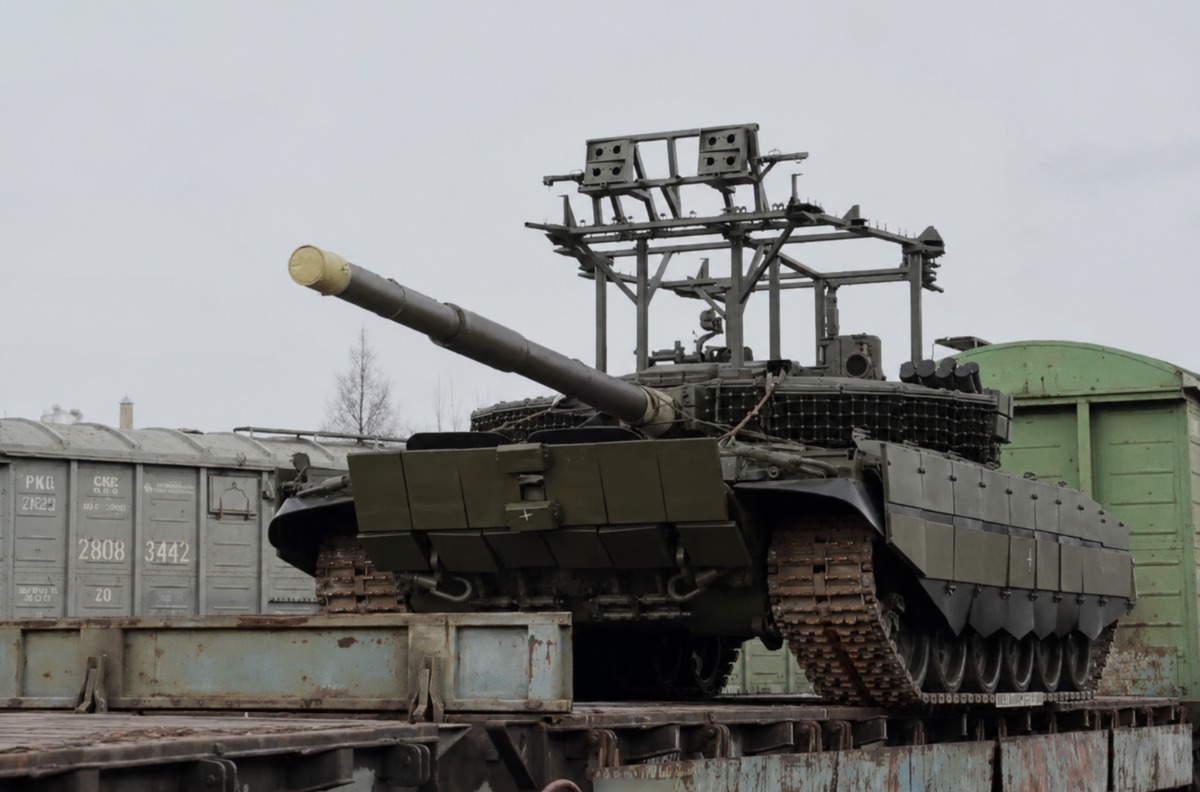
- Rostec dispatched a new batch of T-90M, T-80BVM, and T-72B3M tanks built by Uralvagonzavod ahead of Russia's 81st Victory Day anniversary.
- Rostec confirmed 2025 upgrades to tank electronic warfare suites and added upper hemisphere protection for engine and transmission compartments across the fleet.
Rostec has dispatched a new batch of T-90M, T-80BVM, and T-72B3M tanks to Russian forces, the state defense conglomerate announced on Sunday.
The shipment, described by Rostec as incorporating lessons learned from combat experience and direct feedback from frontline troops, represents the latest in a continuous production flow that Uralvagonzavod has maintained throughout the war in Ukraine. The Nizhny Tagil-based tank manufacturer, which sits within the Rostec structure, has been the backbone of Russia’s armored vehicle production since the full-scale invasion began in February 2022, and the company has repeatedly cited wartime feedback loops as the driver of ongoing technical improvements to all three platforms in the batch.
Uralvagonzavod director general Alexander Potapov framed the delivery in explicitly historical terms, drawing a direct line from the T-34 of World War II to the tanks his factory is shipping today. “In its time, the legendary T-34 fully met the requirements of the era. It became not just a combat vehicle — it became the tank of Victory,” Potapov said. “And today in battle, our T-72s, T-80s, and T-90s also meet modern challenges, combat conditions, and new threats. But these are already different tanks. Time will pass, new tanks will appear as an answer to new threats, but they will be built on the basis of what we are creating now. And our children and grandchildren will speak of today’s 72s, 80s, and 90s the same way we speak of the T-34.”
Victory Day is Russia’s most politically charged military commemoration, and Rostec’s decision to announce a tank delivery in that context — invoking the weapon most associated with Soviet sacrifice and ultimate battlefield success in World War II — is a calculated piece of wartime industrial messaging directed as much at domestic audiences as at any military procurement audience. The tanks going to the front are the point. The T-34 comparison is the frame the Kremlin wants around them.
Beyond the symbolism, Rostec’s announcement included substantive technical disclosures about ongoing modifications to the platforms in production. The electronic warfare protection suite across the tank fleet was significantly upgraded as far back as 2025, according to the company’s statement. Additional armor protecting the engine and transmission compartment projection was also added to the upper hemisphere defensive package — a modification that addresses one of the most documented vulnerabilities Russian armor has faced in Ukraine, where first-person-view drones and loitering munitions have repeatedly attacked tanks from above, targeting the thinner top armor over the engine deck. Work continues on both passive and active protection development, and on improving the operational and technical characteristics of the vehicles, with what Rostec describes as a primary focus on comprehensively improving tank survivability and crew safety.
The top-attack vulnerability problem has been one of the defining tactical challenges of the armored war in Ukraine. Ukrainian drone operators and their Russian counterparts have both developed and refined techniques for attacking tanks from above, exploiting the geometric reality that the roof of a tank turret and the engine deck present thinner armor than the frontal arc. The improvised cope cages and slat armor structures that began appearing on Russian armor in 2022 as field modifications have since evolved into more systematized protection approaches, and Rostec’s reference to enhanced engine compartment protection in the upper hemisphere confirms that factory-level solutions are now being incorporated into production vehicles rather than applied as field expedients after delivery.
Russia’s three main production tank platforms each occupy a distinct position in the current force structure. The T-90M is the most modern and most capable of the three, featuring the Kalina fire control system, the Relikt explosive reactive armor package, and an improved engine. The T-80BVM is a modernized version of the gas turbine-powered T-80, offering high power-to-weight ratio and cold-weather performance at the cost of significantly higher fuel consumption than its diesel counterparts. The T-72B3M remains the numerically dominant platform, a heavily upgraded descendant of the Soviet-era T-72 that has been produced and refurbished in the largest quantities of any Russian tank type since 2022. Delivering all three types in a single batch reflects the reality of Russian armored force composition — a heterogeneous fleet drawing on multiple production lines and refurbishment programs simultaneously.
Uralvagonzavod has operated under significant Western sanctions since the invasion, with restrictions targeting the precision machine tools, microelectronics, and specialized materials that modern tank production and electronics integration require. Rostec’s continued delivery announcements suggest the factory has maintained output through a combination of domestic substitution, parallel import channels, and the drawdown of pre-war component stockpiles, though the full extent to which sanctions have affected production rates and technical quality cannot be independently verified from the available source material.
Russia is shipping tanks to a front that has consumed armor at a rate unprecedented in post-Cold War warfare. Whether the production line can sustain losses that independent analysts have tracked in the thousands since 2022 is the question that Potapov’s Victory Day rhetoric does not address.