


Preparations are underway in Beijing for what is expected to be one of China’s most expansive military parades in years. While ground forces equipment has already impressed observers, analysts say the aviation segment may become the parade’s defining moment.
Andreas Rupprecht, a leading expert on Chinese military aviation, told Defence Blog that the scale of rehearsals alone already exceeds expectations.
“So frankly — and just focusing on the aviation segment and what China is expected to showcase — the rehearsals for the parade alone are already exceeding everything one could have expected (okay, maybe only the presentation of the H-20 stealth bomber would be a sensation now),” he said.
China has unveiled advanced aircraft at past parades, most notably in 2019 during the 70th anniversary of the People’s Republic. Then, the J-20 stealth fighter, J-16, J-10C, Y-20A transport, YY-20A tanker, and the H-6N bomber were displayed for the first time, along with drone systems such as the WZ-8 and GJ-11. Today, these platforms are considered routine and are no longer the center of attention.
According to Rupprecht, the confirmation of the J-20A and its twin-seat variant, the J-20AS, within the People’s Liberation Army Air Force (PLAAF) is one of the first major developments this year.
“This has since been topped by the equally confirmed operational service of the J-35A in the PLAAF and the naval version, the J-35,” he said.
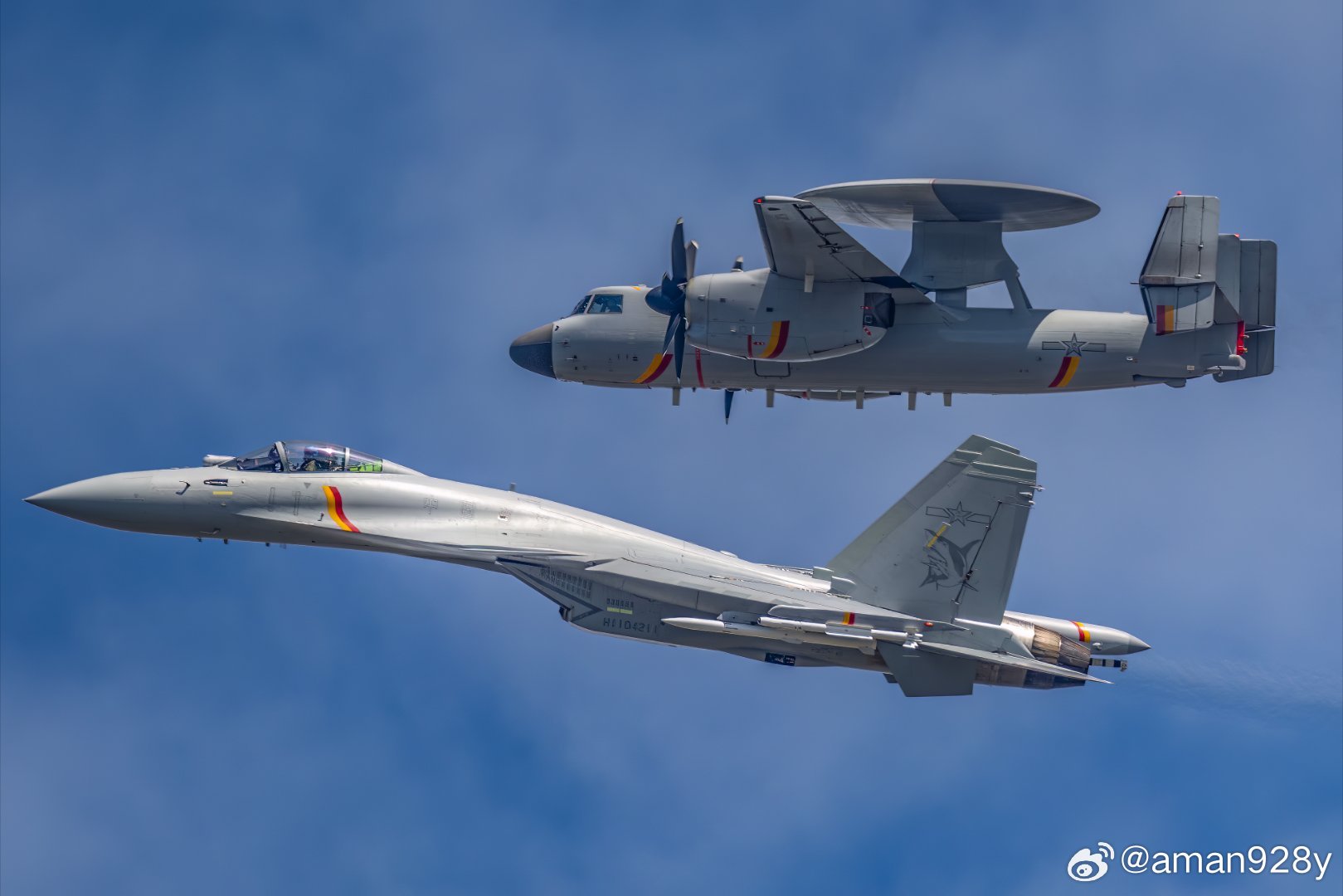
Equally noteworthy is the appearance of the KJ-600, a naval airborne early warning aircraft, alongside advanced versions of the J-15 carrier-based fighter. These include the J-15DH, the J-15DT — an electronic warfare variant — and the catapult-capable J-15T carrying PL-15 long-range missiles. The upgraded Y-20B transport aircraft and electronic warfare platforms such as the J-16D are also part of the lineup.
However, Rupprecht cautioned that these displays risk being overshadowed by even more advanced systems.
“Unfortunately, types like the KJ-500A and other EW aircraft such as the Y-9Z (GX-12), Y-9LG (GX-13), and also the new Y-9QF (GX-15), the most modern anti-submarine warfare aircraft, are completely overshadowed by the aforementioned other highlights,” he noted.
What may draw further attention, Rupprecht said, are the unmanned combat aerial vehicles (UCAVs). “First of all, there is the GJ-11 UCAV again – including the naval version GJ-11J (GJ-21?) – and finally the CCA/UCAVs, which were recently shown for the first time, still cautiously concealed under tarpaulins, of which up to four different types may be shown.”
China’s defense industry has rapidly expanded its aviation capabilities over the last two decades, aiming to challenge Western dominance in both manned and unmanned aircraft. For observers and OSINT analysts, the upcoming parade represents an opportunity to confirm long-rumored platforms and evaluate their integration into China’s military structure.
“All in all, simply a sensation and a treasure trove of new systems for all OSINT specialists,” Rupprecht concluded.
The parade, expected to highlight both traditional and cutting-edge systems, underscores Beijing’s efforts to project power across multiple domains. For regional rivals — including Japan, Taiwan, and the Philippines — the demonstration will be closely watched for what it reveals about China’s evolving military strategy.