

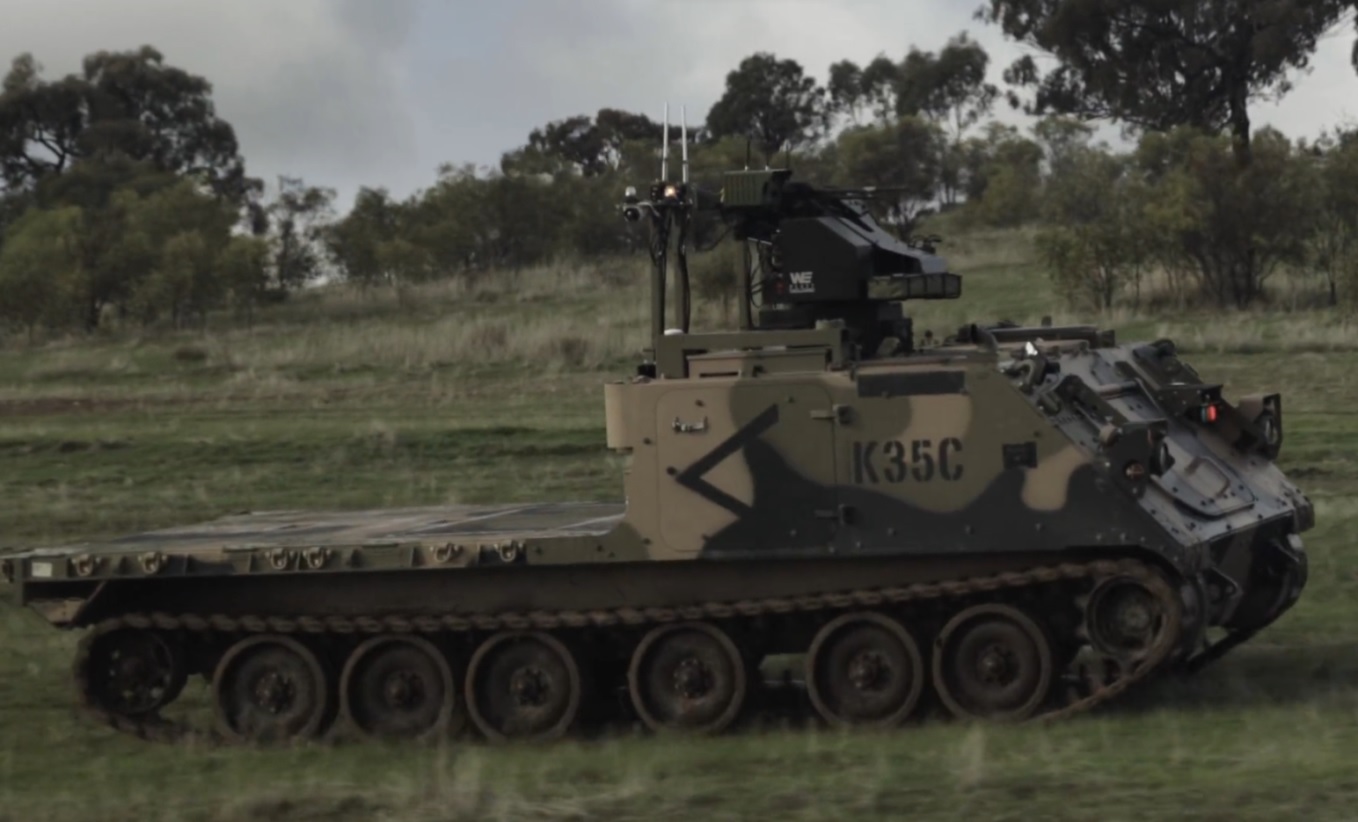
The Australian Army is ushering in a new era of military capability as soldiers undergo training to operate uncrewed M113AS4 Armoured Personnel Carriers (APCs) equipped with integrated remote weapon systems.
This innovative development integrates Optionally Crewed Combat Vehicles (OCCVs), enhancing the capabilities of the M113AS4s with Electro Optical Systems (EOS) Remote Weapon Systems (RWS).
Key to this transformation is the installation of a Vehicle Management System, built on BAE Systems’ domain-agnostic autonomy technologies. This system empowers the M113AS4s to operate autonomously, marking a significant advancement in the Army’s arsenal.
The project, which began in 2019, involved outfitting two M113AS4 Armoured Personnel Carriers with the necessary hardware and software to enable autonomous operation. In 2020, the scope of the project expanded to include an additional 16 M113AS4 vehicles converted to OCCVs. This extension allowed these vehicles to be operated autonomously or with a standard crew, providing greater flexibility in the field.
WATCH 📹 as #AusArmy soldiers learn how to operate an uncrewed M113AS4 Armoured Personnel Carrier with integrated remote weapon systems.
❓ Keen to learn more about Army’s emerging technology projects? Visit https://t.co/VlbysC7XSO pic.twitter.com/kVmfNJ19FP
— Australian Army (@AustralianArmy) October 19, 2023
The integration of unmanned ground vehicles (UGVs) represents a logical progression in military capabilities. By reducing the need for human presence in the battlespace, these systems offer significant advantages. UGVs, with their ability to traverse vast areas and engage enemy forces, broaden deployment options while minimizing human exposure to enemy fire. This strategic shift allows for the deployment of a military force with minimal human presence, creating a distraction for a superior force. This, in turn, enables other units to engage in less risky engagements, ultimately reducing casualties.
While the concept of an almost entirely unmanned military force may seem unlikely and unworkable at present, unmanned aerial vehicles (UAVs) have demonstrated their effectiveness in air-to-ground strikes. UGVs are rapidly advancing in their development, and Artificial Intelligence (AI) as a controlling mechanism is becoming increasingly sophisticated. These advancements pave the way for converting more conventional military capabilities into unmanned systems, with the potential for further transformations in the future.
The Australian Army’s integration of OCCVs with autonomous capabilities represents a significant step toward enhancing military readiness and operational flexibility. As technology continues to advance, it is clear that the role of unmanned systems in modern warfare will continue to evolve, shaping the future of military operations and strategy.