Britain’s largest defense company, BAE Systems, has released detailed reports on unmanned ground vehicles and autonomous systems, according to defense analyst Abraxas Spa on his Twitter account.
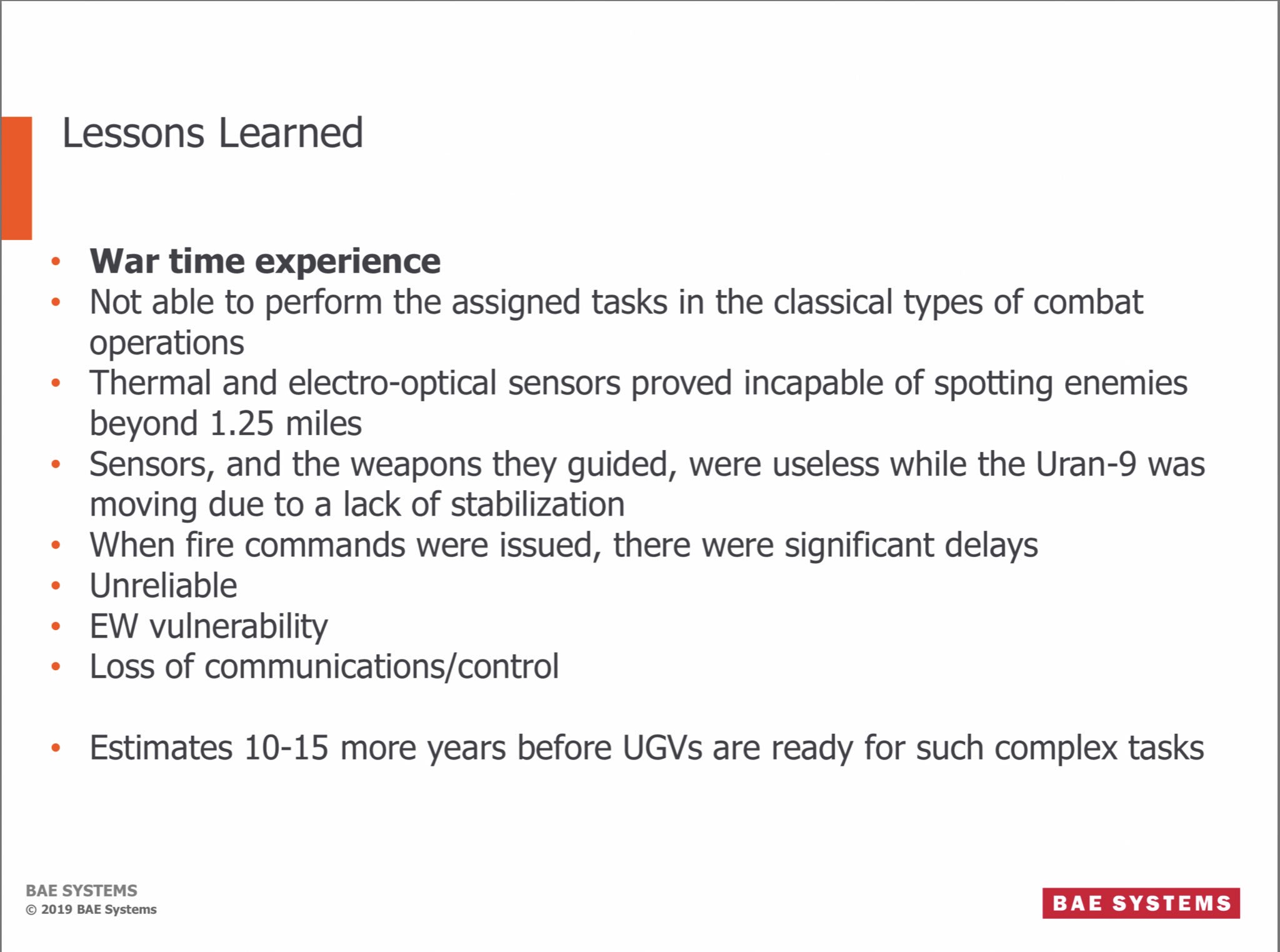
According to BAE Systems, modern Russian combat drones face serious shortcomings. The report includes an analysis of Russia’s Uran-9 unmanned ground vehicle (UGV) and concludes that it is unable to carry out assigned tasks during conventional combat operations.
The report noted that the Uran-9 combat UGV is unreliable. Its thermal and electro-optical sensors were unable to detect enemy targets beyond 1.25 miles. The sensors and the weapons they guided were ineffective while the vehicle was in motion due to a lack of stabilization, and when fire commands were issued, there were noticeable delays.
Senior Research Officer Andrei Anisimov told a conference at the Kuznetsov Naval Academy in St. Petersburg that the Uran-9’s performance in Syria showed that “modern Russian combat Unmanned Ground Vehicles (UGVs) are not able to perform the assigned tasks in the classical types of combat operations.” He concluded that it would take another ten to fifteen years before UGVs could be ready for such complex missions.
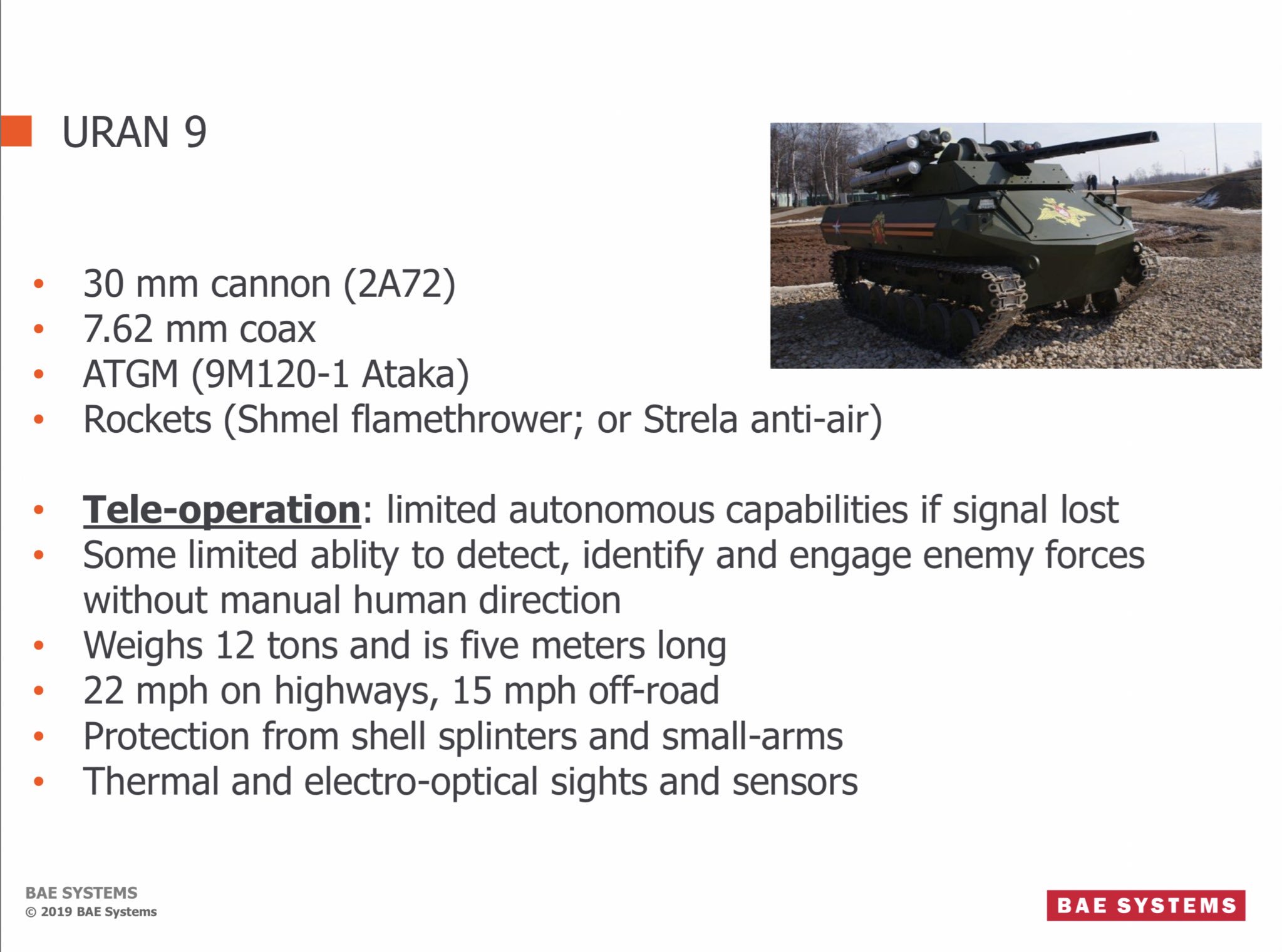
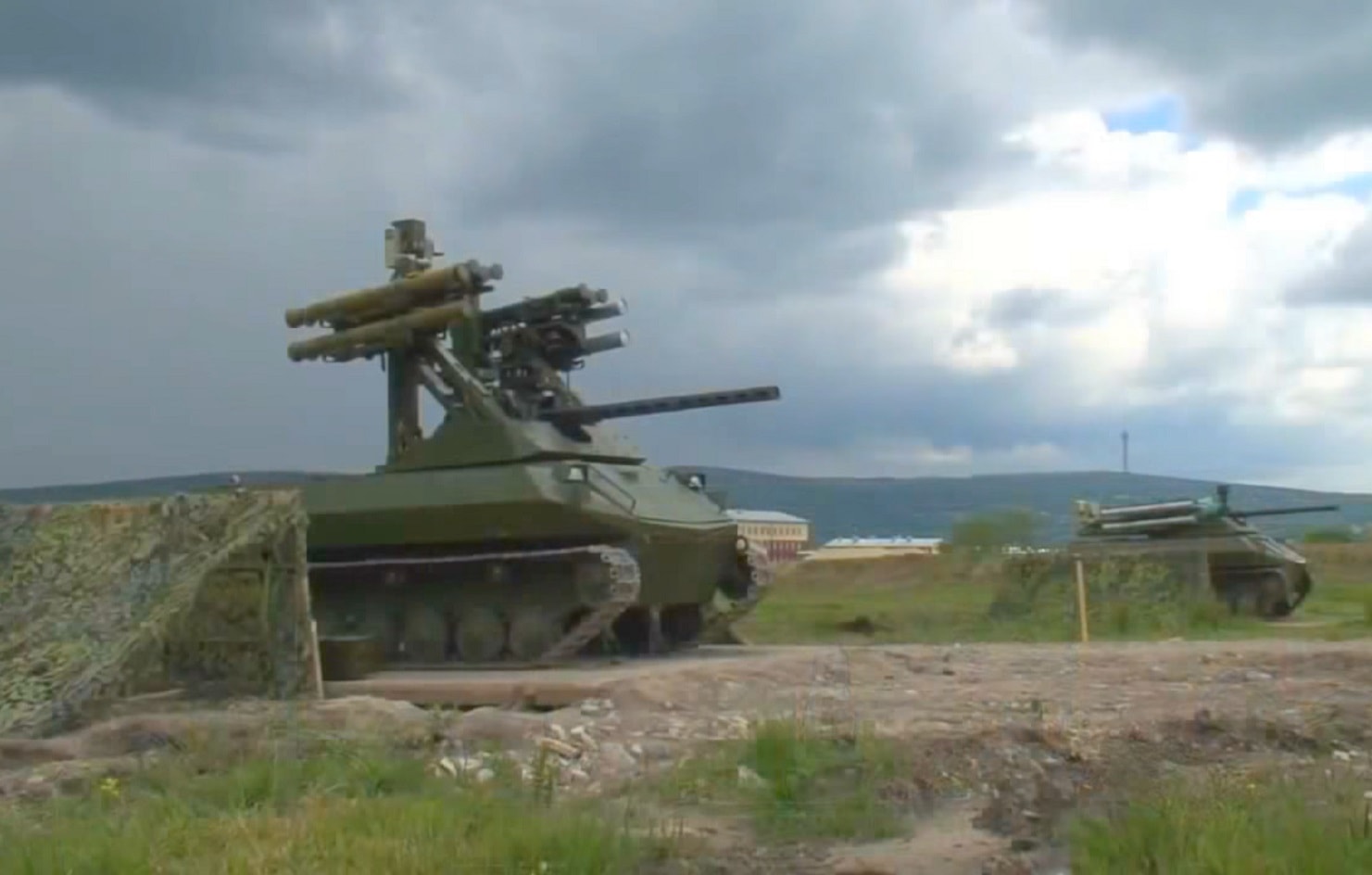
The Uran-9 is designed to conduct remote reconnaissance and provide fire support for combined-arms, reconnaissance, and counter-terrorism units. The system includes two reconnaissance and fire support robots, a transporter for their movement, and a mobile control station.
Each robot is armed with a 30 mm 2A72 automatic cannon, a coaxial 7.62 mm machine gun, and Ataka anti-tank guided missiles. The armament configuration can be adjusted according to customer requirements.
The robots are also fitted with a laser warning system and equipment for target detection, identification, and tracking.