

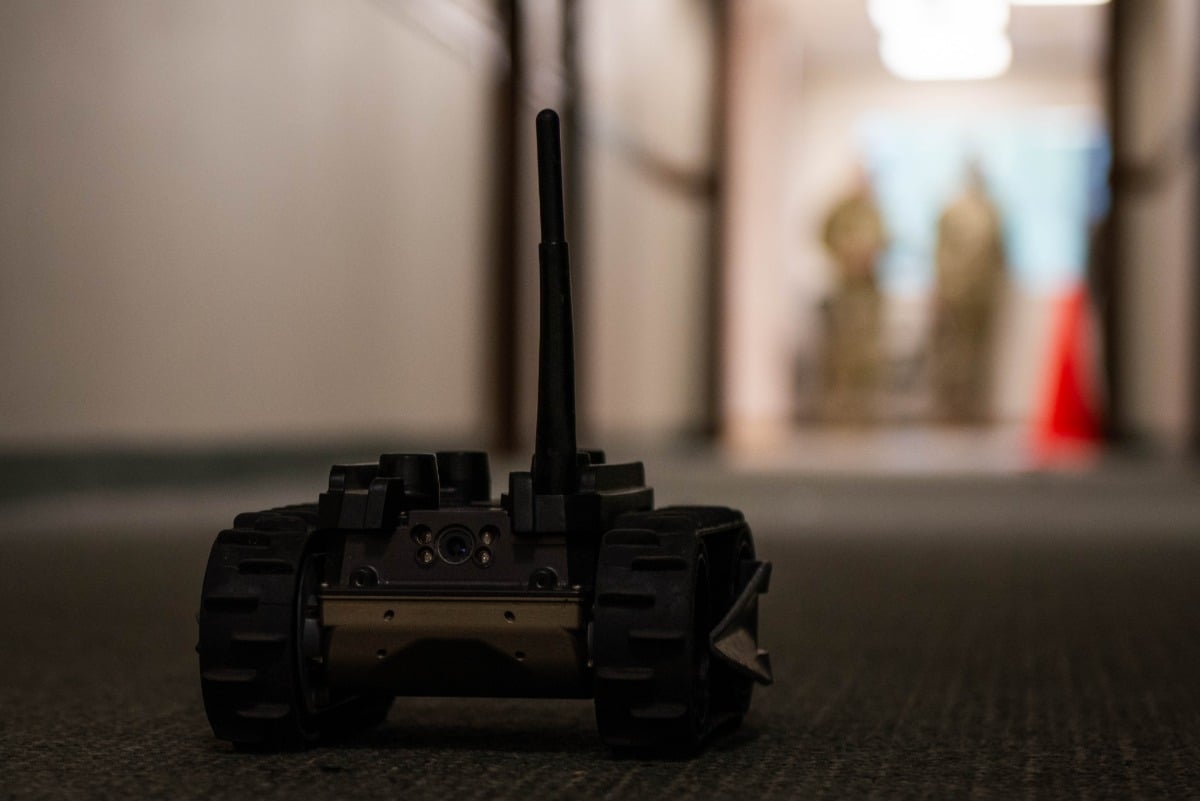
- The U.S. Army solicited a contractor to supply 110 FirstLook robotic systems and consumables kits to Tunisia under a Foreign Military Sale.
- Quotes were due July 17, with an anticipated contract award no later than July 23, 2026.
A robot small enough to throw through a window and tough enough to survive a five-story fall onto concrete is headed to Tunisia’s military, part of a U.S. arms sale that will let North African soldiers see around dangerous corners before anyone has to walk into them.
The U.S. Army’s Contracting Command at Aberdeen Proving Ground in Maryland published a solicitation this week seeking a contractor to supply 110 FirstLook robotic systems, along with matching spare parts kits, to Tunisia under a Foreign Military Sale, the formal U.S. government process that lets American defense companies sell military equipment to allied nations with Washington’s direct oversight and approval.
The FirstLook, built by Teledyne FLIR Defense, is not a bomb-disposal robot in the traditional sense of a large, slow, tracked vehicle rolling up to a suspicious package. It is a small, throwable reconnaissance robot weighing just 6.6 pounds (3 kilograms), rugged enough to survive being tossed 16 feet (5 meters) onto concrete without breaking, and built specifically so a soldier can literally throw it through a doorway or window ahead of themselves to see what’s waiting inside before stepping into the room. Four built-in cameras give the robot a full 360-degree field of view with adjustable zoom and infrared illumination for operating in total darkness, and the robot can climb obstacles up to 7 inches (17.8 centimeters) high, right itself automatically if it flips over, and keep running for up to six hours on a single charge, all controlled remotely through a touchscreen tablet called the uPoint system that lets one operator manage multiple connected robots at once.
That combination of toughness and disposability matters because the FirstLook’s entire purpose is protecting the person who would otherwise have to walk into a dangerous space first. Explosive ordnance disposal technicians, infantry clearing buildings, and counterterrorism units have used the platform for over a decade specifically to gather visual, audio, and sensor information about a hazardous area, whether that means a suspected explosive device, a room that might be booby-trapped, or a building that could be sheltering an armed threat, all without exposing a human to that risk first. The design traces back to iRobot, the same company known for inventing the Roomba vacuum, which introduced the original FirstLook in 2011 before its defense division spun off into Endeavor Robotics and was later acquired by Teledyne FLIR in 2019.
The solicitation calls for two line items covering the deal. The first is the FirstLook robotic system itself, delivered with a rugged transit case, an integrated lithium-ion battery, a chassis fitted with flippers for climbing obstacles, and a one-year warranty, all supplied in what the Army notice describes as a quantity of 110 units, though the document’s line-item wording carries some internal ambiguity about exact unit counts that the notice itself does not fully clarify. The second line item covers a matching consumables kit for each robot, including replacement tracks, wheels, flippers, antennas, and cables, the kind of wear-and-tear parts that keep a fleet of throwable robots operational after repeated drops, throws, and rough handling in the field rather than needing a full unit replacement every time a part breaks.
The purchase falls under the U.S. Army Security Assistance Command, based in New Cumberland, Pennsylvania, the office responsible for managing weapons and equipment sales to foreign governments on the Pentagon’s behalf, and the contract itself will go through Aberdeen Proving Ground’s contracting office as what the government calls a Firm Fixed Price agreement, meaning the winning company agrees to a set price for the entire order rather than being reimbursed for costs as they arise. The solicitation is also set aside specifically for small businesses, giving smaller American manufacturers and distributors a chance to compete for the award rather than opening it to every defense contractor regardless of size, and the government plans to award the contract based on what it calls a Lowest Priced Technically Acceptable evaluation, a common government purchasing method that awards the deal to whichever qualifying bidder offers the lowest price once every technical requirement has been met, rather than favoring a more expensive option for marginal performance gains.
Tunisia’s interest in this kind of equipment fits a pattern seen across several U.S. partner nations working to counter explosive threats and improve close-quarters security capabilities, particularly in a country that shares a long, porous border with Libya and has spent years working to contain militant activity in its border regions following the instability that followed Libya’s 2011 civil war. A small robot that can be thrown into a room, a cave, or a vehicle before a soldier follows is exactly the kind of low-cost, immediately deployable capability that lets a smaller military extend its situational awareness without needing the budget or infrastructure of a much larger defense force behind it.