

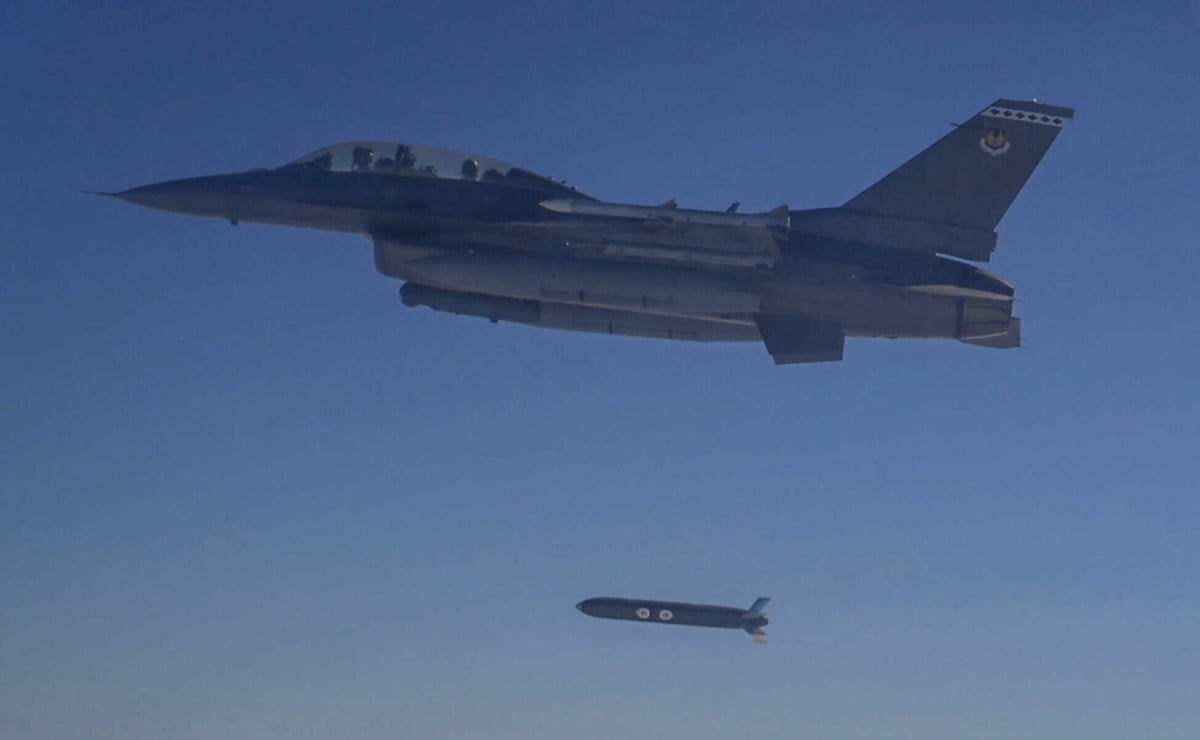
- The Air Force Research Laboratory awarded Zone 5 Technologies a $12 million contract on June 18, 2026, for Rusty Dagger manufacturing technology development, completing by September 2027.
- The Small Business Innovation Research Phase III contract obligated $7.5 million immediately, covering work in Miamisburg, Ohio, focused on production-scale manufacturing capability.
The U.S. Air Force has awarded a $12 million contract to Zone 5 Technologies to advance manufacturing technology for the Rusty Dagger program, a fast-moving effort to produce affordable, mass-scale long-range strike missiles that has moved from program launch to potential combat employment in roughly two years.
The contract, awarded June 18, 2026, by the Air Force Research Laboratory at Wright-Patterson Air Force Base in Ohio, covers research and development focused specifically on manufacturing technology for the Rusty Dagger Franchise, with work to be performed in Miamisburg, Ohio, and an expected completion date of September 2027. Of the $12 million total, $7.5 million was obligated immediately using fiscal year 2026 research, development, test and evaluation funds.
That manufacturing focus is the core of what makes this contract significant. Building a cruise missile that works is difficult. Building one that can be produced by the thousands at a fraction of the cost of conventional precision weapons is a fundamentally different engineering challenge, and it is the challenge the Rusty Dagger program exists to solve. The Air Force launched the Extended Range Attack Munition program in early 2024 with an explicit and publicly stated primary purpose: to provide Ukraine with affordable, mass-producible long-range strike weapons faster than existing programs could deliver them. That directness about the program’s operational rationale was unusual in American defense procurement, where weapons development programs typically speak in abstract warfighting requirements rather than naming specific recipients or conflicts.
The AGM-188A Rusty Dagger addresses both problems simultaneously through a design concept that is straightforward in principle and difficult in execution. Zone 5 Technologies, a small defense company headquartered in San Luis Obispo, California, built the missile as a turbojet-powered, air-launched, precision-guided standoff munition that fits within the size and weight envelope of a standard Mk 82 unguided bomb, the 500-pound (227 kg) general-purpose bomb that has equipped Western and allied air forces for decades. The physical compatibility with the Mk 82 footprint is the design’s central strategic advantage: any aircraft currently equipped to carry that bomb, which encompasses virtually every fixed-wing combat aircraft in Ukraine’s inventory as well as those of dozens of NATO allies, can potentially carry the Rusty Dagger without significant modification to the weapon station or the aircraft itself. The barrier to fielding shrinks dramatically when the receiving platform requires no new integration work.
Zone 5 Technologies occupies an atypical position in the American defense industrial base, operating as a small business in a domain historically controlled by large prime contractors including Raytheon, Lockheed Martin, and Boeing. The Small Business Innovation Research program that funded the Rusty Dagger’s development channels defense dollars specifically toward smaller, more agile companies capable of moving faster than the major contractors on targeted technical problems. The Rusty Dagger’s trajectory reflects that speed advantage in a way that stands out even by the compressed timelines the Ukraine conflict has forced on Western arms developers: from program launch in early 2024 to a Phase III manufacturing contract in June 2026 represents a pace that conventional defense acquisition programs rarely sustain across the full arc from concept to production readiness.
The Phase III designation carries specific meaning in the Small Business Innovation Research framework. Phase I covers feasibility research. Phase II covers prototype development and demonstration. Phase III is where a technology transitions from promising prototype to something a manufacturer can actually build in quantity, and it is typically funded not through the innovation research program itself but through regular defense procurement or other government contracts, reflecting a judgment that the technology has proven itself sufficiently to justify production investment. The Air Force’s decision to fund a dedicated manufacturing technology development effort at this stage signals confidence that the Rusty Dagger design is sound and that the remaining work is industrial rather than scientific.
The Miamisburg, Ohio work location adds a production geography dimension to the program. Ohio has a substantial defense manufacturing presence, and situating the manufacturing technology development work there rather than at Zone 5’s California headquarters suggests the program is building toward a production arrangement with facilities capable of the throughput a mass-employment strike weapon requires. The September 2027 completion date for the current contract gives the program roughly 15 months to resolve the manufacturing challenges that stand between the current design and factory-floor production at meaningful scale.
What that scale might look like remains one of the program’s most consequential open questions. The entire logic of the Rusty Dagger, a low-cost missile that fits on existing aircraft without modification, only delivers its strategic value if it can be produced in numbers large enough to change the calculus of a sustained air campaign. A weapon that costs a fraction of a Storm Shadow per unit but can only be manufactured in dozens per month offers limited operational advantage. The manufacturing technology contract is the program’s attempt to answer that question before it becomes an operational constraint.
Adding context to the program’s trajectory, a Russian military-affiliated Telegram channel has claimed that Ukraine used AGM-188 Rusty Dagger missiles to strike the Sborka semiconductor plant in Voronezh, a Russian city approximately 470 km (292 miles) from the Ukrainian border and a facility previously identified as part of Russia’s missile production supply chain. The claim originated with the channel “Voevoda Broadcasts,” cited by the open-source intelligence account Status-6, and has not been independently verified or confirmed by either the Ukrainian or American governments at time of publication. If accurate, it would represent the weapon’s first documented combat use, at a target deep enough inside Russian territory to require genuine standoff range and precise enough to suggest the guidance system performed as designed.