

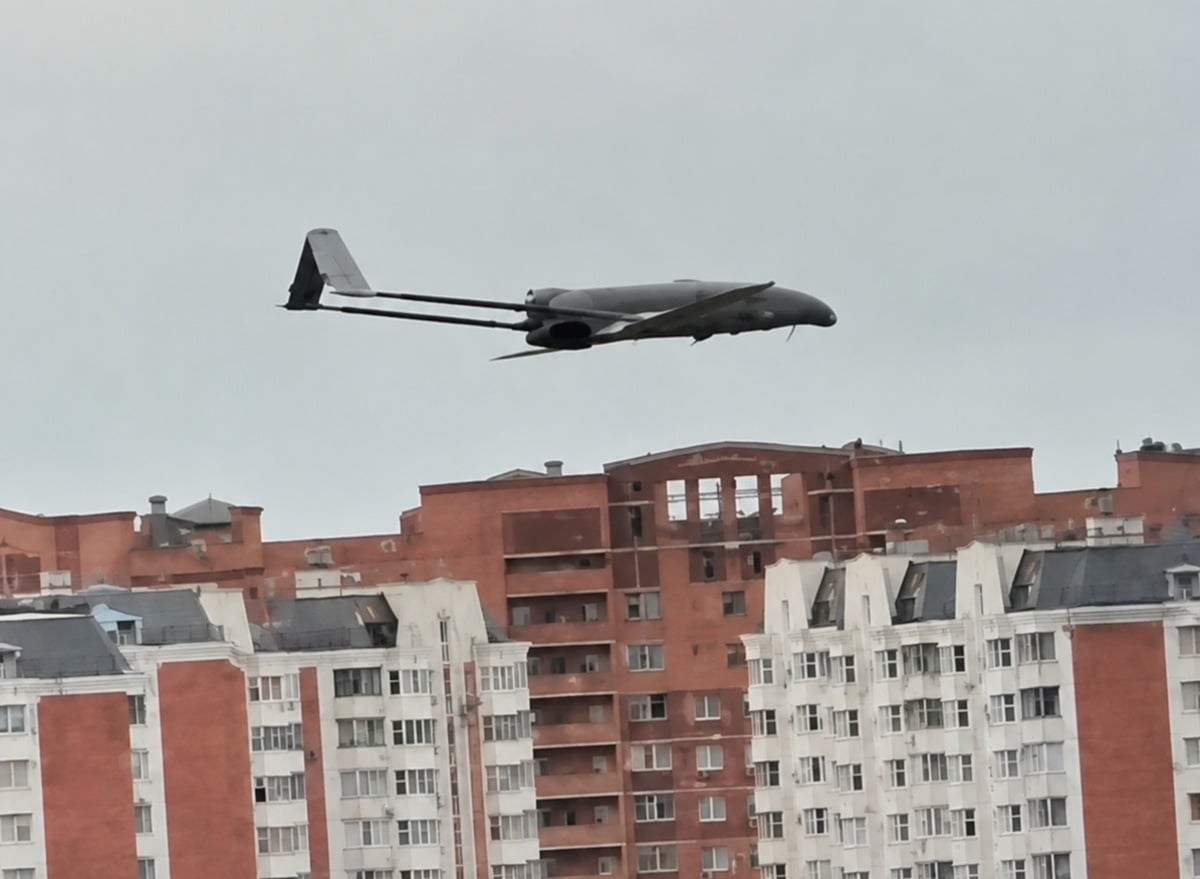
- A Ukrainian deep-strike drone officer told Militarnyi that long-range drones achieve a 20 to 30 percent penetration rate against Russian air defenses, with launch volumes rising sharply through 2026.
- Reuters reported in spring 2026 that Ukrainian drone strikes forced nearly all major central Russian refineries to halt or reduce output, eliminating roughly a quarter of Russia's total refining capacity.
Cheap, mass-produced Ukrainian long-range one-way attack drones are breaking through one of the most expensive air defense networks ever assembled, with a 20 to 30 percent penetration rate that is proving sufficient to systematically dismantle Russia’s oil refining industry and degrade its military logistics, a Ukrainian officer with direct command experience in the deep-strike drone program disclosed in an interview with Militarnyi.
The officer, who serves as founder of the 14th Separate Regiment and leads the project team of the 1st Separate Center of the Special Purpose Forces, made clear that the 20 to 30 percent figure should not be read as a failure rate. It should be read as proof that Ukrainian drones, costing a fraction of the interceptors Russia fires to shoot them down, are defeating a layered air defense system that includes the S-300, S-400, Pantsir-S1, Tor, and Buk complexes, systems whose combined procurement value runs into hundreds of billions of dollars and whose operating costs per intercept far exceed the cost of the drones they destroy. Russia has built the most densely layered air defense architecture in the world around its most critical facilities. Ukraine’s drones are getting through it anyway, in growing numbers, week after week.
Ukraine launched over 1,000 long-range drones at Russia in August 2024, according to analysis cited by Militarnyi. That figure grew to more than 3,000 in July 2025 and reached approximately 7,000 in March 2026. Russia’s Ministry of Defense claimed to have intercepted a record 8,973 Ukrainian long-range drones in May 2026, a figure that, even discounted for the routine inflation in Russian official reporting, illustrates a trajectory with no ceiling in sight. If 20 to 30 percent of that May figure successfully struck their targets, somewhere between 1,800 and 2,700 individual strikes landed on Russian territory in a single month. That is not a nuisance. That is a strategic air campaign conducted without a single manned aircraft.
The officer addressed the difficulty of measuring the true cost-effectiveness of deep strikes, describing a return ratio that can reach one dollar invested for every hundred dollars of damage inflicted on the adversary, while acknowledging that the full consequences of a successful strike often take months to fully manifest.
“Here, sometimes the process of understanding the damage caused stretches over months,” he said in the Militarnyi interview. “For example, you stopped some enterprise or military facility. Or, for example, an operation against a military airfield. You suppressed this airfield, they moved their aircraft to another one, thereby increasing the flight distance, and they can make not three flights a day, but two. This reduced the effect on our front line. Accordingly, we saved lives. How do you count that?”
The answer, as the oil infrastructure campaign demonstrates, is that the counting eventually becomes undeniable. Reuters reported in spring 2026 that nearly all major refineries in central Russia had been forced to halt or reduce production following Ukrainian drone strikes, with the combined capacity of affected facilities exceeding 83 million metric tons per year, equivalent to approximately 238,000 metric tons (263,000 short tons) per day. That represents roughly a quarter of Russia’s total oil refining capacity knocked offline or degraded in a single campaign cycle. Russian diesel production fell from 7.5 million metric tons per month to 5.9 million metric tons in April and May 2026, a decline of more than 20 percent in a fuel category essential for both military vehicle operations and the civilian economy sustaining Russian war production. Russia subsequently began planning to import gasoline by sea, according to Militarnyi, an extraordinary reversal for a country that ranks among the world’s largest oil producers and has exported petroleum products for decades.
The Atlantic Council documented in May 2026 that Ukrainian drone strikes against port terminals during the same period disrupted Russian oil export logistics alongside the refinery hits, compressing Russia’s ability both to process crude into usable fuel and to export what it could not refine domestically. The combination of export disruption and domestic production loss is more damaging than either alone, because it simultaneously reduces the fuel available for Russian military operations and cuts the export revenue that funds the procurement replacing those losses.
The drone types conducting these strikes are lightweight, relatively simple aircraft produced at industrial scale by a growing Ukrainian defense industry that manufactured an estimated four million robotic and autonomous systems in 2025, according to the Council on Foreign Relations, with production tracking toward five to six million in 2026. The long-range variants carry warheads ranging from around 50 kilograms (110 pounds) in the case of the Fire Point FP-1, which has a demonstrated range of up to 1,600 kilometers (994 miles), to the 105-kilogram (231-pound) warhead of the shorter-range FP-2. Ukrainian President Volodymyr Zelenskyy announced on June 20, 2026, that Fire Point engineers had demonstrated the ability to strike targets at distances of up to 3,000 kilometers (1,864 miles), a range that places virtually every significant military and industrial facility in the Russian Federation within reach of Ukrainian systems regardless of where they are positioned within Russian territory.
Russia’s air defenses are not passive in the face of this campaign. The S-400 Triumf, Russia’s most capable long-range air defense system, is designed to engage targets at altitudes up to 30 kilometers (98,425 feet) and ranges up to 400 kilometers (249 miles), using radar and active homing missiles that cost several million dollars per round. The Pantsir-S1, which defends point targets at shorter ranges, fires missiles costing hundreds of thousands of dollars each. A Ukrainian deep-strike drone costs, by various public estimates, somewhere between $20,000 and $100,000 depending on type and payload. When Russia fires a Pantsir interceptor missile worth $300,000 to shoot down a drone worth $50,000, it spends six dollars to save one. When it misses, Ukraine lands a $50,000 weapon on a refinery that costs billions to repair and weeks to restart. That asymmetry is the economic engine of the entire campaign, and it operates in Ukraine’s favor regardless of the interception rate, as long as enough drones get through to keep degrading what they hit.
The officer was equally direct about the command structure governing all of this. No unit operating deep-strike drones selects its own targets. Every strike takes place within a targeting architecture generated at the General Staff level, with strategic plans running on monthly, bimonthly, and six-month cycles. Individual units can offer feedback on execution, but the target list arrives from above.
“Look, it’s a big system,” he said. “There are bodies at the General Staff level that generate certain strategies for a month, two months, half a year, on how this should work. That is, they pass down a certain task to us, we work it out. We can give some comments on how best to implement it, but we do not choose the targets.”
Russia spent decades and hundreds of billions of dollars building an air defense system designed to stop American bombers and cruise missiles. Ukraine bypassed the question of how to defeat it and asked a different one instead: how many cheap drones does it take to overwhelm it? The answer, refined over two years of operational learning, appears to be: more than Russia can intercept, launched faster than Russia can replace its missiles.