

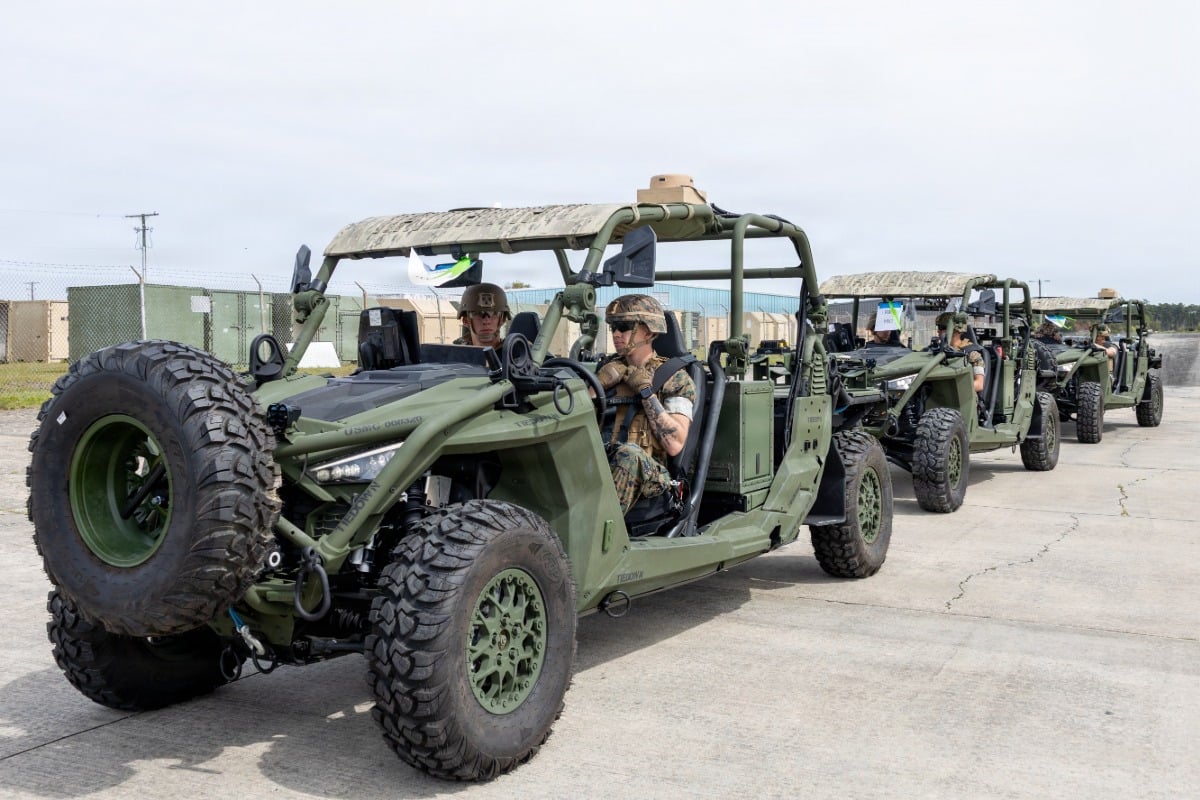
- The U.S. Marine Corps ordered more than 70 Polaris MRZR Alpha vehicles under a new $98 million ULTV contract awarded May 22, 2026.
- More than half the vehicles ordered are the 5kW export power variant; all are four-seat green vehicles delivered with mission-specific accessories.
The U.S. Marine Corps has placed its first order under a new vehicle contract with Polaris Government and Defense, buying more than 70 MRZR Alpha ultra-light tactical vehicles along with a suite of mission-specific accessories, with more than half of the vehicles configured to export 5 kilowatts of electrical power directly from the vehicle itself.
The order comes under an indefinite delivery, indefinite quantity contract, a purchasing structure that sets a ceiling value and ordering period without committing to a fixed quantity upfront, allowing the Marines to draw down vehicles as needs develop rather than buying a fixed fleet all at once. That contract, awarded May 22, 2026, through the Program Acquisition Executive for Marine Corps, carries a ceiling of up to $98 million and runs for up to five years. The first delivery order, placed within weeks of the contract award, signals that the Marine Corps wasted no time activating the vehicle pipeline.
The MRZR Alpha is Polaris’s most advanced iteration of a platform that has become one of the most widely used light tactical vehicles in American special operations and expeditionary forces over the past decade. Built by Polaris Government and Defense, the defense-focused division of the Minneapolis-based powersports manufacturer best known for its off-road recreational vehicles, the MRZR family has served Marine Raiders, Army Special Forces, and conventional infantry units across multiple theaters. The Alpha variant builds on that foundation with increased payload capacity, improved off-road performance, and design features specifically optimized for tactical air transport, meaning the vehicle can be loaded into helicopters and tiltrotor aircraft and delivered directly to the point of need without the road network access that heavier vehicles require.
The most operationally significant element of this particular order is the proportion of 5-kilowatt export power variants among the vehicles purchased. More than half of the 70-plus vehicles ordered carry this configuration, which allows the MRZR Alpha to function as a mobile power source capable of running electronic systems, communications equipment, sensors, and other power-hungry gear that modern infantry units carry in increasing quantities. A vehicle that can move a four-person team across difficult terrain and simultaneously power their electronic equipment reduces the number of separate systems a unit needs to bring forward, a logistics advantage that compounds quickly when operating in distributed or isolated positions far from established supply lines.
Erin Telander, defense program manager at Polaris Government and Defense, described what the engineering effort behind the power export capability required. “Polaris engineering and development efforts resulted in expanded accessories developed specifically for MRZR Alpha customers, like the Marines,” Telander said. “That includes the ability to export 5kW of power directly from the vehicle itself, which the Marines will be able to leverage with their latest order.”
The accessory package accompanying the vehicle order reflects the accumulated operational experience of Marine units that have used MRZR platforms in the field and identified what additional equipment the baseline vehicle needs to function effectively across the full range of missions the Corps assigns it. A reversible roof kit provides protection from the elements while offering camouflage flexibility, with a multicam pattern on one side and olive drab on the other, allowing crews to switch between patterns based on the environment they are operating in without carrying separate covers. A road march kit adds turn signals, a horn, and rearview and side mirrors for administrative movements on roads and tracks, where the vehicle needs to conform to traffic awareness standards that pure off-road tactical driving does not require. A modular cargo system with side rails and a heavy-duty tailgate encloses the rear deck, providing secure attachment points for gear and the option to drop the tailgate for additional cargo space, with aircraft rails built in for accessories including litter mounts that allow the vehicle to serve as a casualty evacuation platform. A fire extinguisher and a towbar mount round out the kit.
These accessories reflect a vehicle philosophy that has become increasingly important to expeditionary forces: the platform as a configurable system rather than a fixed-function vehicle. The same MRZR Alpha that carries a reconnaissance team on an insertion mission can be reconfigured to evacuate a casualty, haul communications equipment, or serve as a forward power node for a small patrol base, with accessory swaps rather than vehicle changes. That flexibility reduces the number of specialized vehicles a unit needs to maintain and sustain, a consideration that matters considerably for Marine forces operating from amphibious ships with limited vehicle stowage.
Polaris’s supply chain model reinforces the operational value of the vehicle’s commercial DNA. Because the MRZR Alpha is built on commercial powersports technology rather than purely military-specification components, parts are available through Polaris’s existing worldwide network of dealers and distributors rather than exclusively through military supply chains, which can be slow and geographically constrained when units deploy to remote locations. That parts availability supports what the Marine Corps calls distributed operations, the concept of operating in small, dispersed units across wide areas rather than concentrating forces in large bases, where access to centralized maintenance and supply support is limited by design.
The Marine Corps’s investment in ultra-light tactical vehicles reflects a broader doctrinal direction the service has pursued with increasing commitment since publishing its Force Design 2030 plan, which repositioned the Corps away from large armored formations and toward lighter, more mobile forces optimized for operations in maritime and island environments where vehicle weight and size directly constrain what can be transported and deployed. In that context, a vehicle that a helicopter can carry, that a four-person team can operate, and that can power its own electronic suite while navigating terrain that heavier platforms cannot cross is not a convenience but a capability that the Corps’s operational concept depends upon.