

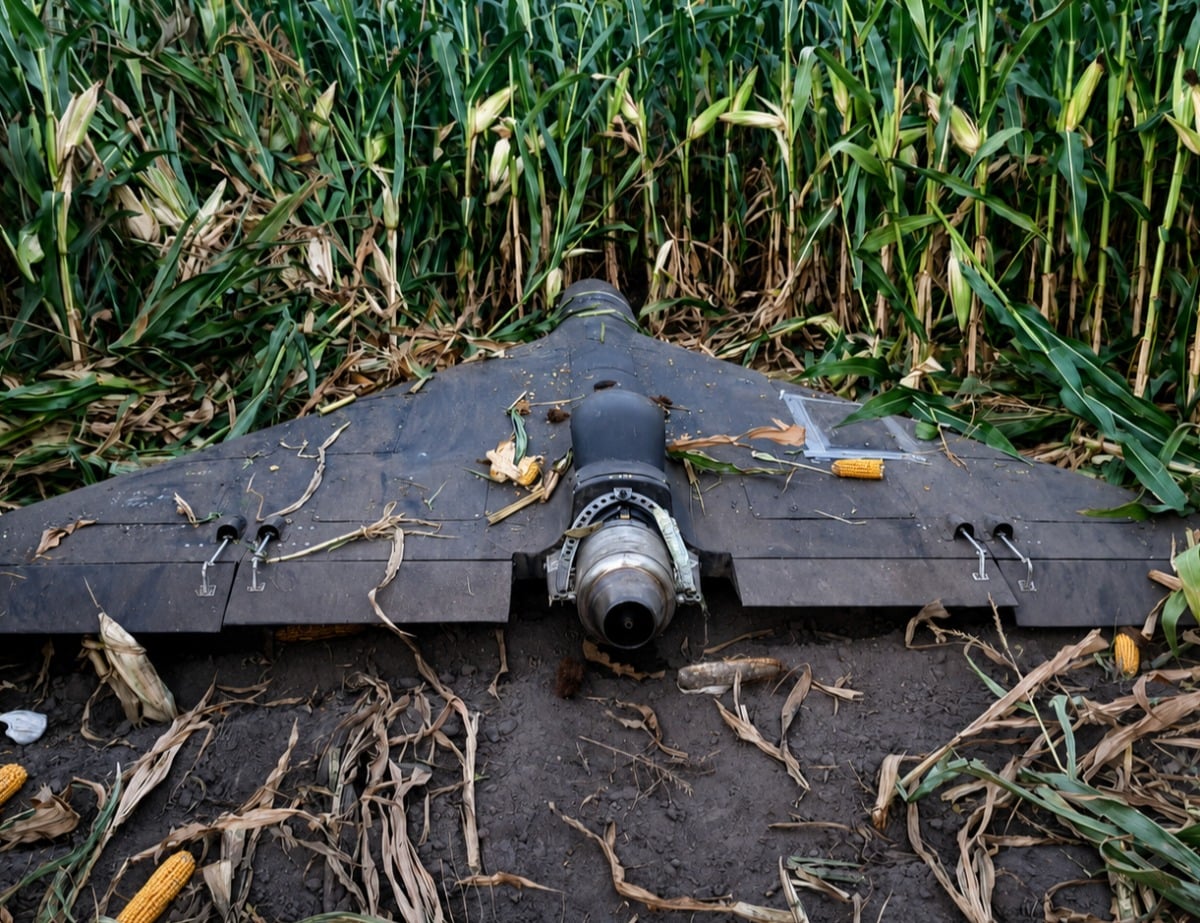
- Ukrainian interceptor drones cannot systematically chase jet-powered Russian drones exceeding 300 km/h due to battery and speed limitations, a frontline commander told Militarnyi.
- Russia launched 1,400 jet-powered Geran-series drones from January to mid-June 2026, versus just 180 in all of 2025, according to Militarnyi.
Ukraine’s drone interceptor crews cannot reliably chase down Russia’s new jet-powered attack drones because their aircraft simply are not fast enough to catch them before their batteries run out, a frontline Ukrainian air defense commander has revealed in an interview to Militarnyi.
The commander, who goes by the call sign “Ramzes” and leads the anti-drone squadron known as “Posipaky” within the 39th Anti-Aircraft Missile Regiment, did not dispute that Ukrainian crews are shooting down Russian drones. He was more specific and more sobering than that: what is happening now is not systematic defense. It depends on luck, individual skill, and catching a target at the exact moment it slows down to maneuver, and it is not a repeatable, scalable solution to a threat that Russia is scaling rapidly.
“But at this moment, right now… This is not systematic,” Ramzes said in the interview. “It’s guys, thanks to luck, thanks to their skills, thanks to experience understanding that when it makes a maneuver, its speed drops, and guys through skill, let’s say, shoot it down.”
The core of the problem is arithmetic. Russia’s jet-powered attack drones, the Geran-3, Geran-4, and Geran-5 series that Moscow has been deploying in increasing numbers throughout 2026, fly at speeds exceeding 300 kilometers per hour (186 mph). For an interceptor drone to reliably pursue and close on a target, the standard operating principle requires the interceptor to be at least 25 percent faster than what it is chasing. Ukraine’s current interceptor fleet, built around electric quadcopters and fixed-wing designs optimized for hunting the slower propeller-driven Shahed-136, which cruises at roughly 185 to 200 kilometers per hour (115 to 124 mph), does not consistently meet that threshold when the target is a jet-powered variant.
Ramzes illustrated the practical consequence with a specific scenario that makes the mathematics undeniable. A Shahed flying at 300 kilometers per hour (186 mph) against an interceptor flying at 310 kilometers per hour (193 mph) produces a closing speed advantage of only 10 kilometers per hour (6 mph). By the time the interceptor narrows the gap enough to engage, it has traveled so far from its launch point that the battery is drained before the kill can be made.
“Look, if a Shahed is flying at 300 km/h and our interceptor is flying at 310 km/h and we intercept it, say, in Kharkiv Oblast, then we will probably catch it somewhere in Cherkasy Oblast, with a 10 km/h difference,” he said. “The problem is simply that our battery will run out.”
Even the propeller-driven Shahed variants, which cruise at 200 to 250 kilometers per hour (124 to 155 mph) and represent the bulk of Russia’s ongoing drone campaign, do not present a simple interception problem. Ramzes described scenarios where a crew scrambles to intercept a target only to find the battery partially depleted from a previous sortie, or where another crew positioned closer to the threat completes the interception first, leaving the first crew airborne with nothing to engage and insufficient charge to pursue another target.
“You launch for an intercept, and your battery is already drained. Or the crew in front of you shoots it down, the one that’s closer. You took off, you see it, you confirm it, and you already have no battery, you need to return to catch another one,” he said. “That is, it’s complex work. One must not think that Shaheds are just shot down like that. It is a great deal of work by a large number of people, and not only crews, but also those sitting at the command post, informing, those who communicate with each other, who notify neighboring units.”
The third major constraint Ramzes identified is weather, and it applies across the entire interceptor operation regardless of speed. Visual contact with the target is currently essential in most engagements. When there is precipitation, cloud cover, or fog, the drones simply fly inside the clouds and the interceptors cannot find them.
“All the crews who work with us, almost all the waves they shoot down, but only if there is weather,” he said. “Even now, drones with a guidance system are used, but even they do not guarantee that a Shahed will be found in poor weather conditions. That is, if we have precipitation, fog, cloud cover, Shaheds simply fly in the clouds, we don’t see them, and then almost 100% can fly through.”
Russia has executed a dramatic acceleration in its use of jet-powered drones, deploying 1,400 Geran-series jet attack drones from January through mid-June 2026, compared to just 180 throughout all of 2025, according to Militarnyi. General Oleksandr Syrskyi, Commander-in-Chief of the Ukrainian Armed Forces, has publicly stated that Russia plans to raise jet-powered drones to 50 percent of all strike drone volume in its attacks. The Geran-3 alone has a confirmed operational speed of 350 to 550 kilometers per hour (217 to 342 mph), far beyond what current Ukrainian interceptors can match in a sustained chase.
Ukraine is not standing still. Ukrainian Defense Minister Mykhailo Fedorov announced in early June 2026 that a developer within the Brave1 defense technology cluster had successfully combat-tested an autonomous interceptor that automates 95 percent of the interception cycle, with Defender Media subsequently identifying the company as MaXon Systems, a Kyiv-based startup building interceptors that sell for approximately $3,500 per unit. Ukrainian company Yartura has unveiled the Dancer 4.5.0, a fixed-wing interceptor reaching 450 kilometers per hour (280 mph) with an AI-powered re-engagement system that can circle a target until the kill is confirmed. Ramzes himself acknowledged in the Militarnyi interview that Ukraine is already developing systems that “will be coming soon” and are intended to reliably intercept high-speed drones, though he did not provide further details.
The gap between what is needed and what is currently deployed is what makes Ramzes’s interview valuable beyond its tactical detail. It is a frontline commander explaining, in plain language, that the performance of Ukraine’s drone interception network against the most advanced Russian drones is currently not a programmatic success story but a collection of individual acts of skill executed under severe constraints of battery life, weather, and relative speed. The Ukrainian military has built something genuinely impressive in its layered small air defense architecture, with The Defence Blog reporting that interceptors alone destroyed more than 3,500 Russian drones in May 2026. What Ramzes is saying is that the threat is not waiting for the defense to catch up.