

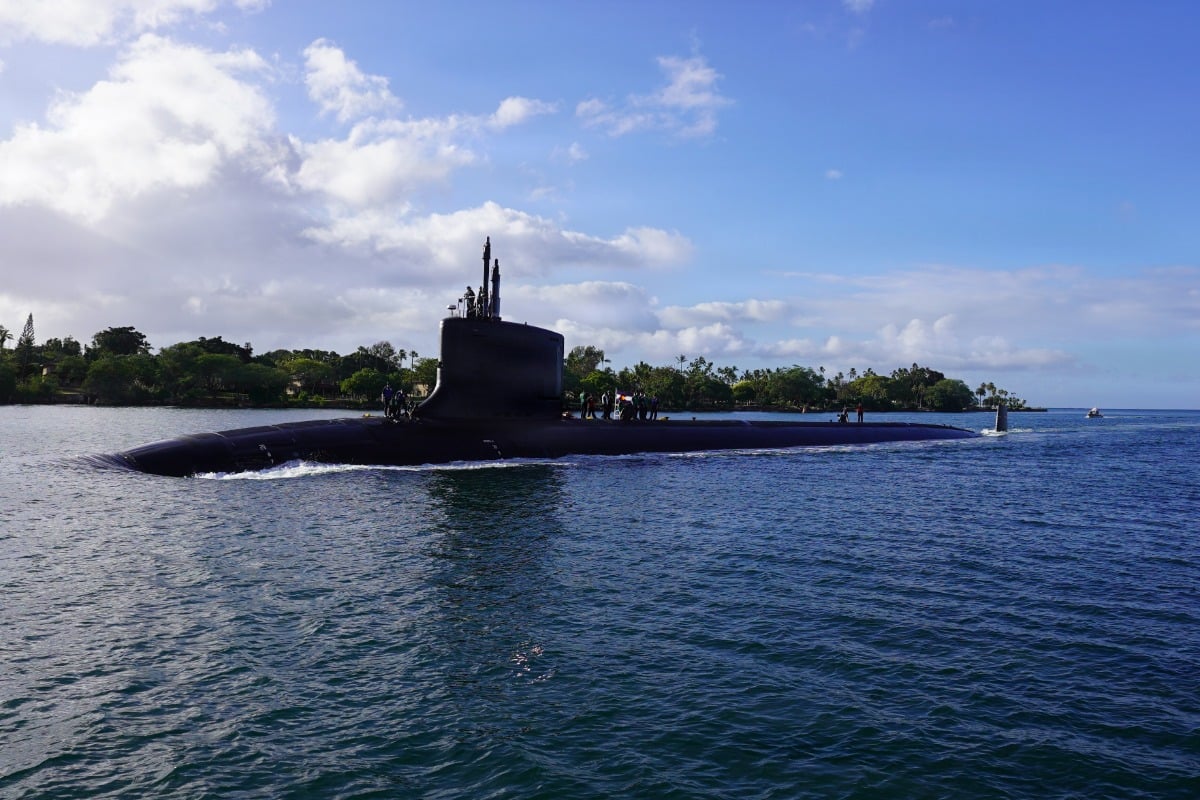
- USS Colorado, a Virginia-class fast-attack submarine, completed scheduled maintenance at Pearl Harbor Naval Shipyard 29 days ahead of schedule on June 10, 2026.
- Colorado is the 15th Virginia-class submarine and is assigned to Submarine Squadron 7, capable of anti-submarine warfare, strike, special operations, and ISR missions.
A nuclear-powered attack submarine completed its scheduled maintenance period at Pearl Harbor Naval Shipyard nearly a month ahead of schedule, handing the U.S. Pacific Fleet a combat-ready boat 29 days earlier than planned at a moment when undersea readiness in the Indo-Pacific has become one of the Navy’s most closely watched metrics. USS Colorado, a Virginia-class fast-attack submarine based in Hawaii, wrapped up its maintenance on June 10, 2026, at Pearl Harbor Naval Shipyard and Intermediate Maintenance Facility, with the shipyard and submarine crew completing a complex repair and maintenance package through what the shipyard’s commander described as sustained teamwork and relentless focus on first-time quality work.
The Virginia-class is the backbone of America’s current fast-attack submarine force, a program with more than two dozen Virginia-class submarines commissioned since USS Virginia entered service in 2004, with construction split between Huntington Ingalls Industries in Newport News, Virginia, and General Dynamics Electric Boat in Groton, Connecticut. Virginia-class submarines are nuclear-powered, conventionally armed fast-attack submarines, meaning they carry Tomahawk cruise missiles for long-range land attack, torpedoes for anti-submarine and anti-ship warfare, and the sensors, stealth characteristics, and endurance to conduct intelligence collection and special operations support missions across wide ocean areas. Colorado, commissioned March 17, 2018, at Naval Submarine Base New London in Groton, Connecticut, is the 15th Virginia-class boat built and the fifth Block III submarine, a variant that introduced a redesigned bow with the Large Aperture Bow sonar array and two Virginia Payload Tubes, additional launch positions for Tomahawk missiles that expand the boat’s strike capacity beyond the standard vertical launch tubes in its sail. Colorado is assigned to Submarine Squadron 7 and operates across the full range of Virginia-class mission sets including anti-submarine warfare, strike operations, special operations forces support, and intelligence, surveillance, and reconnaissance.
Returning a nuclear submarine to the fleet 29 days early is a meaningful outcome precisely because submarine maintenance is not like maintaining a car or even a conventional warship. Every system inside a nuclear-powered submarine operates under pressure, radiation monitoring requirements, and safety protocols that do not permit corner-cutting, and the work itself takes place in extraordinarily confined spaces with limited access to the components being repaired. The shipyard workforce performing that work must hold specialized certifications, follow documented procedures on every step, and achieve quality standards on the first attempt wherever possible, because rework in a submarine’s interior is expensive, time-consuming, and potentially dangerous if it disturbs adjacent systems.
Capt. Ryan McCrillis, commander of Pearl Harbor Naval Shipyard and Intermediate Maintenance Facility, described the factors that drove the early completion. “Finishing ahead of schedule is not about rushing, it’s about hard work and persistence,” McCrillis said. “It’s producing first-time, high-quality work and attacking every roadblock with urgency. It’s a team effort, from the newest apprentice to senior shipyard leaders, the ship’s force, the project team, and support from the fleet and headquarters.”
Chad Renti Cruz, the PHNSY and IMF project superintendent for Colorado, described how the joint team operated when problems arose during the maintenance period. “From the get-go, the team gelled as one,” Cruz said. “Whenever challenges or problems came up, we swarmed the issue, got all the right people in the room to lay out a solid plan, and executed it to a T.”
The submarine’s crew was not passive during the maintenance period. Virginia-class crews routinely remain integrated with shipyard work during availability periods, contributing detailed system knowledge that helps maintenance teams identify problems earlier and solve them faster than they could working from technical documentation alone. Cmdr. Justin Reeves, Colorado’s commanding officer, credited that crew involvement directly. “Colorado’s success was largely due to the continual hard work, communication, and coordination between our Sailors and the shipyard team,” Reeves said. “Ending the availability early allows us to get back out to sea and prepare the crew for operations.”
Pearl Harbor Naval Shipyard occupies a strategically important position in the U.S. submarine maintenance network that has become increasingly consequential as the Navy expands its Pacific commitments under the AUKUS partnership. The shipyard describes itself as the most comprehensive fleet repair and maintenance facility between the U.S. West Coast and the Far East, a geographic reality that makes it the primary intermediate maintenance node for submarines operating across the vast distances of the Indo-Pacific. When a Virginia-class submarine finishes maintenance at Pearl Harbor, it can return directly to operations in waters stretching from the western Pacific to the Indian Ocean without the multi-week transit that returning to a mainland shipyard would require.
The shipyard’s workload has grown substantially as AUKUS commitments have added Australian submarine maintenance training to its existing workload, with more than 230 Australian civilian maintainers and Royal Australian Navy personnel currently under instruction at Pearl Harbor alongside the American workforce. That additional training burden makes scheduling efficiency on existing U.S. submarine maintenance projects more important, not less, because every day saved on a project like Colorado’s availability is a day the workforce can apply to the next project in the queue without delaying fleet readiness elsewhere.