

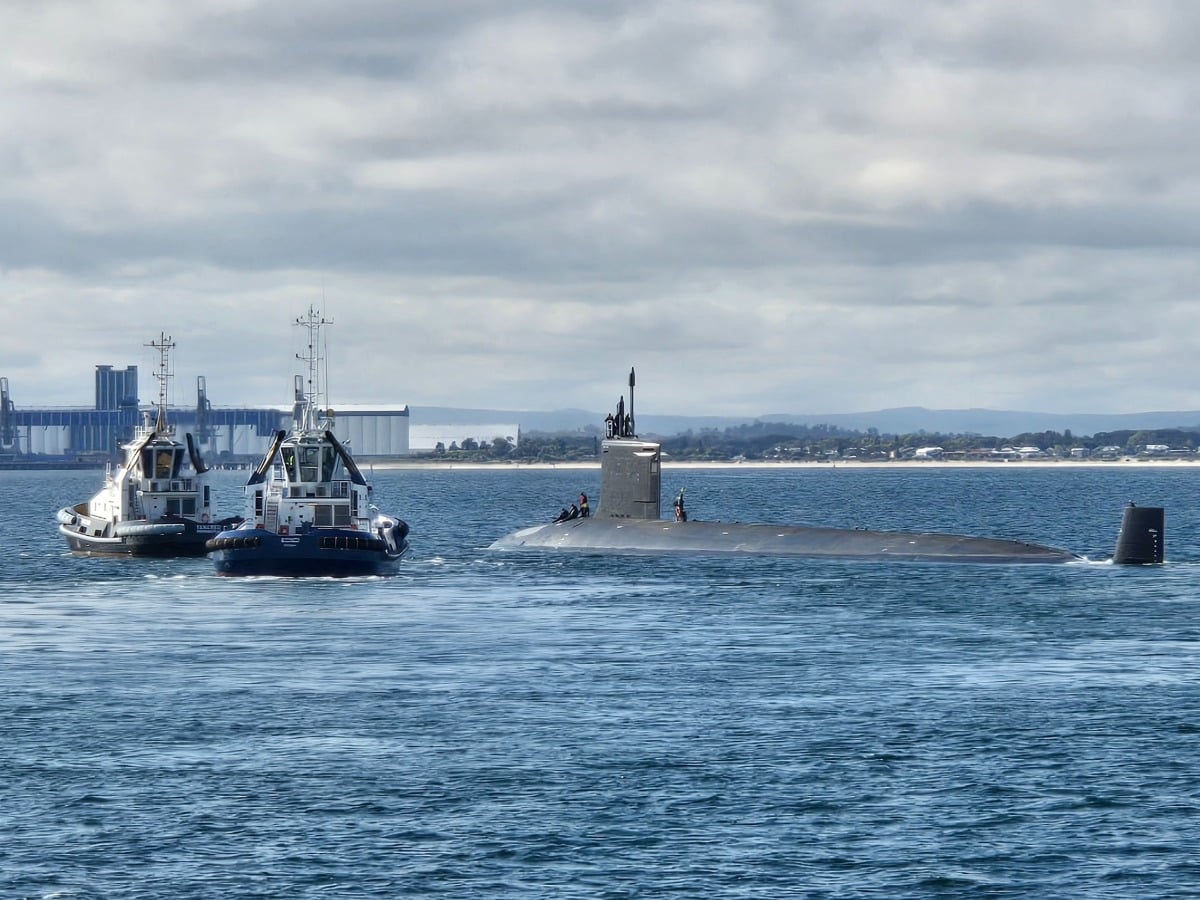
- The U.S. Navy reestablished Submarine Squadron 3 at HMAS Stirling, Western Australia on June 10, 2026 to support the AUKUS Submarine Rotational Force-West program.
- U.S. and UK nuclear-powered attack submarines will begin rotational deployments from HMAS Stirling in 2027, with up to four U.S. and one UK submarine present at any time.
A submarine squadron that the U.S. Navy decommissioned fourteen years ago has been reestablished, this time not in Hawaii where it once operated but at a Royal Australian Navy base near Perth, in one of the most concrete steps yet taken to turn the AUKUS security pact from a diplomatic agreement into a working military alliance.
Rear Adm. Chris Cavanaugh, commander of Submarine Force, U.S. Pacific Fleet, formally reestablished Submarine Squadron 3, known as CSS-3, to operate from HMAS Stirling in Western Australia in support of rotational U.S. and UK submarine deployments, laying the command infrastructure needed before the first nuclear-powered attack submarines begin rotating through the base in 2027.
CSS-3 originally operated out of Pearl Harbor, Hawaii, and was decommissioned in February 2012 as the Navy consolidated its Pacific submarine command structure. The reestablished squadron creates a forward U.S. Navy command element to support rotational submarine operations at HMAS Stirling, integrated with Royal Australian Navy counterparts and oriented toward the sea lanes of the eastern Indian Ocean and the western Pacific that any conflict in the region would immediately contest.
AUKUS, the trilateral security partnership between Australia, the United Kingdom, and the United States announced in September 2021, has two main pillars, with Pillar I focused on helping Australia acquire conventionally armed, nuclear-powered submarines. The pathway toward that outcome, known as the Optimal Pathway and announced in March 2023, runs through a transitional phase called Submarine Rotational Force-West, or SRF-West, under which American and British nuclear submarines will conduct rotational deployments from HMAS Stirling beginning in 2027, allowing Australian personnel to gain operational experience aboard nuclear-powered boats before Australia fields its own fleet. From as early as 2027, AUKUS partners will have a rotational presence at HMAS Stirling of one UK and up to four U.S. nuclear-powered submarines, forming the working core of the allied undersea force in the region.
CSS-3’s personnel will integrate directly with Royal Australian Navy counterparts at HMAS Stirling, with their primary mission being to lay the groundwork for maintenance, logistics, and operational support for all rotational U.S. and U.K. submarines at the base. That groundwork is neither simple nor quick. Nuclear-powered submarines require specialized maintenance facilities, trained technicians who understand their unique systems, classified spare parts pipelines, and operational support structures that take years to build correctly. CSS-3 provides the U.S. command node that coordinates all of that work on the Australian end, ensuring that when the first submarines begin arriving for rotational deployments, the support infrastructure is already in place to keep them operational.
“Adding an additional forward-positioned submarine squadron in the Indo-Pacific enhances our presence, agility, and responsiveness across a range of operations,” Cavanaugh said. “CSS-3 enables our submarines and crews to respond rapidly in support of the U.S. joint force mission of regional deterrence.”
The workforce dimension of SRF-West is as significant as the hardware. Vice Adm. Rob Gaucher, Director of Submarine Programs, described the broader logic of building Australian maintenance capability as a function that benefits both countries simultaneously. “With SRF-West, we have submarines rotating through a critical region with an organic, predominantly Australian, maintenance workforce keeping those boats fit to fight,” Gaucher said. “That not only supports readiness, but it also reduces the burden on the U.S. shipyards and increases our fast-attack submarine force’s readiness while preparing Australia to maintain their own SSNs.”
The training pipeline already running to support that workforce is substantial. Rear Adm. Scott Brown, deputy Program Acquisition Executive for Industrial Operations for Public Shipyards, detailed the current scale of that effort. “To date, approximately 20 Australian civilian maintainers and 25 Royal Australian Navy divers and Fleet Support Unit officers and sailors have completed their training at Pearl Harbor Naval Shipyard, and we have more than 230 others currently under instruction in Hawaii,” Brown said. “The Pearl Harbor team is working to build Australia’s sovereign SSN maintenance capability that will keep our submarines ready for tasking in Western Australia. Right now, Australian maintainers are learning by doing aboard in-service SSNs which provides additional work hours to the shipyard and helps us get boats back to the fleet on time.”
The establishment of CSS-3 follows two other significant institutional steps taken in recent weeks. Naval Support Activity Stirling, a U.S. Navy support activity for personnel assigned to SRF-West and not a permanent U.S. submarine base, was formally established on May 30 under Navy Region Japan’s oversight, providing services and programs for American military personnel, civilian staff, contractors, and families assigned to SRF-West. Pearl Harbor Naval Shipyard and Intermediate Maintenance Facility is also expected to stand up a maintenance and logistics detachment in Western Australia in mid-2026, which will oversee and execute intermediate-level maintenance on U.S. submarines assigned to SRF-West while continuing to train the growing Australian workforce.
The Australian government is investing up to $8 billion to expand HMAS Stirling in Western Australia, creating around 3,000 direct Australian jobs, a figure that illustrates how deeply the AUKUS submarine program has embedded itself in Australia’s domestic political economy as well as its defense posture. HMAS Stirling sits on Garden Island near Rockingham, south of Perth, positioned at the entrance to the Indian Ocean and close to the AUKUS partners’ critical sea lanes connecting the Pacific and Indian Oceans. Its geography makes it the logical base for a submarine force oriented toward the maritime approaches to Southeast Asia and the western Pacific.