

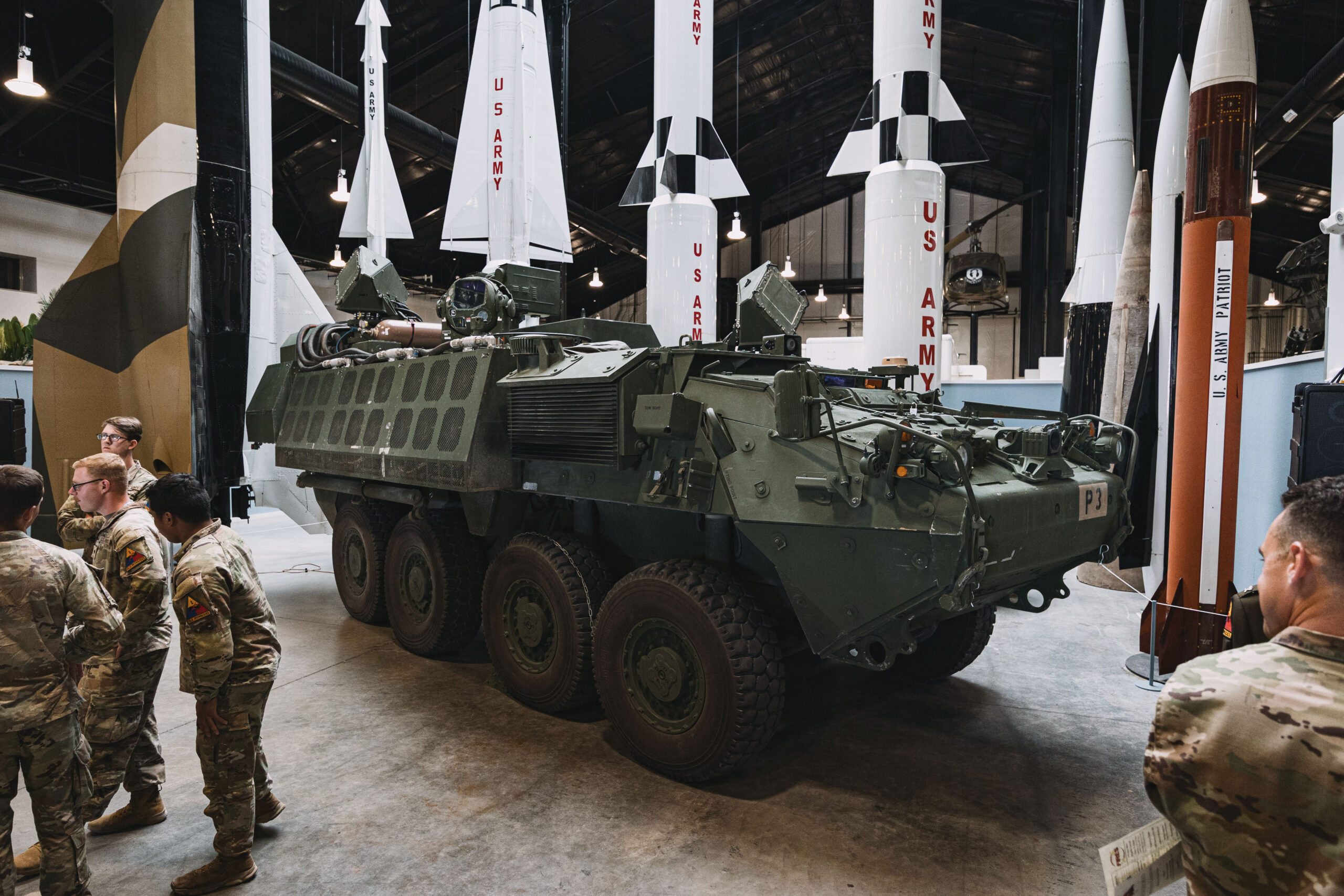
The U.S. Army officially inducted its first Directed Energy Maneuver-Short Range Air Defense (DE M-SHORAD) system into the Fort Sill Museum.
The system, developed by the Army’s Rapid Capabilities and Critical Technologies Office (RCCTO), utilizes a high-energy 50 kW-class laser mounted on a Stryker vehicle to defeat unmanned aircraft and other low-altitude threats.
According to COL Gutierrez, project manager for Directed Energy, the system’s induction “is a powerful statement in Army transformation.” He noted that in just two years, the Army progressed from fielding its first platoon of DE M-SHORAD-equipped Strykers to deploying them operationally.
The induction ceremony recognized not just the hardware, but also the rapid development of tactics, techniques, and procedures (TTPs) by soldiers of the 4th Battalion, 60th Air Defense Artillery Regiment (4-60th ADAR), who played a central role in refining how the system is used in combat.
Brig. Gen. Glenn Henke, Commandant of the U.S. Army Air Defense Artillery School, said in a statement, “The DE M-SHORAD represents a critical step forward in how the Army counters aerial threats. Its induction into the Fort Sill Museum not only honors a major milestone in directed energy development but also reinforces the Army’s commitment to integrating cutting-edge technologies that enhance force protection and battlefield dominance.”
Originally planned for a controlled testing environment, the DE M-SHORAD program was expedited due to the increasingly complex global threat landscape. This acceleration led to an in-theater operational assessment conducted by the Army Test and Evaluation Command (ATEC). The assessment featured 50 live-fire engagements against surrogate Group 1-3 unmanned aerial systems and incorporated the DE M-SHORAD into broader base defense architecture.
The test outcomes validated both the technical performance of the system and the operational readiness of its supporting units. The Army emphasized that lessons learned during the assessment will shape future deployment strategies and doctrinal updates.
The DE M-SHORAD is part of the Army’s broader modernization efforts aimed at addressing short-range aerial threats with rapid, precise, and scalable responses. With its quiet, laser-based interception capability, the system introduces a new era of silent defense against drones and missiles, where speed and accuracy are paramount.
Its placement at Fort Sill’s Air Defense Artillery Training Support Facility signals the system’s place not just in current operations but in the historical trajectory of Army innovation. The system will support the 75th Fires Brigade and future deployments across theaters requiring agile and advanced air defense solutions.
By combining a new class of energy weapon with advanced operational procedures, the U.S. Army is signaling its shift toward future-focused warfare—where unmanned systems are countered not only with missiles and guns, but also with beams of concentrated light.
As COL Gutierrez concluded, the ceremony “culminates years of development, innovation, and frontline adaptation—driven by soldiers and engineers working together to face the threats of tomorrow.”