


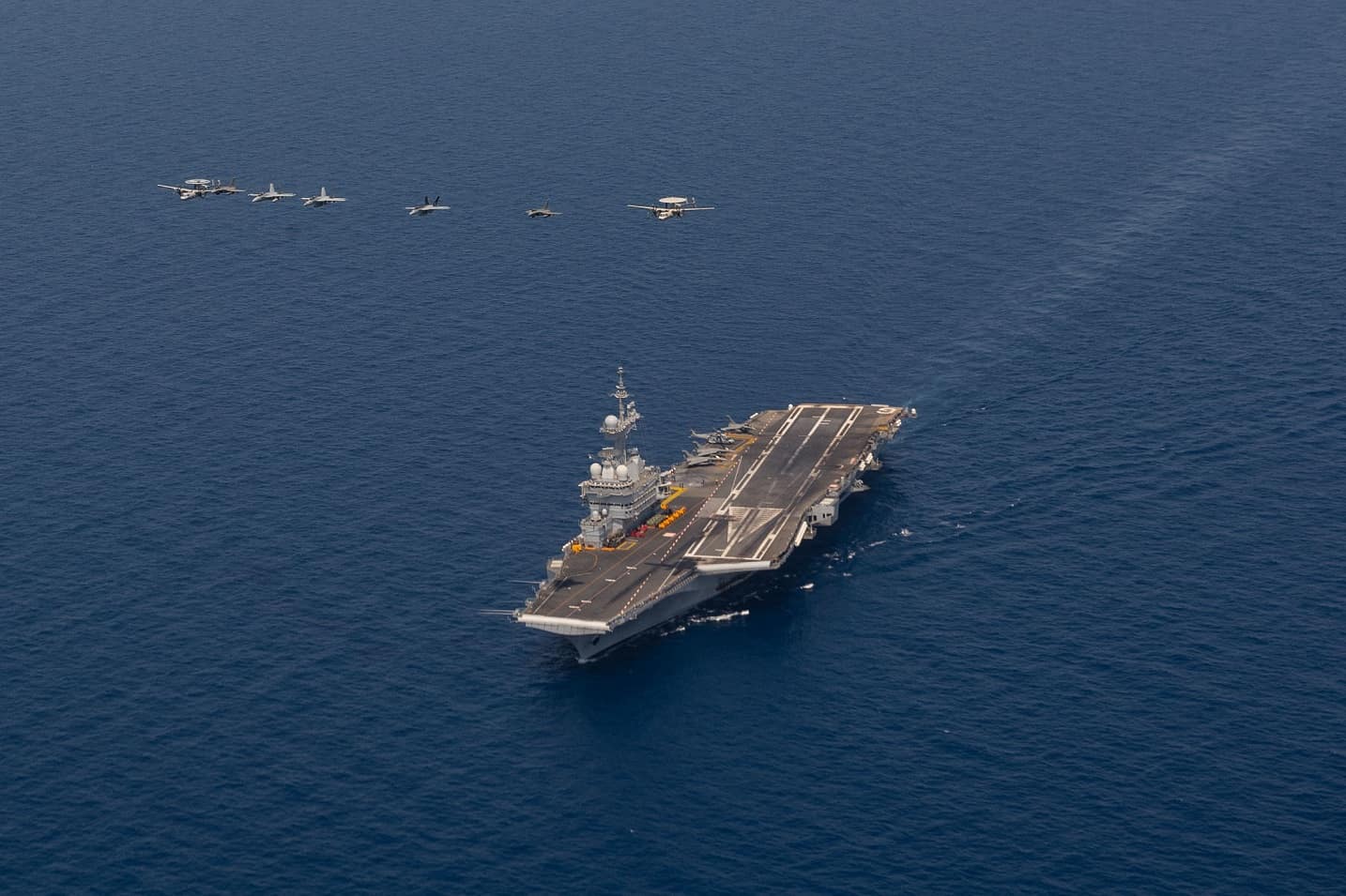
Pentagon announced Tuesday that Maritime forces from France’s Charles de Gaulle Carrier Strike Group and the John C. Stennis Carrier Strike Group participated in a naval passing exercise (PASSEX) in the Red Sea, April 15.
The Charles de Gaulle Carrier Strike Group, composed of France’s Marine Nationale aircraft carrier FS Charles De Gaulle (R 91), F70AA-class air defense destroyer FS Forbin (D 620), and the Royal Danish Navy Iver Huitfeldt-class frigate HDMS Niels Juel (F 363), along with the John C. Stennis Carrier Strike Group, composed of the aircraft carrier USS John C. Stennis (CVN 74), guided-missile cruiser USS Mobile Bay (CG 53), and guided-missile destroyer USS McFaul (DDG 74), conducted dissimilar aircraft training, a nighttime gun exercise (GUNEX), a liaison officer exchange program, and a photo exercise.
“French Rafale aircraft and American [F/A-18] Super Hornets conducted air-to-air combat and tanking (refueling) training,” said Cmdr. Desobry Bowens, Carrier Air Wing Nine’s operation officer (CAG-Ops) embarked aboard the John C. Stennis. “The Rafales also performed touch-and-go procedures on the [John C. Stennis’] flight deck.”
The ships and their crews were put through several integrated training events.
“We did a liaison officer exchange, where their CAG-Ops and admiral spent time aboard the John C. Stennis, and our admiral went to the Charles De Gaulle,” said Bowens. “We also exchanged landing signal officers from both aircraft carriers to cross-train. Both carriers have similar aircraft landing equipment.”
Conducting joint operations and exercises in the region with allied NATO partners is beneficial to everyone involved.
“[This] PASSEX enhances partnerships with our NATO allies, and promotes interoperability,” said Bowens. “We can better understand how each other operates. [The John C. Stennis Carrier Strike Group’s] mission often includes presence operations, and when we work in combined airspace, we show strength through resolve. We’re not just two aircraft carriers passing by each other at sea, we’re working together.”
A similar viewpoint was shared by French leadership.
“This PASSEX with John C. Stennis strike group, a few days only after entering the Red Sea, emphasizes Charles de Gaulle’s come back at its highest level,” said Capt. de Saint Germain, commanding officer of Charles de Gaulle. “That kind of interaction is the best way to increase our interoperability with our American ally.”
The John C. Stennis also provided targets for French Rafales to strafe at during the nighttime GUNEX.
PASSEX is just one of many exercises conducted by partner-nations in support of regional security and stability. The exercise concluded with a photo exercise, capturing the strength through unity that multi-national navies have while operating together.
This PASSEX is one of the many ways the U.S. Navy works with France’s Marine Nationale in the U.S. 5th Fleet area of operations. In January 2019, USS John C. Stennis and France’s Marine Nationale F70AA-class air defense destroyer FS Cassard (D 614) culminated weeks of interoperability training
The John C. Stennis Carrier Strike Group is deployed to the U.S. 5th Fleet area of operations in support of naval operations to ensure maritime stability and security in the Central Region, connecting the Mediterranean and the Pacific through the western Indian Ocean and three strategic choke points.
U.S. 5th Fleet area of operations encompasses about 2.5 million square miles of water area and includes the Arabian Gulf, Gulf of Oman, Red Sea, and parts of the Indian Ocean. The expanse is comprised of 20 countries and includes three critical choke points at the Strait of Hormuz, the Suez Canal, and the Strait of Bab al-Mandeb at the southern tip of Yemen.

